
Best Water Softener for a Family of 4, Sized at Three Hardness Levels
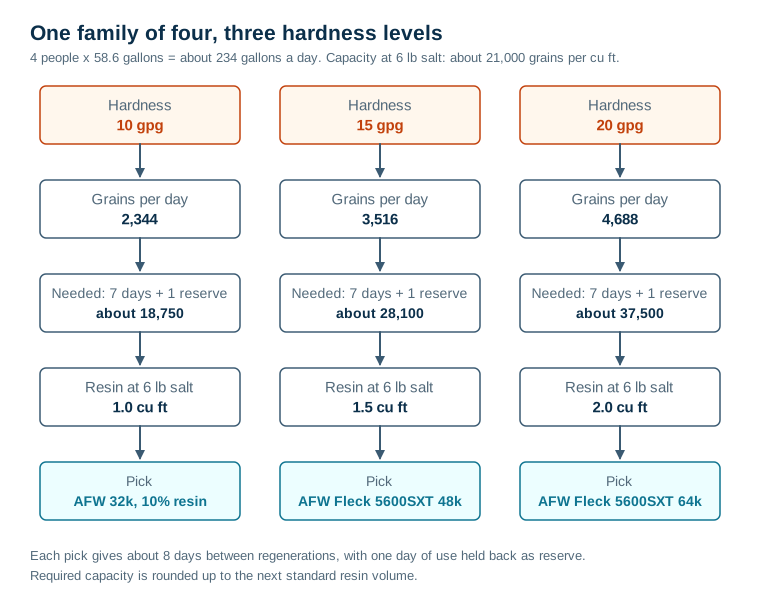
The best water softener for a family of 4 holds about 1.0 cubic foot of resin at 10 grains per gallon of hardness, 1.5 cubic feet at 15 gpg and 2.0 cubic feet at 20 gpg. Those are sold as 32,000, 48,000 and 64,000-grain units. The household size fixes how much water you use, and the hardness decides how big the softener has to be.
So instead of one "best for four people" answer, this page runs the sizing once at three hardness levels and names one pick for each. The arithmetic is short and shown in full, so you can check it against your own water report.
Disclosure: Hard Water Solved may earn a commission if you buy through links on this page, at no extra cost to you. It does not change which products we include or how we rank them. Read our disclaimer.
Method. No unit here was physically tested by us. Each pick is the complete system whose stated resin volume matches the sized requirement, judged from the seller's spec page and warranty wording. It had to be a salt-based, metered softener sold new on Amazon.com. Capacity is re-stated at 6 lb of salt per cubic foot, not the box rating.
Prices are not listed here because they change often. Use the buttons to see the current price on Amazon.
The Sizing, Done Once for Four People
Two inputs differ from most size charts, and both matter:
- Water use. Measured indoor use averaged 58.6 gallons per person per day in the Water Research Foundation's Residential End Uses of Water study. Four people use about 234 gallons a day. Many charts still assume 75 gallons each.
- Capacity at a real salt setting. At an efficient 6 lb of salt per cubic foot, standard resin removes about 21,000 grains per cubic foot. That figure comes from the design guidance in Water Conditioning & Purification's guidelines for designing water softeners. The box rating assumes about 32,000, which takes far more salt.
The method is the standard one. Daily load is hardness times gallons. Size for about seven days between regenerations plus one day of reserve, then divide by capacity per cubic foot and round up to a stock resin volume:
| Hardness | Grains per day (234 gal) | Needed for 7 days + 1 reserve | Resin at 6 lb/cu ft | Sold as | Days per cycle |
|---|---|---|---|---|---|
| 10 gpg | 2,344 | about 18,750 | 0.89 → 1.0 cu ft | 32,000 grain | about 8 |
| 15 gpg | 3,516 | about 28,100 | 1.34 → 1.5 cu ft | 48,000 grain | about 8 |
| 20 gpg | 4,688 | about 37,500 | 1.79 → 2.0 cu ft | 64,000 grain | about 8 |
If your water report gives hardness in mg/L or ppm, divide by 17.1 to get grains per gallon. On a well with iron, add about 4 gpg for each ppm of iron before you start. The full method, including how to use your own meter readings, is in how to size a water softener. What the grain number on a softener actually measures is explained in what does grain capacity mean.
Best Water Softener for a Family of 4 at Each Hardness
At 10 gpg: AFWFilters Fleck 5600SXT 32k With 10% Resin
- What it is: 1.0 cubic foot of 10 percent crosslink resin in a 9x48 tank on a Fleck 5600SXT metered valve, with a 14x14x36 brine tank and 3/4-inch bypass. The seller quotes 5 gpm service flow and 7.5 gpm peak, with 2.2 gpm of backwash flow.
- Warranty (seller): 5 years on the control head, 10 years on the mineral tank.
- At 6 lb salt: about 21,000 grains. For four people at 10 gpg that is about eight days per cycle with a day in reserve.
- Why 10 percent resin: most homes at 10 gpg are on city water, where the tighter resin lasts longer against chlorine. On a chlorine-free well it adds little.
The catch is flow, not grains. A 9-inch bed handles about 4.4 gpm continuously and 6.6 gpm at peak at the usual design guideline. That is fine for one bathroom, or for two whose showers rarely overlap. If two showers and the washing machine regularly run together, buy the 15 gpg pick below and set it to a low salt dose instead.
At 15 gpg: AFWFilters Fleck 5600SXT 48k
- What it is: 1.5 cubic feet of standard 8 percent high-capacity resin in a 10x54 tank on a Fleck 5600SXT with a paddle-wheel meter, a 14x34 square brine tank, Fleck bypass and 1-inch yoke.
- Warranty (seller): 5 years on the valve, 10 years on the tank.
- At 6 lb salt: about 31,500 grains, about eight days per cycle for four people at 15 gpg.
- A flow figure to discount: this listing quotes "up to 12 gpm service flow rates (28 GPM peak)". The same seller quotes 6.5 gpm service and 9.8 gpm peak for its other 1.5 cubic foot systems in the same size of tank. Plan on the lower figure. A 10-inch bed handles about 8.2 gpm at the peak guideline.
This is the classic family-of-four softener, and at 15 gpg the arithmetic agrees with the convention. If you are on chlorinated city water, the same seller's 10 percent resin version costs a little more on its store and lasts longer against chlorine.
At 20 gpg: AFWFilters Fleck 5600SXT 64k
- What it is: 2.0 cubic feet of standard 8 percent high-capacity resin in a 12-inch tank on a Fleck 5600SXT, with an 18x33 brine tank and bypass. The seller quotes up to 10 gpm service and 15 gpm peak.
- Warranty (seller): 5 years on the control head, 10 years on the mineral tank.
- At 6 lb salt: about 42,000 grains, about eight days per cycle for four people at 20 gpg.
- Flow bonus: the 12-inch bed handles about 7.9 gpm continuously and 11.8 gpm at peak, comfortably above a typical family's busiest moment.
At 20 gpg the usual "buy a 48k" advice still works, just with shorter cycles. A 1.5 cubic foot bed at an efficient salt dose would regenerate every five to six days with a day of reserve held back. The 64k stretches that to about eight days at the same salt setting, and its wider tank adds flow. If the extra cost over the 48k matters more to you than either, the 48k is a reasonable second choice at this hardness.
Check Flow Before You Click Buy
Grain capacity decides how long a softener lasts between regenerations. It says nothing about how much water can pass through it at once. For four people, list what really runs together at the busiest moment of the day:
- Showers. The EPA says standard showerheads use 2.5 gallons per minute and WaterSense models no more than 2.0.
- Everything else. Time how long a fixture takes to fill a 1-gallon jug. 20 seconds means 3 gpm.
Two WaterSense showers, a washing machine at 3 gpm and a kitchen tap at 1.5 gpm add up to about 8.5 gpm. Compare that with the bed's peak guideline: about 6.6 gpm for a 9-inch tank, 8.2 gpm for a 10-inch and 11.8 gpm for a 12-inch. If your busiest moment is above your pick's figure, step up one tank size and lower the salt dose to keep the cycle length sensible. The reasoning behind those guidelines is in grain capacity vs peak flow rate.
Why Not Just Buy the 48k Everyone Recommends?
Most family-of-four advice lands on 48,000 grains because it multiplies four people by 75 gallons and then compares the result with the box rating. Rerun the same table with 75 gallons a day each (300 gallons a day) and every hardness level moves up one size:
| Hardness | Measured use (234 gal) | Chart use (300 gal) |
|---|---|---|
| 10 gpg | 1.0 cu ft | 1.5 cu ft |
| 15 gpg | 1.5 cu ft | 2.0 cu ft |
| 20 gpg | 2.0 cu ft | 2.5 cu ft |
Oversizing is not a disaster, but it has costs. A bigger unit costs more up front, and if the household uses too little water to regenerate it at least weekly, the bed sits in still water for long stretches. Undersizing is the more common complaint, and it shows up as hard water late in the cycle. Signs a water softener is undersized lists the symptoms and how to tell them from a programming fault. Why the box number overstates capacity at efficient settings is set out in advertised vs usable softener capacity.
Other Family-Size Softeners Considered
| Unit | Why it is not a headline pick here | Amazon |
|---|---|---|
| Aquasure Harmony 48k | A low-cost 48k with a 10x54 tank, but the resin volume is not stated and the valve is proprietary. Its manual's programming worksheet uses 75 gallons per person. A fair budget alternative at 15 gpg | Check price on Amazon |
| SoftPro Elite 48k | 10% resin and upflow brining, but resin volume and tank size are not published, so it cannot be sized from the table above | Check price on Amazon |
| DuraWater Fleck 5600SXT 48k | Listing confirmed, but we could not check its details outside Amazon | Check price on Amazon |
| Clack WS1 48k with brine tank | The Amazon listing showed "currently unavailable" on 1 October 2026, and we could not verify its resin volume or tank size elsewhere | Unavailable |
When a Family of Four Needs Something Different
- Iron on a well. Add 4 gpg per ppm of iron, choose fine-mesh resin, and aim for about three days per cycle. A family at 15 gpg with 2 ppm of iron sizes like a family at 23 gpg. The method is in how iron changes water softener sizing.
- Chlorinated city water. Prefer 10 percent crosslink resin at every hardness level. The life arithmetic is in standard vs chlorine-resistant softener resin.
- Hardness above about 25 gpg. A family of four at 25 gpg removes about 5,900 grains a day, which needs about 2.5 cubic feet at an efficient setting.
- Hardness under about 3.5 gpg. Buy none. The water is soft enough that a softener costs more than it saves.
The best water softener for a family of 4 is the one sized to your hardness, not to your headcount. Find your gpg, pick the matching row, check your busiest moment against the tank size, and you have your answer.
Frequently Asked Questions
What size water softener does a family of 4 need?
It depends on hardness. Using a measured 58.6 gallons per person a day and an efficient salt setting, a family of four needs about 1.0 cubic foot of resin at 10 grains per gallon, 1.5 cubic feet at 15 gpg and 2.0 cubic feet at 20 gpg. Those are sold as 32,000, 48,000 and 64,000-grain softeners. Each gives about eight days between regenerations with a day held in reserve.
Is a 48,000-grain softener right for a family of four?
It is right for a family of four at around 15 grains per gallon, which is why it is the most common recommendation. At 10 gpg it is larger than needed on capacity, though it can still make sense for flow in a house with two bathrooms in use at once. At 20 gpg and above it runs short at an efficient salt setting, and a 64,000-grain unit fits better.
How many gallons of water does a family of 4 use per day?
Measured indoor use in US homes averaged 58.6 gallons per person per day in the Water Research Foundation's 2016 study, or about 234 gallons a day for four people. Many sizing charts still assume 75 gallons per person, or 300 gallons a day, which pushes the answer up a size. Read your own water meter over a week if you can.
Is a 32,000-grain softener too small for a family of 4?
Not at moderate hardness. At 10 gpg a family of four removes about 2,300 grains a day, and one cubic foot of resin at an efficient salt dose gives about 21,000 grains, roughly eight days with a day in reserve. The limit is more often flow: a 9-inch tank handles less water at once than a 10-inch one, so check how many showers run together.
What happens if my softener is too small for my family?
It regenerates very often, uses more salt and water per grain removed, and can let hard water through on heavy days before the overnight regeneration. If the valve is set correctly and you still see hard water late in each cycle, the bed is probably undersized for your hardness and water use.
Should a family of four buy a twin-tank softener?
Rarely. A twin-tank unit keeps soft water available during regeneration, which matters for very high or round-the-clock use. A family of four with a metered single-tank softener that regenerates overnight seldom notices the difference, and the twin unit costs considerably more.
