
Best Water Softener for City Water: Picks That Survive Chlorine
The best water softener for city water is one built to survive the chlorine or chloramine your utility adds, not just one that removes hardness. In practice that means 10 percent crosslink resin at the least, and a carbon stage in front once your residual runs near 2 mg/L or above. Chloramine supplies need catalytic carbon, which none of the combination units here include.
Which of those is cheaper depends on one number from your utility's annual water quality report. So this guide starts there, then ranks three picks on what they are likely to cost over ten years.
Disclosure: Hard Water Solved may earn a commission if you buy through links on this page, at no extra cost to you. It does not change which products we include or how we rank them. Read our disclaimer.
Step One: Find Your Disinfectant in the Consumer Confidence Report
Every community water system in the US publishes an annual Consumer Confidence Report, and the EPA's CCR page explains how to find yours. You need three things from it:
- The disinfectant. Look in the regulated table for "chlorine" or "chloramines", and in the treatment description. Some reports list "total chlorine", which on a city supply usually means chloramine.
- The range, not the average. A system reporting 0.5 to 2.4 mg/L is not a 0.5 mg/L system. Plan on the upper half of the range, especially if you live near the treatment plant.
- Seasonal changes. Many chloramine utilities switch to free chlorine for a few weeks a year to clean the mains. Ask when theirs runs.
If the report is unclear, a free and total chlorine test kit at the tap settles it. Total chlorine well above free chlorine means chloramine. The Water Quality Association's chloramine fact sheet notes that chloramine can need a carbon contact time of 10 minutes or more for complete removal, which is why the disinfectant decides the carbon question. The full method for reading your supply is in how chloramine affects a water softener.
First, though, check that you need a softener at all. City water under about 3.5 grains per gallon of hardness rarely justifies one. Do you need a water softener on city water explains how to find the top of your utility's hardness range.
The Entry Gate: 10% Resin or a Carbon Stage
Method. No unit here was physically tested by us. To be considered, a softener had to be a complete salt-based system sold new on Amazon.com, on a metered valve, and it had to pass one gate: 10 percent crosslink resin, or a carbon stage ahead of the resin. Units that pass were then compared on expected resin life and ten-year cost from sellers' spec pages, manuals and warranty wording.
Prices are not listed here because they change often. Use the buttons to see the current price on Amazon.
| Unit considered | Resin | Carbon stage | Gate | Ranked? |
|---|---|---|---|---|
| AFWFilters Fleck 5600SXT 48k, 10% resin | 10% | No | Pass | Yes |
| AFWFilters 48k with upflow carbon | 10% | 1.5 cu ft high-activity carbon | Pass | Yes |
| SoftPro Elite 48k | 10% | No | Pass | Yes |
| DuraWater Fleck 5600SXT 48k, 10% resin | 10% | No | Pass | No: no current price we could verify |
| Premier Fleck 5800SXT 48k, 10% resin | 10% | No | Pass | No: no current price we could verify |
| AFWFilters Fleck 5600SXT 48k, high-capacity resin | 8% | No | Fail | No |
| Aquasure Harmony 48k | Crosslink % not stated | No | Fail | No. Its manual caps chlorine at 2 ppm and recommends carbon |
The reasoning behind the gate is short. Chlorine attacks the cross-links that hold a resin bead together. A tighter 10 percent bead has more structure to lose, and a carbon stage stops most free chlorine before it reaches the resin at all. How that damage shows up, and how to check an existing bed, is covered in how chlorine damages softener resin.
Best Water Softener for City Water: The Picks at a Glance
| Pick | What protects the resin | Cheapest over 10 years when… | Amazon |
|---|---|---|---|
| AFWFilters Fleck 5600SXT 48k, 10% resin | 10% crosslink resin | Residual is about 1 mg/L or less | Check price on Amazon |
| AFWFilters 48k with upflow carbon, 10% resin | 10% resin plus 1.5 cu ft of carbon | Free chlorine near 2 mg/L or above | Check price on Amazon |
| SoftPro Elite 48k | 10% crosslink resin, upflow brining | Rarely on cost alone. You pay for upflow and the warranty | Check price on Amazon |
Expected Resin Life on Chlorine vs Chloramine
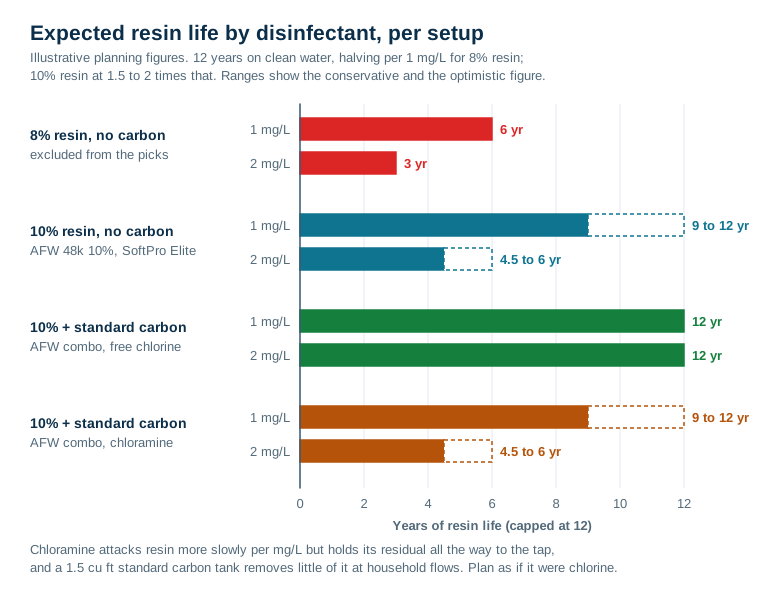
Resin makers do not publish life tables by residual, so the figures below are a planning model, not a guarantee. They follow Ecolab Purolite's rule of thumb in its note on factors affecting softening resin performance and life: each 1 mg/L of chlorine cuts resin life by about half. Start from 12 years on clean water. Give 10 percent resin 1.5 to 2 times the life of standard resin, the range resin sellers commonly quote. The arithmetic is worked through in standard vs chlorine-resistant softener resin.
| Pick | Free chlorine 1 mg/L | Free chlorine 2 mg/L | Chloramine |
|---|---|---|---|
| AFW 48k, 10% resin | 9 to 12 years | 4.5 to 6 years | Plan on the chlorine figure at the same mg/L |
| AFW 48k with upflow carbon | About 12 years, while the carbon is changed on time | About 12 years, carbon changed more often | As 10% resin alone. 1.5 cu ft of standard carbon removes little chloramine |
| SoftPro Elite 48k | 9 to 12 years | 4.5 to 6 years | Plan on the chlorine figure at the same mg/L |
Why chloramine gets its own column. Chloramine is a weaker oxidiser per mg/L, so in principle it wears resin more slowly. In practice it holds its residual all the way to the tap, and ordinary carbon at household flows removes little of it. On the site's own carbon arithmetic, a 1.5 cubic foot standard carbon tank covers roughly 7.5 gpm of free chlorine at a 1.5-minute contact time, but only about 1 gpm of chloramine at the 10 minutes WQA cites. That is why the combination unit's advantage disappears on a chloramine supply.
Ten-Year Running Cost at Your Residual
This is an illustrative model. Beyond the purchase price, it counts what each pick needs within ten years: resin re-beds (a 1.5 cubic foot 10 percent re-bed each time) and, for the combination unit, carbon media changes (1 plus 0.5 cubic feet of high-activity carbon each time, before labour). Get your own quotes for a re-bed and for carbon media, then add them to the current price of each unit. Salt is left out because all three use similar amounts at the same setting. SoftPro's claimed salt saving is not independently verified.
| Pick | 1 mg/L free chlorine | 2 mg/L free chlorine | 2 mg/L chloramine |
|---|---|---|---|
| AFW 48k, 10% resin | 0 or 1 re-bed | 1 or 2 re-beds | 1 or 2 re-beds |
| AFW 48k with upflow carbon | 1 carbon change, no re-bed | 1 or 2 carbon changes, no re-bed | 1 or 2 re-beds as above, before any carbon changes |
| SoftPro Elite 48k | 0 or 1 re-bed | 1 or 2 re-beds | 1 or 2 re-beds |
How to read it:
- At about 1 mg/L or less, 10 percent resin alone is the cheapest way to soften city water. The carbon combo costs more and protects a bed that was going to last a decade anyway.
- Near 2 mg/L of free chlorine, the two AFW options come out close over ten years, and the combo usually costs a little less. It also removes chlorine taste and smell, which resin never does. Above 2 mg/L the gap widens in the combo's favour.
- On chloramine, neither picked combo protects the resin. The cheapest sound setup is the 10 percent unit plus a separately sized catalytic carbon tank. For an 8 gpm peak that is roughly 3.2 cubic feet of catalytic media, about twice the carbon in the combo. How to size and schedule one is in how a carbon filter and water softener work together.
The Picks
AFWFilters Fleck 5600SXT 48k With 10% Resin: Best for Most City Homes
- What it is: 1.5 cubic feet of 10 percent crosslink resin on a Fleck 5600SXT metered valve, with brine tank and bypass. The seller quotes 6.5 gpm service and 9.8 gpm peak, and 2.7 gpm of backwash flow.
- Warranty (seller): 5 years on the control head, 10 years on the mineral tank.
- Capacity at an efficient 6 lb salt dose: about 31,500 grains, roughly eight days for a family of four at 15 gpg.
Wrong for: a chloramine supply where you want the resin to last its full life (add catalytic carbon), residuals that stay above about 2 mg/L, and houses whose busiest moment regularly passes about 8 gpm.
AFWFilters 48k With Upflow Carbon: Best for High Free-Chlorine Residuals
Sold with a flex-line adapter.
- What it is: two tanks. The first is 1.5 cubic feet of coconut-shell high-activity carbon in an upflow tank that does not backwash, so it needs no drain or power. The second is a Fleck 5600SXT 48k softener with 10 percent resin. The seller recommends it for service flows up to 12 gpm and households of 2 to 5.
- Warranty (seller): 5 years on the Fleck valve, 10 years on the tank.
- What the seller claims vs what to plan on. The listing says the carbon removes "chlorine and chloramines." The carbon is described as high-activity coconut carbon, not catalytic, and at 1.5 cubic feet it is far short of the contact time chloramine needs at household flows. Treat it as a free-chlorine stage.
- Upkeep: an upflow tank cannot be backwashed, so the carbon is replaced on a schedule. Test chlorine between the two tanks once a year and change the media when it appears.
Wrong for: chloramine supplies, and low-residual supplies where 10 percent resin alone is cheaper.
SoftPro Elite 48k: Best if You Want Upflow and a Lifetime Warranty
- What it is: 10 percent crosslink resin with upflow brining, a large brine tank, bypass and a protective tank jacket. SoftPro's brand page describes a limited lifetime warranty on the valve and tanks. Read the exclusions before relying on it.
- What is claimed: up to 75 percent less salt and "up to 15 gpm". SoftPro's pages do not state the resin volume or tank diameter, so neither figure can be normalised here.
Why it ranks third on this page: its resin is no more chlorine-resistant than the AFW 10 percent unit's, and it has no carbon stage. On a city supply it costs considerably more for the same resin life. The premium buys upflow regeneration, explained in upflow vs downflow regeneration, and the warranty. Wrong for: buyers choosing on chlorine protection, which is this page's test.
Matching the Pick to Your Report
| Your report says | Buy |
|---|---|
| Hardness under about 3.5 gpg | No softener |
| Free chlorine, upper range about 1 mg/L or less | AFW 48k, 10% resin |
| Free chlorine, upper range near 2 mg/L or above | AFW 48k with upflow carbon |
| Chloramine, any level | AFW 48k, 10% resin, plus a catalytic carbon tank sized for your peak flow |
| Utility switching to chloramine soon | Plan for the chloramine row now |
Size the softener on hardness and measured water use, as set out in how to size a water softener. Then put any carbon stage first in the line, so the resin only ever sees dechlorinated water.
Buy None of These If…
- Your city water is soft, under about 3.5 gpg at the top of the range.
- You mainly want better-tasting drinking water. A carbon filter or a point-of-use system does that for less. A softener does not touch taste or chlorine.
- You rent, or cannot run a drain line. All three picks need a drain for regeneration.
- Your area restricts softener discharge. Check local rules first.
The best water softener for city water is the one whose resin protection matches your residual. Read the report, find the upper end of the range, and let that number choose between 10 percent resin alone and resin behind carbon.
Frequently Asked Questions
What is the best water softener for city water?
For most city homes with a free chlorine residual of about 1 mg/L or less, a 1.5 cubic foot softener with 10 percent crosslink resin is the best value, such as the AFWFilters Fleck 5600SXT 48k with 10 percent resin. Where the residual runs near 2 mg/L or higher, a softener with a carbon stage in front, such as AFWFilters' 48k softener with upflow carbon, becomes the cheaper choice over ten years.
Does chlorine in city water damage a water softener?
It damages the resin, slowly. Chlorine breaks the cross-links that hold each resin bead together, so beads swell, lose capacity and eventually break up. The industry rule of thumb, from resin maker Purolite, is that each 1 mg/L of chlorine roughly halves resin life. The valve and tanks are not the concern. The resin is.
Is 10 percent crosslink resin worth it on city water?
Usually yes. It costs a little more and lasts noticeably longer on chlorinated water, commonly quoted at about twice the life of standard 8 percent resin, though resin makers do not publish that multiplier. On a supply with a residual above about 0.2 mg/L the extra years usually pay for the premium. It slows damage rather than stopping it.
Do I need a carbon filter with my softener on city water?
Not always. At a free chlorine residual of about 1 mg/L or less, 10 percent resin alone is usually cheaper over ten years. Near 2 mg/L and above, a carbon stage starts to pay for itself by keeping chlorine off the resin. On chloramine, ordinary carbon is not enough: it needs catalytic carbon and a larger tank.
How do I know if my city uses chlorine or chloramine?
Read your utility's annual Consumer Confidence Report. It names the disinfectant and gives the range of residual measured during the year. If the report is unclear, call the utility's water quality line. A free and total chlorine test kit at the tap also tells you: if total chlorine is well above free chlorine, the residual is mostly chloramine.
Can I use a water softener without a carbon filter on chloramine?
You can, and many homes do, but plan on the resin wearing out sooner, as it would on chlorine at a similar level. Chloramine is a slower oxidiser per mg/L but it holds its residual all the way to the tap, and small standard carbon tanks remove little of it. Ten percent resin is the minimum. Catalytic carbon sized for your peak flow is the real protection.
