
Clack WS1 Water Softener Review: Programming, Parts and Repairs

This Clack WS1 water softener review starts with the answer: the WS1 is an excellent valve that is awkward to buy. It is a 1-inch, piston-type control valve made by Clack Corporation in Windsor, Wisconsin, and one of the two valves most online softeners are built around. Judged on its own service manual, it earns its reputation. It passes 27 gpm at a 15 psi pressure drop, keeps its programme in nonvolatile memory, and comes apart for a rebuild with three wear parts that are sold together as one inexpensive kit. Its limits are practical, not mechanical. Clack's warranty goes to the system builder, not to you. The menus are dense. And the only complete Clack WS1 system on Amazon was showing as unavailable on 1 October 2026.
Disclosure: Hard Water Solved may earn a commission if you buy through links on this page, at no extra cost to you. It does not change which products we include or how we rank them. Read our disclaimer.
Clack WS1 Water Softener Review Verdict: 5 Strengths, 3 Limits
Strengths
- Flow headroom. 27 gpm service flow at a 15 psi drop, including the bypass and meter, and a Cv of 7.0.
- Backwash capacity. It can pass up to 27 gpm of backwash at 25 psi, so it can serve larger tanks and heavier filter media than the common Fleck 5600SXT.
- It remembers everything. Settings live in nonvolatile memory. After a power cut you reset the clock and nothing else.
- Cheap, front-loading rebuild. The spacer stack, main piston and regenerant piston slide out of the front of the valve.
- Real diagnostics. The valve stores days and gallons since the last regeneration, reserve used for each of the last seven days, and up to 63 days of usage history.
Limits
- No consumer warranty from Clack. The five-year Clack warranty is given to the system builder. Your cover is whatever the seller writes.
- The menus assume an installer. System setup asks for grains capacity at your salt fill, which a buyer has to calculate or trust the seller for.
- Hard to buy as a homeowner. Clack does not sell direct, and the one complete system on Amazon is unavailable.
How this review was built. It is built from documents, not from a unit on a bench. The evidence is Clack's WS1 & WS1.25 Drawings and Service Manual (form V3115-99, dated 10/24/2025), the WS1 programming manual, Pentair's 5600SXT specification sheet, distributor system listings and retail parts listings. Prices are not listed here because they change often. Use the buttons to see the current price on Amazon.
Clack WS1 Specifications, From the Service Manual
| Specification | Clack WS1 | Clack WS1.25 |
|---|---|---|
| Service flow at 15 psi drop (includes bypass and meter) | 27 gpm | 32 gpm |
| Backwash flow at 25 psi drop | 27 gpm | 30 gpm |
| Cv, service | 7.0 | 8.8 |
| Brine refill rate | 0.5 gpm | 0.5 gpm |
| Inlet and outlet | 0.75 in to 1.5 in | 0.75 in to 1.5 in |
| Operating temperature | 40°F to 110°F | 40°F to 110°F |
| Tank connection | 2.5 in-8 NPSM | 2.5 in-8 NPSM |
| Memory | Nonvolatile EEPROM | Nonvolatile EEPROM |
| Compatible regenerants | Sodium chloride, potassium chloride, potassium permanganate and others | Same |
All figures are from Clack's WS1 and WS1.25 service manual. The same valve can run downflow or upflow brining, on demand, on a time clock or both, and as a filter as well as a softener. The downflow and upflow versions use different bodies and pistons. The manual warns that a mismatched body and piston will let hard water bypass during service, which matters if anyone has swapped parts before you.
Potassium chloride is on the compatible list, so a Clack-valved softener can run on potassium if you would rather not add sodium. Potassium chloride is usually dosed higher than sodium chloride for the same capacity, so expect to buy more of it.
What the 27 gpm Rating Means in Your House
The WS1's flow number is the one sellers lead with, and it is a valve rating, not a system rating. In a finished softener the resin tank usually sets the flow before the valve does.
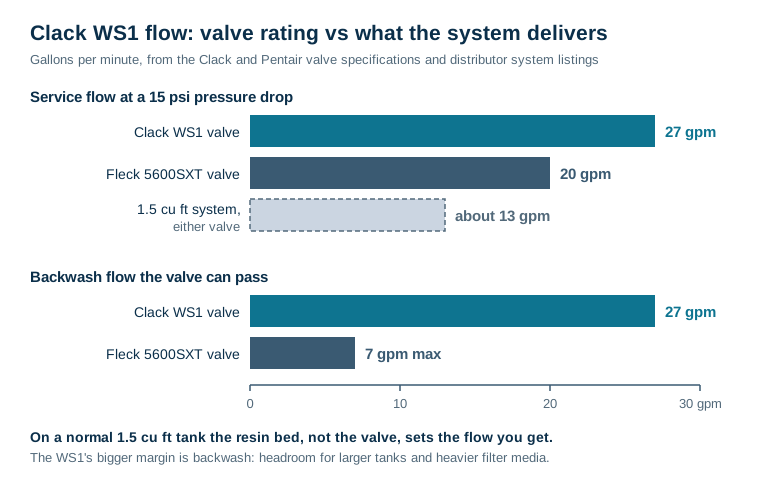
Pentair's own 5600SXT technical sheet gives the Fleck valve 20 gpm continuous at a 15 psi drop and a maximum backwash of 7 gpm. Yet distributor listings for packaged 1.5 cubic foot systems in a 10 by 54 inch tank quote about 13 gpm whichever of the two valves sits on top. The bed of resin, not the valve, is the restriction.
So the service-flow gap matters only in two cases:
- Large homes with big tanks. On a 2.5 or 3 cubic foot bed, where the tank can pass more water, the WS1 stops being the limit sooner than a 5600SXT would.
- Backwash-hungry media. Backwash flow has to lift and clean the bed. The WS1's headroom lets a dealer fit it to larger tanks, and to filters such as carbon or iron media that need a strong backwash, without changing valve family.
For a typical three-bathroom house on a 1.5 cubic foot unit, the WS1 and the 5600SXT deliver the same soft water at the tap. If flow is your worry, size the tank. Our softener sizing method covers peak flow as well as capacity.
Programming the Clack WS1: A Walk-Through of the Four Menus
The WS1 has five buttons and four menus. Each menu opens with a two-button hold of about three seconds, and pressing CLOCK leaves any menu while keeping the changes made so far.
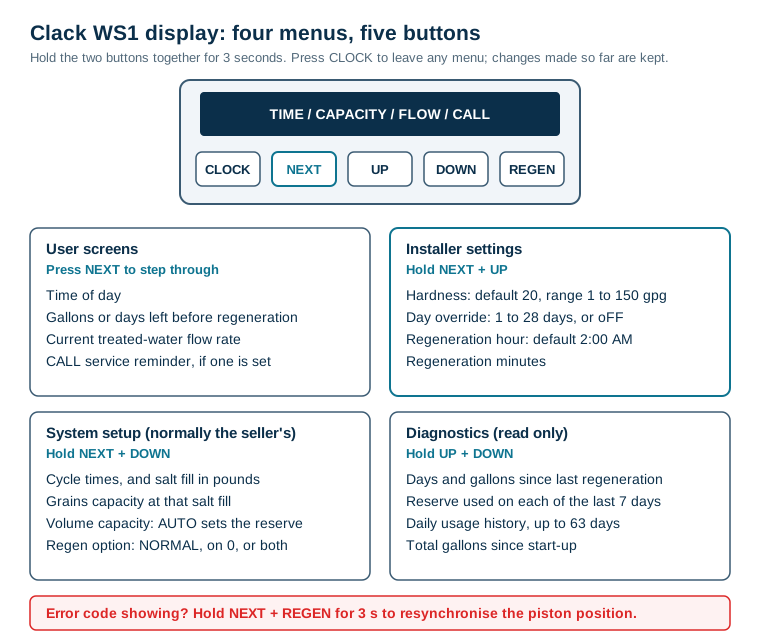
Button labels and screen names vary slightly between circuit-board generations, so check them against the programming manual for your board. The structure below is the same across the common WS1 boards.
Menu 1: the user screens (press NEXT)
NEXT steps through the time of day, then the gallons or days left before the next regeneration, then the current treated-water flow rate. A fourth screen, CALL, appears only if the seller set a service reminder. Two signals are worth knowing:
- "Softening" flashes whenever water is flowing through the meter. If taps are running and it does not flash, the meter is not reading. That is the first check when a softener stops regenerating on its own.
- REGEN TODAY means the valve has decided to regenerate at the set time tonight. One press of REGEN requests the same thing manually. Holding REGEN for three seconds starts a regeneration immediately, and that cannot be cancelled.
Menu 2: installer settings (hold NEXT and UP)
This is the menu a homeowner should own. It has four settings:
| Setting | Range and default | What to set |
|---|---|---|
| Hardness | 1 to 150 gpg, default 20 | Your tested hardness. Add for dissolved iron, as the manual allows, using the iron compensation rule |
| Day override | 1 to 28 days, or oFF | The longest gap between regenerations. 7 to 14 days keeps a lightly used bed fresh |
| Regeneration hour | Default 2:00 AM | A time when nobody draws water, because the house gets hard water during regeneration |
| Regeneration minutes | Any | Fine-tunes the start time |
Hardness is the setting that most often goes wrong. Many systems ship with the default of 20 gpg still entered. If your water is 10 gpg, the valve regenerates twice as often as it needs to and burns twice the salt. If it is 30 gpg, the house runs out of soft water before each regeneration.
Menu 3: system setup (hold NEXT and DOWN)
This is where the system builder sets the cycle times, the salt fill in pounds and the grains capacity. The two must match. Clack's own manual says the capacity for the chosen fill "should be confirmed by OEM testing", because more salt buys more capacity, but at a falling rate. A 1.5 cubic foot unit programmed with a 48,000-grain capacity and a 9 lb fill is lying to itself, and will run out of soft water early. Our page on advertised versus usable softener capacity has the table to check the pair against.
Three other settings in this menu matter:
- Volume capacity: AUTO. The valve calculates its own reserve from the capacity and hardness. This is the normal choice for a demand softener.
- Regeneration time option. NORMAL waits for the set time. "on 0" regenerates the moment capacity hits zero. "NORMAL + on 0" does both, regenerating at night normally and immediately if the house runs dry during the day.
- Refill PRE or POST. PRE refills the brine tank two hours before regeneration, so the brine sits for less time than it would after a POST refill.
If you change anything here, write down the original values first.
Menu 4: diagnostics (hold UP and DOWN)
Diagnostics is read-only and is the WS1's best feature for an owner. It shows days and gallons since the last regeneration, the reserve used on each of the last seven days, a daily usage history of up to 63 days, and total gallons since start-up. If the softener seems to regenerate too often, this tells you whether the cause is water use, such as a running toilet, or the settings.
Which Clack WS1 Parts Fail
The troubleshooting table in the service manual names the same few parts again and again. A damaged seal and spacer stack turns up as a cause of hard water at the tap, too much salt use, water running to drain and an E1 error. A plugged injector turns up under failure to draw brine. Foreign matter on the piston and stack turns up under the E3 motor timeout.
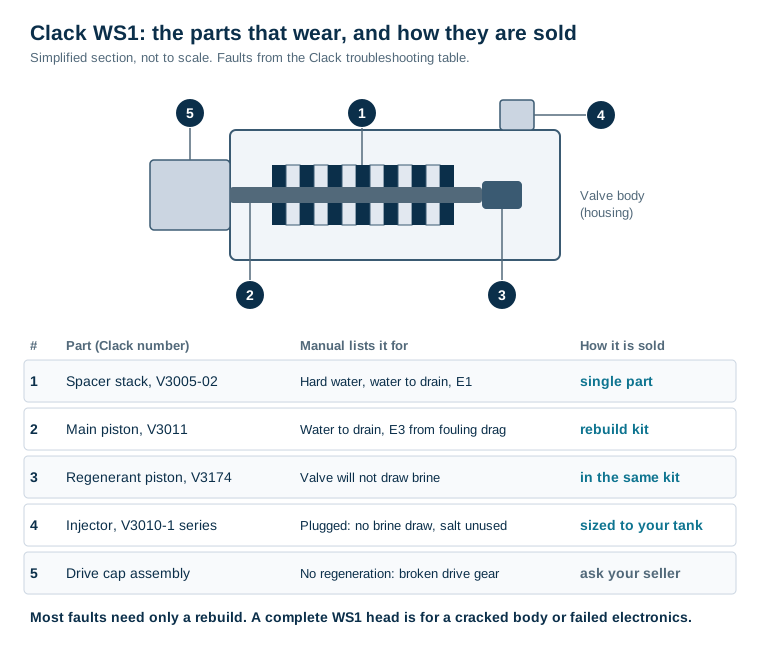
| Part | Clack number | Typical symptom |
|---|---|---|
| Spacer stack (seal pack) | V3005-02 | Hard water bleeding through, water running to drain |
| Main piston, downflow | V3011 (sold in rebuild kits) | Water to drain, E3 motor timeout from drag |
| Regenerant (brine) piston | V3174 (sold in rebuild kits) | Valve will not draw brine |
| Injector | V3010-1 series, sized to tank | No brine draw, salt level never drops |
| Complete interior kit (stack + both pistons) | Several brands | All of the above |
| Complete WS1 head | V1EEDME and similar | Only for a cracked body or failed electronics |
These parts are sold by US parts retailers and on Amazon. They are inexpensive wear parts rather than complete systems, so we don't link them as picks.
The rebuild itself is designed for an owner. Clack notes that caps and nuts need only firm hand tightening because they seal on o-rings, and that only silicone-based lubricant may be used, never petroleum jelly, WD-40 or spray silicone. Our guide to servicing a softener control valve walks through the bypass, depressurising and piston removal. If you can see water at the head rather than at the drain, start with why a softener leaks at the control head, because o-rings on the bypass and fittings are cheaper still.
The error codes
| Display | Manual's meaning | First fix |
|---|---|---|
| E1, Err 1001 or 101 | Control cannot sense the motor moving | Reseat the motor, check wires, hold NEXT and REGEN 3 s |
| E2, Err 1002 or 102 | Motor ran too short and stalled | Check piston and stack for binding, check voltage, resync |
| E3, Err 1003 or 103 | Motor ran too long finding the next position | Clean or replace piston and stack, resync |
| Err 1004 or 104 | Motor timed out returning home | Snap the drive bracket back in, resync |
Every fix ends the same way: hold NEXT and REGEN for three seconds, or unplug the power supply for five seconds. A code that returns after a resync is a parts problem, not a programming one.
Clack WS1 vs Fleck 5600SXT in Brief
| Clack WS1 | Fleck 5600SXT | |
|---|---|---|
| Service flow, 15 psi drop | 27 gpm | 20 gpm |
| Maximum backwash | 27 gpm at 25 psi | 7 gpm |
| Cv | 7.0 | 5.0 |
| Interior rebuild | Stack plus two pistons, front access | Seal and spacer kit plus piston |
| Installer familiarity | Common | Very common |
The two valves do the same job. The WS1 has more flow and backwash margin and a detailed diagnostics menu. The 5600SXT has the larger installed base, which can make a local service call easier to find. A full head-to-head belongs on its own page. For a single household on a 1.5 cubic foot system, buy the better-built system and the better seller, not the valve.
The Clack WS1 Warranty: Read Who It Covers
Clack's limited warranty in the service manual is unusual for a consumer product, because the consumer is not party to it. Clack warrants to the OEM, the company that builds the softener, that its valves will be free from defects for five years from the date of shipment from Clack's plant, when installed and run within recommended limits. It excludes freezing, hot water, misuse and similar damage, and it requires the weather cover on outdoor installations.
What reaches you is whatever the system seller adds on top. Some sellers offer longer valve cover than Clack gives them, some less, and some exclude the wear parts in this review. Before buying any Clack-valved softener, ask for the seller's written warranty and check it with our guide to reading a water softener warranty.
Buying a Clack WS1 System in 2026
The Amazon listing. The only complete Clack WS1 system we found on Amazon, the "Clack WS1 48,000 Grain Water Softener with Brine Tank," showed "Currently unavailable" with no restock date on 1 October 2026. Its listing gives no resin type, tank size or warranty. We would not buy it if it returns until the seller can supply those.
The head on its own is not sold on Amazon. Parts specialists sell it, priced by configuration.
Where Clack systems actually come from. Clack sells only to system builders and dealers. A Clack-valved softener comes from a local water-treatment dealer or an online specialist that builds systems around the valve. When you compare them, ask each seller for four things: resin volume in cubic feet, resin type (standard or 10% crosslink), the salt fill and grains capacity it will be programmed at, and its written warranty.
If you want to buy from Amazon today, the closest equivalent is a Fleck-valved system rather than a Clack one:
- DuraWater 48,000-grain Fleck 5600SXT system: 1.5 cubic feet of resin preloaded, a bypass and 1-inch yoke, and a 14 x 36 inch brine tank with a safety float. On a 1.5 cubic foot bed it delivers the same flow at the tap as a Clack system of the same size.
Who the Clack WS1 Is Wrong For
- Anyone who wants one company to call. With Clack, the valve maker and the warrantor are different companies. If you want a single brand that makes, sells and services the whole unit, a dealer brand or a big-box cabinet unit is simpler.
- Buyers who need Amazon delivery this month. The system is not available there now.
- Small households with soft-to-moderate water. A 27 gpm valve on a one-bathroom home adds cost without adding anything you will notice.
- Owners who will never open a menu. The WS1 rewards someone who checks the hardness setting and reads diagnostics. If the seller's defaults are wrong and nobody changes them, a cheaper valve programmed correctly will do better.
For everyone else, especially larger homes, well systems that pair a softener with a backwashing filter, and owners who want to do their own rebuilds, the Clack WS1 is one of the best valves a softener can carry. Choose the system builder as carefully as the valve. If you are still deciding whether salt-based softening is right for your water at all, start with salt-based vs salt-free water treatment.
Frequently Asked Questions
Is the Clack WS1 better than the Fleck 5600SXT?
On paper the WS1 is the stronger valve. Its service flow is 27 gpm at a 15 psi drop against 20 gpm for the 5600SXT, and it can pass 27 gpm of backwash against the 5600SXT's 7 gpm maximum. In a typical 1.5 cubic foot system that service-flow gap mostly disappears, because the resin tank limits flow to around 13 gpm with either valve. The WS1's real advantages are backwash headroom, nonvolatile memory and a three-part rebuild. The Fleck's advantage is that more installers know it.
How long does a Clack WS1 valve last?
Clack does not publish a service life. It warrants the valve to the system builder for five years from shipment. In practice the valve body and electronics usually outlast the wear parts: the spacer stack and pistons are the parts that get replaced, and they are designed to come out through the front of the valve. When those parts are renewed, the head itself can stay in service for many years. The resin and the seals decide most of a system's life.
How do I clear an error code on a Clack WS1?
Hold NEXT and REGEN together for three seconds, or unplug the power supply for five seconds and plug it back in. That resynchronises the software with the piston position. If the error comes back, the manual points to a motor that is not fully seated, a loose drive bracket, missing reduction gears or a fouled piston and spacer stack. A recurring E3 or Err 1003 usually means the piston and stack need cleaning or replacing.
What should the day override be set to on a Clack WS1?
The day override sets the longest the valve will wait between regenerations, from 1 to 28 days, or oFF. On a metered softener it is a backstop, not the main trigger. Many installers set it to 7 to 14 days so a lightly used softener still regenerates and keeps the resin fresh. Set it to oFF only if you are sure the meter will always trigger regeneration on volume.
Can I rebuild a Clack WS1 myself?
Yes. Clack designed the valve for front service: you bypass the softener, relieve pressure, remove the drive cap assembly, pull the piston, then pull the spacer stack with the Clack service wrench. Caps and nuts only need hand tightening because they seal on o-rings. After any work on the drive cap or pistons, the manual says to unplug the valve and hold NEXT and REGEN to resynchronise it.
Where can I buy a Clack WS1 water softener?
Clack sells valves only to system builders and dealers, not to homeowners. Complete Clack WS1 systems come from water-treatment dealers and online specialists. The one complete Clack WS1 system listed on Amazon showed as currently unavailable when checked on 1 October 2026, and the bare head is not sold there. Parts and rebuild kits are widely available.
