
How Pressure Drop Affects Softener Sizing
Water softener pressure drop rises roughly with the square of the flow through the unit. The single figure on a spec sheet is the loss at one flow the manufacturer chose. To find the loss at your house's peak, scale it: rated drop × (your peak flow ÷ rated flow)². A softener advertised at a 5 psi drop at 7 gpm loses about 15 psi at 12 gpm.
The single figure is not wrong. It just tells you almost nothing until you move it to your own flow, and the unit with the smaller advertised number is not always the one that loses less pressure in your house.
One Rating Is One Point on a Curve
A softener is a restriction. Water has to pass through the control valve's ports, down through the resin bed, up the distributor tube and back out through the valve. Each of these costs pressure, and the cost grows as the flow grows.
The standard test measures this across a range. According to Water Conditioning & Purification's summary of the pressure-drop test method, NSF/ANSI 44 requires that a softener's drop "must not exceed 15 psi at the manufacturer's rated service flow", and the test reads the drop at 20, 40, 60, 80, 100, 120 and 140 percent of that flow. So a certified softener has been measured along a curve, even if the brochure prints only one point from it.
Two things follow from how the curve is shaped:
- The loss is small at low flow and climbs fast at high flow. Doubling the flow roughly quadruples the drop. A softener that is invisible at one tap can be very noticeable with two showers and the washing machine running.
- Not every part follows the square law equally. The control valve behaves almost exactly like it. The resin bed's share tends to rise somewhat less steeply. Using the square law for the whole unit is a reasonable estimate. It slightly overstates the loss when you scale a rating up to a higher flow, which is the safe direction to be wrong in.
Find the Water Softener Pressure Drop at Your Peak Flow
You need two numbers from the spec sheet, the rated flow and the drop at that flow, and one number from your own house, the peak flow. How to work out the peak is covered in grain capacity vs peak flow rate.
Drop at your flow = rated drop × (your flow ÷ rated flow)²
| Rated at | Your flow | Calculation | Drop at your flow |
|---|---|---|---|
| 15 psi at 12 gpm | 6 gpm | 15 × (6 ÷ 12)² | 3.75 psi |
| 15 psi at 12 gpm | 10 gpm | 15 × (10 ÷ 12)² | 10.4 psi |
| 15 psi at 14 gpm | 10 gpm | 15 × (10 ÷ 14)² | 7.7 psi |
| 5 psi at 7 gpm | 12 gpm | 5 × (12 ÷ 7)² | 14.7 psi |
| 25 psi at 16 gpm | 10 gpm | 25 × (10 ÷ 16)² | 9.8 psi |
Do the calculation twice: once at your realistic peak, the fixtures that genuinely run together on a busy morning, and once at the fixture-unit peak from the plumbing code table. The first should be comfortable. The second should still be survivable.
Why a Smaller Advertised Drop Can Be the Worse Unit
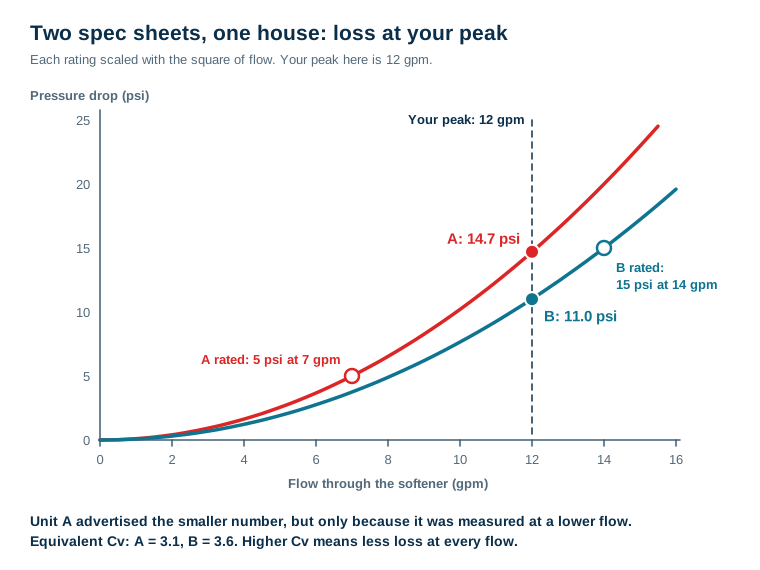
Here are two spec sheets:
- Unit A: "Only 5 psi pressure loss" at 7 gpm
- Unit B: 15 psi pressure loss at 14 gpm
Unit A looks three times better. Move both to a house that peaks at 12 gpm:
- Unit A: 5 × (12 ÷ 7)² = 14.7 psi
- Unit B: 15 × (12 ÷ 14)² = 11.0 psi
Unit B loses less at 12 gpm, and in fact at every flow. Unit A's rating was simply taken at a lower flow. Neither manufacturer lied. One of them picked a test point that flattered the number.
The fix is to never compare drops quoted at different flows. Convert both to the same flow first, or convert both to a Cv.
Cv: The Number That Makes Specs Comparable
Cv is the flow in gallons per minute that produces exactly 1 psi of drop. Valve makers publish it, and you can calculate an equivalent Cv for a whole softener from any single rating:
Cv = rated flow ÷ √(rated drop)
Then the drop at any flow is:
Drop = (flow ÷ Cv)²
| Rating | Equivalent Cv | Drop at 8 gpm | Drop at 12 gpm |
|---|---|---|---|
| Unit A: 5 psi at 7 gpm | 3.1 | 6.5 psi | 14.7 psi |
| Unit B: 15 psi at 14 gpm | 3.6 | 4.9 psi | 11.0 psi |
| Fleck 5600SXT valve alone: 15 psi at 20 gpm | 5.2 | 2.4 psi | 5.4 psi |
| Fleck 7000 valve alone: 15 psi at 28 gpm | 7.2 | 1.2 psi | 2.8 psi |
The valve figures come from Pentair's published ratings: 20 gpm at 15 psi for the 5600SXT valve alone and 28 gpm at 15 psi for the Fleck 7000 valve alone, which also lists 36 gpm at a 25 psi drop. They are the valve body only. A complete softener built on the same valve always has a lower Cv, because the resin bed and distributor add their own loss. Whether that gap justifies the larger valve's price is the question in choosing between a 5600SXT and a 7000SXT for your peak flow.
Higher Cv is better, at every flow. It is the single most useful number for comparing the hydraulic side of two softeners. In a house with several bathrooms it sets the shortlist, which is where choosing a softener for a large home by the peak flow it sustains starts.
How Much Drop Is Acceptable
There is no universal figure, because it depends on what pressure you start with and what else is in the line. A workable approach is a pressure budget:
- Start from the lowest supply pressure you actually get. On city water, measure static pressure at a hose bib. On a well, use the pressure switch cut-in, often 30 or 40 psi, not the cut-out.
- Subtract everything between the supply and your worst fixture at your realistic peak. That means every treatment stage, the piping, and height: each foot of rise costs 0.433 psi.
- What is left is the pressure at that fixture. If it feels weak to you there, the budget is too tight.
As a rule of thumb, aim for a softener that loses no more than about 8 to 10 psi at your realistic peak. On a strong city supply you can accept more. On a well with a 30 psi cut-in and other equipment in the line, aim for less. Softeners ranked on pressure loss scaled to a 12 gpm peak applies the same scaling to current models.
Keep one hard floor in mind as well. The softener's own valve needs pressure to regenerate. Pentair's Fleck 5600SXT service manual states that "a minimum of 20 psi" is required for the valve to operate effectively. Limits for other valves are covered in minimum and maximum pressure for a water softener.
Multi-Stage Systems: Adding Up the Losses
This is where houses end up with unusable pressure. Each stage in a treatment train subtracts its own drop at the same flow, and the drops add. Stages that each look acceptable on their own can together use up most of a well's pressure.
Worked example (illustrative). A well with a 40/60 pressure switch feeds a sediment filter, an iron filter, a softener, a carbon filter and a UV unit. The busiest realistic demand is 8 gpm, and the worst fixture is a shower 15 feet above the equipment. Each drop below is scaled to 8 gpm from an assumed rating:
| Stage | Assumed rating | Drop at 8 gpm |
|---|---|---|
| Sediment cartridge, clean | 2 psi at 10 gpm | 1.3 psi |
| Backwashing iron filter | 15 psi at 12 gpm | 6.7 psi |
| Softener | 15 psi at 14 gpm | 4.9 psi |
| Backwashing carbon filter | 15 psi at 12 gpm | 6.7 psi |
| UV unit | 2 psi at 12 gpm | 0.9 psi |
| Piping, fittings, valves | 5 psi at 10 gpm | 3.2 psi |
| Rise of 15 ft to the shower | 0.433 psi per ft | 6.5 psi |
| Total | 30.2 psi |
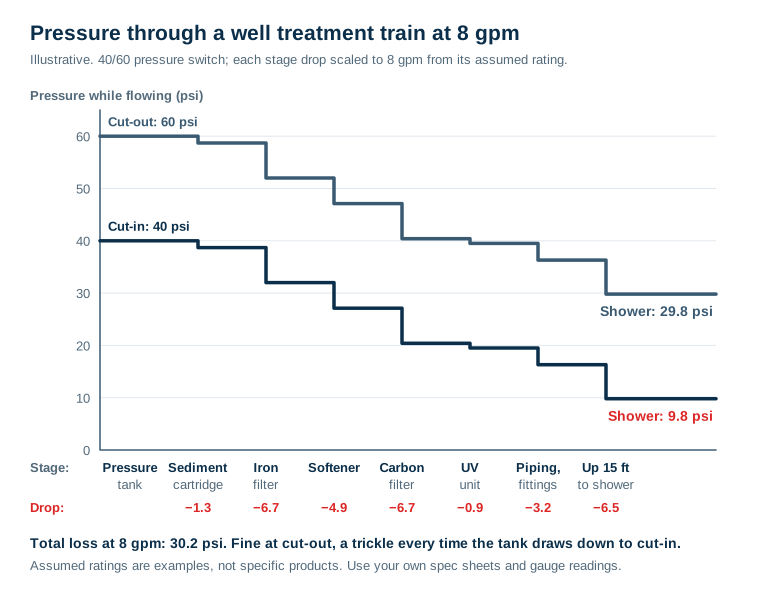
- At cut-out (60 psi), the shower gets about 29.8 psi. Acceptable.
- At cut-in (40 psi), the shower gets about 9.8 psi. That is a trickle, and it happens every time the pressure tank draws down.
The household notices this as a shower that is fine sometimes and weak other times, which is easy to misdiagnose as a pump or pressure-tank fault. Two things make it worse over time: a sediment cartridge loading up, and backwashing media that has compacted.
Ways out, roughly in order of cost:
- Change or upsize the sediment cartridge, and keep a gauge either side of it so you can see when it loads.
- Upsize the stage with the lowest Cv. In the example, the iron and carbon filters cost more than the softener.
- Check the pipe size through the whole train. A 3/4-inch loop on a 1-inch main costs pressure at every stage.
- Raise the pressure switch setting only within the limits of the pump, the pressure tank and the equipment. Every piece of equipment has a maximum pressure rating. This is a job for whoever services the well.
- A booster pump after the treatment is the last resort, not the first.
The two-stage case on city water, a carbon filter ahead of a softener, is worked through in how a whole-house carbon filter and softener work together.
When the Drop Grows Over Time
A new softener's drop is fixed by its design. A drop that increases is a symptom:
- Iron or silt fouling packs the resin bed and slowly raises the loss.
- Resin breakdown on chlorinated water turns beads into fines that pack tightly.
- A loaded prefilter upstream adds its own growing loss, which is easy to blame on the softener.
- Debris at the valve inlet after plumbing work causes a sudden rise rather than a gradual one.
Record the drop across the softener at a known flow, for example with two fixtures open, when it is new. Measure again each year. Why water pressure drops after a softener has the two-gauge test and the list of faults to check.
What Pressure-Drop Figures Cannot Tell You
- Whether the water will be soft. Pressure drop says nothing about capacity or hardness leakage. A unit can pass high flow easily and still be the wrong size in grains.
- What your gauges will read exactly. Inexpensive gauges can disagree by a couple of psi. Do not chase a one-psi difference.
- The behaviour of a fouled or damaged unit. Every figure here assumes clean resin and a working valve.
- Anything about water quality beyond hardness. A softener removes hardness minerals. Choosing one for low pressure loss does not change what it can and cannot remove.
Take the rated point, move it to your own peak flow, compare units by Cv, and add up every stage in the line before you buy.
Frequently Asked Questions
How much pressure drop is normal for a water softener?
At ordinary household flows, a few psi. NSF/ANSI 44 limits a softener's pressure drop to 15 psi at its rated service flow, and since the loss rises roughly with the square of the flow, a unit running at half its rated flow loses about a quarter of that, around 4 psi. Losing 10 psi or more at a single fixture is not normal and points to an undersized unit, a partly closed valve, debris or a fouled resin bed.
How do I calculate water softener pressure drop at my flow rate?
Take the rated drop and rated flow from the spec sheet and scale by the square of the flow ratio: drop at your flow equals rated drop times your flow divided by rated flow, squared. A softener rated 15 psi at 14 gpm loses about 15 × (10 ÷ 14)², or 7.7 psi, at 10 gpm. The square law is an approximation, most accurate for the valve, so treat the answer as an estimate and confirm it with gauges if it matters.
Is 15 psi pressure drop through a water softener too much?
As an everyday operating point, yes. Fifteen psi is the most NSF/ANSI 44 allows at the rated flow, and on a well switching on at 40 psi it is more than a third of the pressure available. It is fine as the ceiling a unit reaches only at the house's rare maximum demand. Choose a system whose rated flow is well above your realistic peak, so the loss at that peak stays under about 8 to 10 psi.
What is Cv on a water softener valve?
Cv is the flow in gallons per minute that produces a pressure drop of 1 psi. It turns any single rating into a full curve: the drop at any flow equals the flow divided by Cv, squared. It also makes units comparable, because a higher Cv always means less loss at every flow. You can calculate an equivalent Cv from any rating by dividing the rated flow by the square root of the rated drop.
Why is my water pressure fine at one tap but bad with two showers running?
Because pressure loss rises roughly with the square of flow. Doubling the flow through the softener and every other restriction in the line roughly quadruples the loss. One tap at 3 gpm might lose under a psi through the softener, while two showers and the washing machine together can lose ten times as much. That is normal hydraulics, and it is why sizing should use peak flow.
Can a whole-house filter and softener together cause low water pressure?
Yes. Every stage in a treatment train subtracts its own loss at the same flow, and the losses add up. A sediment filter, iron filter, softener and carbon filter that each look acceptable on their own can together cost 20 psi or more at peak. On a well that switches the pump on at 40 psi, that can leave a weak upstairs shower whenever the tank is near the bottom of its range.
