
Hague WaterMax Review: The Three-Compartment Tank, Costs and Limits
The Hague WaterMax is a dealer-sold water softener built around one media tank split into three compartments. One compartment, fitted in every unit, holds fine-mesh softening resin. The other two are optional and hold a few pounds, or at most about half a cubic foot, of add-on media such as KDF, carbon, tannin resin, calcite or garnet. That design lets one cabinet soften water and lightly treat a second problem. It does not replace a properly sized iron filter, acid neutralizer or disinfection stage when the water test shows a serious one.
This Hague WaterMax review works from Hague's own product pages, its media guide, its warranty text and the specification tables in its owner's manual. Nothing here comes from physical testing. Where a number comes from an older manual, it says so.
Disclosure: Hard Water Solved may earn a commission if you buy through links on this page, at no extra cost to you. It does not change which products we include or how we rank them. Read our disclaimer.
How this review was put together. Sources: Hague's WaterMax product page and WaterMax media guide, the 60-series WaterMax owner's manual (specification and capacity tables), and Hague's published warranty wording. Capacity is compared at a stated salt dose, not at a box rating. Hague publishes no prices, so the cost section uses dealer cost guides and owner-reported quotes and labels them as such. Prices are not listed here because they change often. Use the buttons to see the current price on Amazon.
Hague WaterMax Review in Brief
| Sold through | Local Hague dealers only, quote after a water test |
| Tank design | One media tank, three compartments (Signature Series offers two- or three-compartment builds) |
| Always fitted | 1.06 cu ft of fine-mesh cation resin plus a bacteriostat (60-series manual) |
| Optional media | KDF55, KDF85, PC carbon, Birm, tannin resin, nitrate resin, calcite, Ultra-fil garnet |
| Softening capacity | 26,700 grains at 6.2 lb of salt; 32,500 grains at 9.5 lb (63MAQ build, 60-series manual) |
| Pressure drop | 9 to 12 psi at 8 gpm, depending on build |
| Warranty | 25 years on media tank, brine tank, main control valve and fine-mesh resin; shorter on other parts |
| Typical installed price | Roughly $4,000 to $6,500 (dealer guides and owner quotes, 2025 to 2026) |
| On Amazon | No |
Good fit: a city or well home with hard water plus one mild second issue, such as chlorine taste, light sediment or low-level ferrous iron, where the owner wants a single dealer to handle testing, installation and service.
Poor fit: water with heavy iron, manganese, sulfur, bacteria or acidity, or a buyer who wants to service the system themselves.
What the Three Compartments Actually Hold
Hague calls the design "patented three-compartment" and says one WaterMax can "remove hardness, foul smells, bad tastes, cloudiness and discoloration." The claim is true in kind. The quantities are what decide whether it is true for your water.
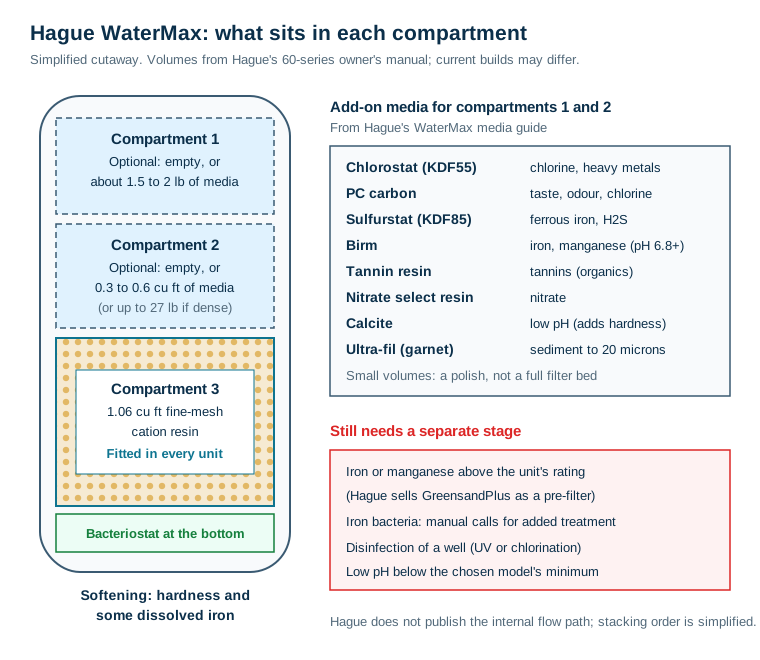
The 60-series owner's manual lists eight factory configurations. In every one of them, the third compartment holds the same 1.06 cubic feet of fine-mesh cation resin. The first two compartments vary:
- Compartment 1 is either empty or holds about 1.5 to 2 lb of media.
- Compartment 2 is either empty or holds 0.3 to 0.6 cubic feet of media. A dense media can run to 27 lb in one build.
Put those numbers next to a stand-alone filter. A typical backwashing carbon tank for a whole house holds 1.5 cubic feet of carbon in a 10 x 54 inch tank. The largest carbon-type fill in the WaterMax tables is about 0.4 cubic feet. That is enough to polish chlorine taste on a city supply, and Hague's manual restricts that build to "municipally supplied chlorinated water only" with a 3 ppm chlorine ceiling. It is not enough contact time for chloramine or heavy organic contamination.
The same logic applies to every add-on. They are small, so they treat mild versions of a problem. Hague's own range shows where the line falls: it still sells a separate GreensandPlus filter, described as a pre-filter "placed in front of your softener," for iron, manganese and hydrogen sulfide.
If the idea of media beds and distributors is new, the mechanics of a standard tank are covered in what is inside a water softener mineral tank. The WaterMax is the same idea with internal dividers.
What Each Layer Targets
Hague's media guide describes each option. Here they are with the job each one does, and the condition that limits it.
| Media | Hague's stated target | Limit to know about |
|---|---|---|
| Fine-mesh cation resin (always fitted) | Hardness; beads 23% smaller than standard mesh | Softening plus some dissolved iron, within the build's rating |
| Bacteriostat (always fitted) | Listed with the US EPA as a bacteriostat; stops bacteria growing in the media | Protects the softener, does not disinfect the water |
| Chlorostat (KDF55) | Chlorine, heavy metals, micro-organism control on city water | Small fill; chlorine only up to the build's limit |
| PC carbon (coconut shell) | Taste, odour, most man-made pollutants, chlorine | 0.4 cu ft at most in the manual's tables |
| Sulfurstat (KDF85) | Ferrous iron, hydrogen sulfide, heavy metals | Mild sulfur only; strong rotten-egg water needs oxidation |
| Birm | Dissolved iron and manganese | Needs pH 6.8 or higher and dissolved oxygen of at least 15% of the iron content |
| Tannin resin | Tannins (organic colour) | Needs the right salt dose and a pre-test for tannin level |
| Nitrate select resin | Nitrate | A health contaminant: confirm results with a lab test after installation |
| Calcite | Raises low pH | Adds hardness back, which the resin must then remove |
| Ultra-fil (garnet) | Sediment down to 20 microns | Fine silt or heavy sand still needs a pre-filter |
Two of these deserve a caution. Fine-mesh resin is a real advantage on iron-bearing well water, and the standard vs fine-mesh resin comparison explains why the smaller bead exchanges faster. The bacteriostat is not a disinfection device. It keeps the inside of the softener from growing slime. If a well tests positive for coliform bacteria, that is a disinfection problem, and the EPA's guidance on protecting your home's well water is to find and fix the source and treat it properly.
Which Problems the Combined Tank Handles, and Which It Does Not
This is the question a dealer quote should answer in writing. Use the water test, not the brochure.
| Water test shows | WaterMax alone? | Why |
|---|---|---|
| Hardness only | Yes | One resin compartment is a normal softener |
| Hardness + chlorine taste (city water) | Yes, usually | KDF55 or a small carbon fill polishes chlorine up to the build's limit |
| Hardness + light sediment | Yes | Garnet catches sediment to 20 microns |
| Hardness + low ferrous iron | Often | Fine-mesh resin and KDF85 handle low dissolved iron within the rating |
| Hardness + mild tannins | Sometimes | Tannin resin compartment, if the tannin level suits it |
| Chloramine, or a carbon need for VOCs | No | Too little carbon contact time; a full-size carbon tank is needed |
| High iron or manganese | No | Needs an oxidising filter ahead of the softener; Hague sells one |
| Strong hydrogen sulfide | No | Needs oxidation, not a few pounds of KDF |
| Iron bacteria | No | Hague's manual says it needs additional treatment |
| Acidic water below the build's minimum pH | No | Most builds need pH 7; a neutralizer goes first |
| Coliform bacteria | No | Needs disinfection, such as UV or chlorination |
The broad pattern holds for any combined unit, not just Hague's: one tank can soften and lightly polish. It cannot do the work of a separately sized oxidising, neutralising or disinfecting stage. The informational guide to salt-based vs salt-free water treatment covers the softening side of that decision. For well water, a full water test panel before treatment is what tells you which column you are in.
Capacity at a Stated Salt Dose
Hague does not sell the WaterMax on a headline grain number in the way online softeners do. Its manual gives capacity at four salt settings instead, which is the honest way to do it. For the 63MAQ build:
| Salt per regeneration | Capacity | Grains per lb of salt |
|---|---|---|
| 1.1 lb | 5,900 | about 5,360 |
| 3.2 lb | 16,300 | about 5,090 |
| 6.2 lb | 26,700 | about 4,310 |
| 9.5 lb | 32,500 | about 3,420 |
Two things stand out:
- The resin bed is about the size of a "32,000-grain" softener. At 1.06 cubic feet, it holds a little more resin than the 1.0 cu ft that online sellers label 32,000 grains. The 63MXQ build adds 0.6 cubic feet of extra resin in compartment 2 and reaches 49,300 grains at 14.4 lb of salt.
- It is salt-efficient at low doses. At 6.2 lb of salt it delivers about 4,310 grains per pound. Standard resin in a conventional softener gives about 3,500 grains per pound at an efficient 6 lb per cubic foot dose, as set out in advertised vs usable softener capacity. The fine-mesh resin and metered regeneration earn that difference.
What that means for sizing: a family using 4,500 grains of hardness a day gets about six days between regenerations from the 63MAQ at 6.2 lb, before reserve. A larger household or very hard water needs the higher-capacity build, which uses more salt per cycle.
Flow is the other half. The manual gives a pressure drop of 9 to 12 psi at 8 gpm, depending on the build. A 12 psi loss at a modest 8 gpm is noticeable on a home with 40 psi at the meter, so ask the dealer which build you are getting and what it drops at your peak flow.
Hague WaterMax Price and Ten-Year Cost
Hague publishes no prices. The WaterMax page ends with "Looking for a price? Get a no cost, no obligation free estimate." Dealer cost guides and owner-reported quotes from 2025 and 2026 put a typical installed WaterMax at roughly $4,000 to $6,500, with multi-stage well systems higher.
Here is how that compares over ten years with a do-it-yourself combination built from separate parts. These are planning figures, not quotes.
| Ten-year cost item | Hague WaterMax (dealer) | Online softener + separate carbon tank |
|---|---|---|
| Equipment and install | about $4,000 to $6,500 | The online combo's current price, plus a plumber's fee if you do not fit it yourself |
| Salt | Lower per grain at low doses | Standard |
| Media replacement | Dealer service | Carbon re-bed every few years, DIY |
| Service labour | Not covered by warranty; dealer call-out rates | Any plumber, standard Fleck parts |
| Covered by warranty | 25 years on tanks, valve, resin | Typically 5 years on the valve, 10 on tanks |
The dealer premium buys three real things: a water test interpreted by someone who will stand behind it, one point of contact for service, and a long warranty on the expensive parts. It also buys a proprietary valve and controller that only a Hague dealer services. Whether that trade is worth a few thousand dollars depends mostly on how much you value not doing it yourself.
The 25-Year Warranty, Read Closely
Hague's WaterMax page quotes the core promise word for word: Hague "will repair or replace the defective item, at no charge for that item, for 25 YEARS from date of installation" for "any Hague Media Tank, Brine Tank, Main Control Valve, or the fine mesh polystyrene resin found to be defective in material or workmanship."
Read the phrases that limit it:
- "At no charge for that item." The part is free. The labour to fit it is not. The 60-series manual excludes service labour costs.
- "Defective in material or workmanship." Resin fouled by iron, sediment or chlorine is not a defect. Neither is freezing damage or a bad installation, both excluded in the manual.
- Other parts. Mechanical and electronic parts outside that list carry a much shorter warranty. The older manual gives three years, followed by a cost-share. Check the current document, because terms change.
Before signing, ask the dealer for the current warranty PDF and check it against the guide to reading a water softener warranty.
Certification
Hague displays the WQA Gold Seal on the WaterMax page. The 60-series manual says models 63MAQ, 63BEQ, 63MXQ, 62AMQ and 62APQ are certified by WQA and refers to NSF/ANSI 44 for softening performance. Certification is per model, not per brand. Ask for the exact model number on your quote and look it up on the WQA listing before you buy.
Amazon Alternatives to the Hague WaterMax
Hague does not sell the WaterMax on Amazon, and no listing for it was found. These are the closest online options that combine softening with a second treatment, each with the trade-off stated.
1. Fleck 5600SXT 48,000-grain softener + backwashing carbon filter. Separate tanks instead of layered media: a 48,000-grain softener with 10% crosslink resin, plus a second 10 x 54 inch tank holding 1.5 cubic feet of activated carbon that backwashes itself. That is several times the carbon a WaterMax compartment holds. Best for city water with chlorine taste.
2. AFWFilters Iron Pro 2 combination softener and iron filter, 64,000 grain. A Fleck 5600SXT valve over 2.0 cubic feet of fine-mesh resin, rated by the seller for ferrous iron up to 6 ppm. It is the closest online match to a WaterMax configured for well water with low dissolved iron, with standard parts.
3. EcoPure EPH130 softener and filtration system. The only one here that, like the WaterMax, puts softening resin and filtration media in one cabinet. The listing describes a 2-in-1 design aimed at better-tasting water, AutoSense demand regeneration and sizing for households of up to five people. It does not state a grain rating or say what the filtration media is, so confirm both on the spec label before you buy.
None of the three includes a water test, installation or a dealer. That is the cost saving, and also the risk.
Who Should Not Buy the Hague WaterMax
- Anyone whose water needs more than softening plus a polish. High iron, manganese, sulfur, acidity or bacteria need their own stage. A dealer who proposes the WaterMax alone for that water is selling the wrong thing.
- Buyers who want to service their own equipment. Parts and controllers are Hague-specific and go through dealers.
- Homes with low water pressure and large peak flows. A 9 to 12 psi drop at 8 gpm leaves little margin.
- Anyone comparing on price alone. If the water test shows only hardness, an online metered softener of similar resin volume does the same softening job for a fraction of the cost.
- Buyers who cannot get an itemised quote. If the dealer will not write down the model number, the media in each compartment and the warranty document, walk away.
The verdict of this Hague WaterMax review: the WaterMax is a well-made answer to a narrow question: soften the water and fix one mild second problem in a single cabinet, with one dealer responsible for it. If that is your question, it is worth a quote. If your water test shows something more serious, the layered tank is not the answer, however well it is built.
Frequently Asked Questions
Is the Hague WaterMax a water softener or a filter?
Both, within limits. Every WaterMax carries a compartment of fine-mesh cation resin, which softens the water and can take out some dissolved iron. The other two compartments can be left empty or filled with add-on media such as KDF, carbon, tannin resin, calcite or garnet sediment media. Those add-ons are small amounts, so they act as a polish for mild problems rather than as a full-size filter.
How much does a Hague WaterMax cost?
Hague does not publish prices. The WaterMax is sold only through local dealers, who quote after a water test. Dealer cost guides and owner-reported quotes from 2025 and 2026 put a typical installed system at roughly $4,000 to $6,500. Well-water builds with a separate pre-filter cost more. Get the quote itemised, with the model number and media in each compartment written down.
Can you buy a Hague WaterMax on Amazon?
No. Hague sells whole-house systems only through its dealer network, and no Hague WaterMax was found for sale on Amazon. Online alternatives that combine softening with filtration do exist, such as a Fleck 5600SXT softener paired with a separate backwashing carbon tank, or a fine-mesh softener rated for ferrous iron.
What does the Hague WaterMax 25-year warranty cover?
Hague's warranty covers the media tank, brine tank, main control valve and the fine-mesh polystyrene resin for 25 years from installation, for defects in material or workmanship. Other mechanical and electronic parts are covered for a shorter period, and Hague's older owner's manual excludes service labour. Ask the dealer for the current warranty document before signing.
Does the Hague WaterMax work on well water?
It can, if the configuration matches the water test. Hague's manual rates each WaterMax build for different hardness, iron, pH and chlorine limits, and it says iron bacteria need additional treatment. Water with high iron or manganese, hydrogen sulfide, or bacteria usually needs a separate stage ahead of the softener, which Hague itself sells as a GreensandPlus pre-filter.
Is the Hague WaterMax worth it compared with an online softener?
It is worth considering if you want one dealer to test, install and service everything, and your water has a mild second problem that a few pounds of add-on media can handle. If your water only needs softening, a standard metered softener plus a separately sized filter tank usually costs far less over ten years and can be serviced by any plumber.
