
How to Choose a Water Softener Installer: 9 Questions Tied to the Code
A good water softener installer is whoever holds the licence your address requires, pulls the permit where one is needed, and gives the right answers on three code items: the air gap at the drain, the bonding jumper on metal pipe, and supply-side backflow protection. That can be a licensed plumber, a dealer's installer, or, for a simple swap, a contractor arranged by a big-box store. The nine questions below test each of those code items. Each one comes with the answer a competent installer gives and the answer that should end the call.
Online reviews and price matter, but they cannot tell you whether the drain line will be pushed into a standpipe or the house will lose its electrical bond. Those mistakes stay invisible until an inspection, a backed-up drain or a home sale finds them.
Disclosure: Hard Water Solved may earn a commission if you buy through links on this page, at no extra cost to you. It does not change which products we include or how we rank them. Read our disclaimer.
The Four Kinds of Water Softener Installer
Four kinds of people quote for softener installs. They differ in licensing, in who chose the equipment, and in what happens when something goes wrong.
| Installer | Usually licensed as | Who chose the softener | Best for | Watch for |
|---|---|---|---|---|
| Licensed plumber | Plumber (state or local) | You | Online or big-box units, new loops, new drains, cut metal pipe | May not program or size the softener; ask who sets it up |
| Water conditioning installer | Water conditioning licence, where the state has one | You or a dealer | Softener and filter work in states that license it separately | Their licence may limit what other plumbing they can do |
| Dealer's installer | Varies; the dealer holds or arranges the licence | The dealer | Dealer brands such as Culligan, Kinetico, EcoWater, RainSoft and Hague, which install their own units | The installer works for the seller, so the sizing and the contract come from the same place |
| Retailer install program or handyman | Often none for the person on site | You | Like-for-like swaps on an existing loop, drain and bypass | Who holds the licence and the warranty if the job grows |
None of these is the right answer everywhere. The decision chart below picks one for your situation. Whichever you choose, the nine questions further down apply to all of them.
Which Water Softener Installer to Hire
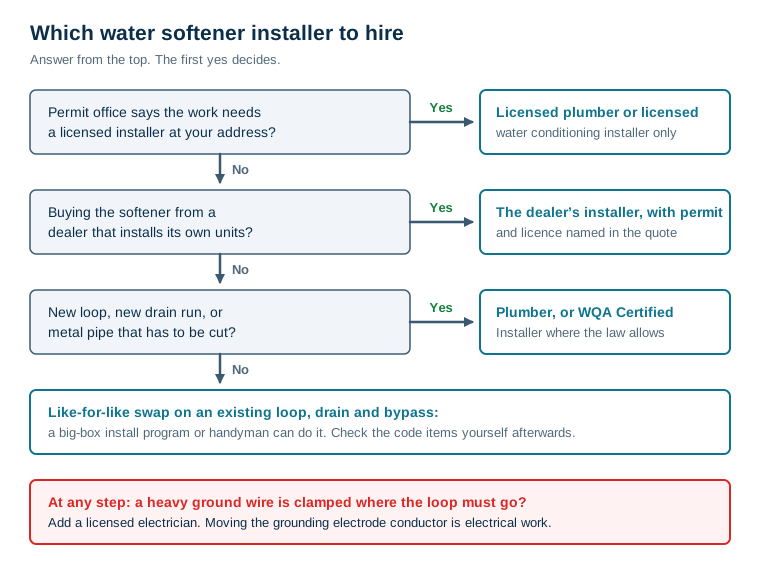
The first question is not about the installer at all. It is about your address. Call your local permit office and ask whether a softener install needs a permit, and who is allowed to pull it. The six questions to ask on that call, and what to have in hand, are in do you need a permit for a water softener.
If the answer is that a licensed installer must do the work, the choice is already narrow. If you are buying from a dealer, its installer comes with the contract. If the job needs new pipe, a new drain run, or cutting into copper or galvanized pipe, hire a plumber. A plain swap on plumbing that is already correct is the only case where a lighter option makes sense.
The red box applies at every step. If a heavy copper wire is clamped to the pipe where the softener loop must go, that may be the grounding electrode conductor. Moving it is electrical work, so an electrician joins the job.
Check the Licence Before You Check the Price
A licence tells you the installer is allowed to do the work. It does not tell you they do it well. Check it anyway, because a job done without one can fail inspection, and it is hard to recover anything from an unlicensed installer when something leaks.
- Find out which licence applies. Some states license water conditioning work separately from plumbing. The Minnesota Department of Labor and Industry is a clear example. Water conditioning installers there must be licensed or registered with the department, and a licensed plumber can do the work without a separate licence. Other states fold softener work into plumbing, and some do not license it at all.
- Look the licence up yourself. Most state licensing boards have a public lookup. A licence number on a van is not the same as a current licence.
- Ask for a certificate of insurance. Liability insurance covers water damage from a failed joint. Ask for the certificate, not a verbal yes.
- Treat WQA certification as a bonus, not a substitute. The Water Quality Association's Certified Installer credential requires a training course, an exam and at least six months of installing water treatment equipment. It focuses on safe installation and code compliance. It is voluntary, so it does not replace a licence. WQA runs a public search for certified professionals from the same page.
Nine Questions That Test a Water Softener Installer
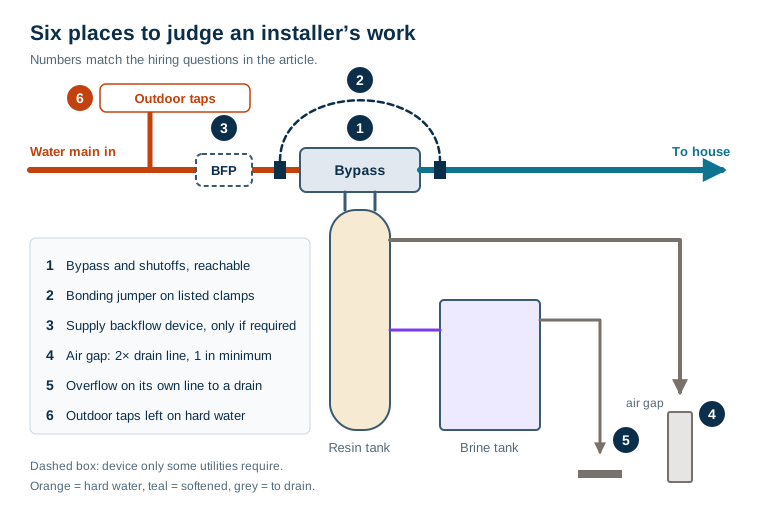
These questions follow the code items an inspector looks at, plus the setup work that decides whether the water is actually soft. The diagram numbers the six places on a finished install where the answers show up.
| # | Question | A good answer | End the call if you hear |
|---|---|---|---|
| 1 | Who pulls the permit? | "We do. It's on the quote," or "Your office says none is needed for this; I checked on [date]" | "Nobody bothers with permits for softeners" |
| 2 | What licence do you hold? | A licence type and number you can look up | "I've done hundreds, I don't need one" |
| 3 | Where does the drain line end? | In open air above the standpipe or floor drain, with a gap of at least twice the line's diameter | "We push it into the standpipe and tape it so it doesn't splash" |
| 4 | My pipe is copper. How do you keep the bond? | A copper jumper on listed ground clamps, on bare metal either side, with slack | "The softener is plugged in, so it's grounded" |
| 5 | Do I need a backflow device on the supply? | "Only if your utility or local code requires one. If we add one, you'll need expansion control at the water heater" | "A check valve covers backflow" |
| 6 | Where does the brine tank overflow go? | Its own gravity line to a drain | "We tee it into the drain line" or "We cap it" |
| 7 | Which taps stay on hard water? | "The outdoor taps, unless you want otherwise" | "Everything gets softened" |
| 8 | What hardness will you program? | "Your test result, adjusted for any iron" | "We leave the factory setting" |
| 9 | What does the quote include, and what do you guarantee? | An itemised list and a written workmanship guarantee | A single figure and "We stand behind our work" |
The drain and its air gap (questions 3 and 6)
This is the item most often done wrong, and the one with the most serious failure. During regeneration the softener sends water to drain. If the end of the drain line sits below the rim of the standpipe, a blocked drain plus a drop in supply pressure can pull waste water back into the softener and the house supply.
Fleck's instructions ask for a gap of twice the drain line diameter, with a 1 inch minimum. The International Plumbing Code asks for at least twice the effective opening. About 2 inches covers every common drain line. A good installer will name a figure without being asked twice. The reasoning and the fittings are in why a water softener drain needs an air gap.
The brine tank overflow is separate. It is a gravity line for when the brine tank overfills. It needs its own route to a drain. Teeing it into the pressurized drain line lets regeneration water back into the brine tank.
The bonding jumper (question 4)
On copper or galvanized pipe, a softener and its plastic bypass break the metal path that bonds the house piping to the electrical system. The National Electrical Code says that path must not depend on water meters, filters "and similar equipment", and calls for a jumper around equipment that may be removed. A.O. Smith's softener manual specifies two grounding clamps and #4 copper wire.
A competent installer knows all of this and also knows when to stop. If the heavy wire already clamped to the pipe is the grounding electrode conductor, they will not unclamp it to make room. The details are in how a softener affects plumbing bonding and grounding. On PEX or CPVC on both sides, there is no metal path to bridge, and an installer who says so is right.
Backflow protection (question 5)
There are two different jobs here, and a poor installer mixes them up. The drain air gap protects your household water and is needed on every install. A device on the supply side protects the public main and is needed only where your utility or local code demands one.
The best answer to question 5 is "it depends on your utility," followed by an offer to check. An installer who sells you a supply-side device without naming the rule that requires it is selling a part, not meeting a code. One who says a plain check valve is backflow protection is wrong. A check valve also closes the plumbing system, and the water heater then needs thermal expansion control. The full picture is in does a water softener need backflow protection.
Layout and startup (questions 7 and 8)
Outdoor taps belong on hard water. Softening the lawn spends salt and water for nothing. An installer who asks which taps you want left hard has thought about the layout before cutting pipe.
The hardness setting decides whether the water is soft at all. It should come from your own test, with dissolved iron added in, not from the factory default. If the installer also sized the unit, ask how. The method is in how to size a water softener, and an installer who sized from your hardness and your actual water use will be able to walk you through it.
Reading the Quote Line by Line
A single price hides the parts of the job that get skipped. Ask for these lines, even if some are zero:
- Permit and inspection fee, or a note saying none is required and which office confirmed it.
- Parts beyond the softener: shutoffs, bypass, fittings, drain line, an air gap fitting where needed, the bonding jumper and clamps.
- New plumbing, such as a loop, a drain run or a relocated outdoor tap line.
- Removal and disposal of the old unit, if there is one.
- Startup: sanitizing, the first regeneration, programming the hardness and checking the result.
- Workmanship guarantee: how long, in writing, and what it covers.
The equipment warranty comes from the maker, not the installer. A leak at a joint the installer made is their problem, not the manufacturer's. That is why the workmanship guarantee should be written down separately.
Red Flags in the Sales Conversation
Some warning signs show up before any pipe is cut.
- Sizing without a test. A quote for a specific softener before anyone has a hardness figure is a quote for whatever is in the van.
- A free water test that leads straight to one product. A test is useful. A test that always ends at the seller's most expensive model is a sales step. Ask for the actual numbers in writing.
- Pressure to sign the same day. A good installer's price will still be there next week.
- Health claims. A softener removes hardness and some dissolved iron. It is not a purifier. An installer who claims otherwise is not a reliable source on the code items either.
- No drain plan. If the installer cannot say where the drain line will run before starting, it will end wherever is easiest.
After the Install: A Ten-Minute Walkthrough
Every answer from the nine questions leaves something you can see. Walk round the finished job with the installer still there and check each numbered point on the diagram above.
- Bypass and shutoffs are within reach, and the installer shows you how to use them.
- The jumper is in place on metal pipe, with both clamps tight on bare metal.
- Any supply-side device is the one your utility named, and it is accessible.
- The drain line ends in open air, held so it cannot slip down.
- The overflow runs on its own downhill line.
- The outdoor taps are still on hard water.
Then test the water at a tap after the first regeneration. A reading near zero means the setup worked. The full list of what goes wrong, matched to its symptoms, is in common water softener installation mistakes. Where a permit was pulled, the inspection covers the code items, but not whether the softener is sized or programmed correctly. That part is still on you.
When You Do Not Need an Installer at All
Many homeowners can install a softener themselves where the local rules allow owner-occupants to do their own plumbing. Brooklyn Park in Minnesota, for example, lets a homesteading owner pull their own plumbing permit. The job is a bypass, a cut into the main line, a drain run, a jumper and a startup. It needs care at three flood points, and the full sequence is in how to install a whole-house water softener.
Hire someone if you are not comfortable soldering or cutting into the main, if the grounding conductor is in the way, or if your address requires a licensed installer. Either way, the same six checkpoints decide whether the install is right.
Frequently Asked Questions
Who should install a water softener, a plumber or the dealer?
Either can, if they hold whatever licence your state or city requires and pull the permit where one is needed. Buy from a dealer and the dealer's own installer normally fits the unit. Buy online or from a big-box store and a licensed plumber is the usual choice, especially when a new loop, a new drain run or cut metal pipe is involved. A like-for-like swap on an existing loop is the one job where a retailer's install program or a handyman may be enough, where local rules allow it.
Does a water softener installer need a licence?
It depends on the state and city. Some states license water conditioning work separately. Minnesota, for example, requires water conditioning installers to be licensed or registered with its Department of Labor and Industry, and licensed plumbers are covered. Other states treat it as plumbing, and some do not license it at all. Your local permit office can tell you which applies at your address.
What questions should I ask a water softener installer?
Ask who pulls the permit, what licence they hold, where the drain line will end and how big the air gap will be, how they will keep the electrical bond on metal pipe, whether your utility requires a supply-side backflow device, where the brine overflow goes, which taps stay on hard water, what hardness they will program, and what the quote and workmanship guarantee cover. The drain, bonding and backflow answers tell you most.
Is WQA certification the same as a licence?
No. The Water Quality Association's Certified Installer credential is voluntary. It requires a training course, an exam and at least six months of installation experience, and it shows the person has studied safe installation and code compliance. It does not replace a state or local licence where one is required. Ask for both where both apply.
How do I check a water softener installation after it is done?
Look at six things. There is open air between the drain line and the standpipe. A copper jumper on clamps bridges the softener on metal pipe. The brine tank overflow has its own line to a drain. The bypass and shutoffs are easy to reach. The outdoor taps stay on hard water. And a hardness test at a tap reads close to zero after the first regeneration. If a permit was pulled, the inspection should cover the code items too.
