
How a Softener Affects Plumbing Bonding and Grounding
Water softener grounding and bonding matters because, in many homes, the metal water pipe is part of the electrical system's grounding and bonding path. A softener with a plastic valve and bypass, cut into copper or galvanized pipe, can break that metal path. A bonding jumper, a copper wire clamped to the pipe on both sides of the softener, restores it.
Softener manufacturers call for this jumper, and the National Electrical Code has wording aimed at exactly this kind of equipment. Where there is any doubt about how your house is grounded, it is an electrician's call, not a plumbing one.
This page explains why the pipe carries a bond, how a softener interrupts it, how a jumper is installed, and where the plumbing job stops and the electrical job starts.
Water Softener Grounding and Bonding: Why Metal Pipe Carries a Bond
There are two reasons a home's water pipe can be part of the electrical system. A given house may have one, both or neither.
The pipe can be a grounding electrode. A metal water service pipe buried in the earth for a long run makes good contact with the ground. The NEC treats a metal underground water pipe in direct contact with the earth for 10 feet or more as a grounding electrode. Older homes in particular often have their main grounding electrode conductor clamped to the water pipe near where it enters the building. The code also requires that electrode to be supplemented by another one, such as a ground rod, precisely because a plumber may one day replace part of the pipe with plastic.
The interior piping must be bonded. Even where the water service is plastic, metal water piping inside the house must be bonded back to the electrical service. The purpose is that if a fault ever energizes the piping, for example through a failed water heater element or a damaged cable touching a pipe, the fault current has a low-resistance path back to the panel. That trips the breaker, instead of leaving the pipes live.
Both paths depend on the metal pipe being electrically continuous. A softener breaks that continuity.
How a Softener Interrupts the Path
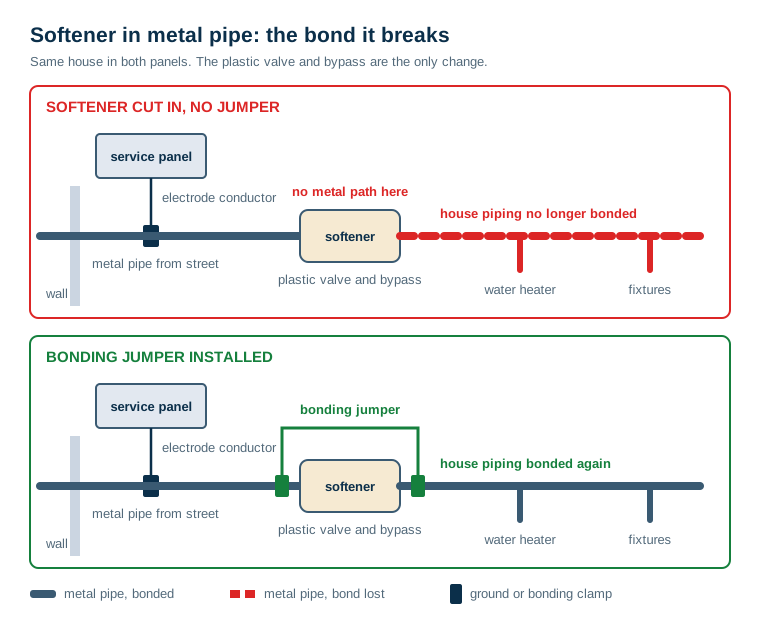
Almost every residential softener has a plastic control valve and a plastic or composite bypass valve. The adapters that join them to the house plumbing are often plastic too. Cut the unit into a copper line and there is now a gap in the metal, typically a foot or two wide, with nothing conductive across it.
What that gap breaks depends on where the electrical connection to the pipe sits relative to the softener:
- The grounding connection is upstream, near the entry (the usual case). The underground pipe is still connected to the panel. But all the interior piping beyond the softener, including the water heater, fixtures and branch lines, has lost its bond.
- The grounding connection is downstream of the softener. The panel is still bonded to the interior piping, but it is now cut off from the underground pipe it was using as an electrode.
Either way, the fix is the same: bridge the gap. Pentair's whole-house softener manual warns that installing its system in metal plumbing "will interrupt the continuity of the plumbing system and grounding source in some homes." Where appliances are grounded through the plumbing, it calls for a bypass made of the same metal as the existing plumbing, or a grounded "jumper wire" to bridge the equipment, before the system is used.
What the NEC Says About Softeners and Similar Equipment
The National Electrical Code (NFPA 70) does not mention water softeners by name. It does not need to. Several of its grounding and bonding provisions describe exactly this situation. The section numbers below are from recent editions. Your jurisdiction adopts a specific edition, possibly with local amendments, and numbering has shifted between editions.
| NEC provision (recent editions) | What it says, in substance | What it means at the softener |
|---|---|---|
| 250.52(A)(1) | Metal underground water pipe in direct contact with the earth for 10 feet or more is a grounding electrode | Your water service may be part of the grounding system |
| 250.53(D)(1) | Continuity of the grounding path or the bonding connection to interior piping must not rely on water meters, filtering devices and similar equipment | A softener is similar equipment. The path must not depend on it |
| 250.68(B) | Bonding is to be provided around insulated joints and around equipment likely to be disconnected for repair or replacement, with jumpers long enough to allow removal | The jumper goes around the softener and has slack so the unit can come out |
| 250.68(C)(1) | Interior metal water pipe used as a conductor for the grounding electrode system must be within the first 5 feet of where the pipe enters the building | A softener installed within those first 5 feet sits right on the electrode path |
| 250.104(A) | Metal water piping in or attached to a building must be bonded to the service, with a bonding jumper sized from a code table | The interior piping beyond the softener still needs its bond |
A NEC table in the article is only a summary. The code text, the adopted edition and the local inspector decide what is required at your address. That is one reason a softener installation can need an electrical sign-off as well as a plumbing one, covered in do you need a permit for a water softener.
How a Bonding Jumper Is Installed
The job is small, but each detail matters.
- Before you cut the pipe, look for an existing clamp and wire. If there is a heavy copper conductor clamped to the pipe where the loop will go, that may be the grounding electrode conductor. Stop. Do not unclamp it to make room. Relocating it is electrical work.
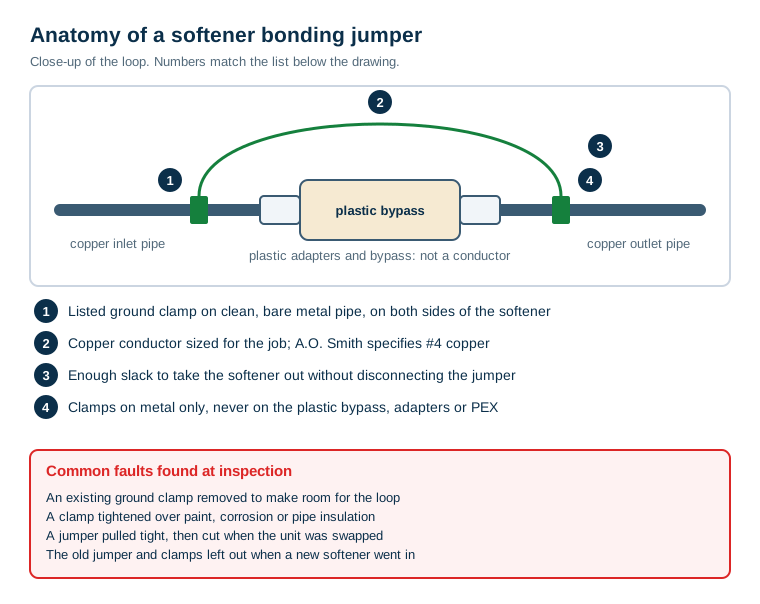
- Choose the clamp positions. One goes on bare metal pipe on the inlet side and one on bare metal pipe on the outlet side, beyond any plastic adapters or bypass fittings. Keep them accessible so an inspector can see them.
- Clean the pipe to bright metal under each clamp. Paint, corrosion, tape and pipe insulation all add resistance.
- Use clamps listed for grounding and bonding, sized for the pipe. A hose clamp or strap is not a substitute.
- Use a copper conductor of the right size. A.O. Smith's owner's manual specifies "two grounding clamps and a #4 copper wire" before installation on metallic plumbing. It warns that failing to follow the instructions "can result in death or electric shock." The NEC sizes these conductors from tables based on the size of the service conductors. #4 copper covers many residential services, but have an electrician confirm the size for a large service or where the pipe is the main electrode.
- Leave slack. The jumper should route clear of the softener and be long enough that the unit and bypass can be removed without disconnecting it. That is the practical meaning of the NEC's "sufficient length to permit removal."
- When you replace a softener, replace or reinstall the jumper. Water-Right's manual makes the same point: if replacing an existing unit, also replace the ground clamps and wire. Old jumpers are often cut or left dangling when the old unit comes out.
A softener's own power supply is usually a plug-in low-voltage transformer. The unit is not "grounded" through the jumper. The jumper is there for the pipe, not the softener.
Pipe Materials: When the Jumper Question Changes
- Copper on both sides: the standard case. Jumper across the softener.
- Galvanized steel on both sides: the same, but getting good contact is harder. Clean thoroughly and check the pipe is sound under the clamp. Old galvanized joints can have poor continuity of their own. Softener installs on old steel pipe are covered in installing a water softener with galvanized pipe.
- Plastic (PEX, CPVC, PVC) on both sides: there is no metal path to interrupt, so there is nothing to jumper. Never clamp to plastic pipe.
- Metal on one side, plastic on the other: a jumper to plastic does nothing. The question becomes how the remaining metal piping is bonded, and that is an electrician's assessment.
Transition fittings for each pipe material are covered in connecting a softener to copper, PEX, CPVC and push-fit.
Checking the Jumper After the Install
A jumper that looks right can still be a poor connection. Clamps loosen as pipes heat and cool. A clamp can also end up on a painted section, or the wire can be nicked where it passes a sharp edge.
What anyone can check by eye:
- Both clamps are on metal pipe that runs continuously into the house piping, not on a short metal nipple between two plastic fittings.
- Both clamps are tight and cannot be rotated by hand.
- The wire is intact and secured in the clamp terminal at each end, with no broken strands.
- Nothing depends on the softener. Mentally remove the softener and bypass: is there still an unbroken metal path from inlet pipe to outlet pipe through the jumper?
What needs an electrician is a measurement. A low-resistance continuity test across the jumper, and a check of the bonding back to the service, confirms the path actually works. If the house has had electrical problems, or you are relying on the water pipe as a grounding electrode, get that measurement rather than trusting the look of the clamps.
The same logic applies to other equipment in the line. The NEC wording already covers water meters, and it applies equally to a whole-house filter housing, a plastic check valve, or a dielectric union at a water heater. Each is a potential break in a metal path. A softener is often installed right next to one of these, so check the whole run between the entry and the water heater, not only the softener loop.
When This Is an Electrician's Call
Installing a jumper across a softener on plain copper, with no grounding conductor in the way, is routine plumbing practice and is in every manual quoted above. Call a licensed electrician instead when:
- the grounding electrode conductor is clamped where the softener needs to go, or you cannot tell what a clamped wire is
- you do not know whether the house relies on the water pipe as its only grounding electrode
- the house has mixed metal and plastic piping
- anyone has felt a tingle or shock from a faucet, tub, shower or pipe. That is a live-fault symptom and a same-day call.
- your jurisdiction requires an electrical permit for bonding work
An electrician can measure continuity across the softener and confirm the bonding at the service, which a plumber normally cannot sign off. Whether the jumper is in the quote is also one of the questions to put to anyone you are hiring to install a softener.
What a Jumper Does Not Do
A bonding jumper does not protect the softener, change how it works, or reduce corrosion in the pipes. It does not make a poorly grounded house safe on its own. It only restores what the softener interrupted. A missing jumper is also invisible in daily use. The water stays soft and nothing seems wrong, which is why it is one of the common water softener installation mistakes that only an inspection finds.
For water softener grounding and bonding, the short version is simple. If the softener was cut into metal pipe, bridge it with a properly sized copper jumper on listed clamps. Leave the existing grounding conductor alone. Bring in an electrician whenever the picture is not that simple.
Frequently Asked Questions
Does a water softener need to be grounded?
The softener itself does not need a ground; its control valve runs on a low-voltage plug-in transformer. What needs attention is the metal water pipe it is cut into. If that pipe is part of the home's grounding or bonding system, the plastic valve and bypass break the metal path, and a bonding jumper across the softener restores it.
What size wire is used for a water softener bonding jumper?
It should be sized for the conductor it is standing in for. A.O. Smith's manual calls for a #4 copper wire with two grounding clamps. The National Electrical Code sizes these conductors from tables based on the service conductor size, so on a large service or where the pipe is the main grounding electrode, have an electrician confirm the size.
Is a jumper wire required across a water softener by code?
The National Electrical Code says the grounding path or the bond to interior piping must not rely on water meters, filtering devices and similar equipment. It also allows bonding jumpers around equipment likely to be disconnected for repair or replacement. How your jurisdiction applies that to a softener depends on the code edition it adopted, so ask your inspector.
Do I need a bonding jumper if my pipes are PEX or plastic?
Not across the softener if the pipe on both sides is plastic, because there is no metal path to interrupt. Never clamp a jumper onto PEX or CPVC. If the house has a mix, with metal pipe on one side of the softener and plastic on the other, have an electrician check how the remaining metal piping is bonded.
Where do you put the ground clamps on a water softener?
One clamp on bare metal pipe on the inlet side and one on bare metal pipe on the outlet side, beyond any plastic adapters or bypass. Clean the pipe to bright metal under each clamp, use clamps listed for grounding and bonding, and leave enough slack in the wire that the softener can be removed without disconnecting it.
Can a missing ground jumper cause a shock from a faucet?
It can make a shock possible if there is also an electrical fault that energizes the house piping, because the fault current may no longer have a low-resistance path back to the service. A tingle or shock from any faucet, tub or pipe is a same-day call to an electrician, not a plumbing fix.
