
WaterBoss Water Softener Review: Is It Really Iron-Ready?
This WaterBoss water softener review tests one claim: that a compact cabinet softener also takes care of iron and sediment. It does, inside a narrower window than the box suggests. The WaterBoss 900's manual rates it for up to 10 ppm of iron, but only clear-water (ferrous) iron, at pH 7 or above, and only while your hardness plus 5 grains per gallon for every ppm of iron stays under 90. Its filter layer handles fine dirt, not sand. Above 5 ppm of iron, with any iron that has already oxidised, or with sand in the water, a separate filter is still needed.
Inside that window, it is one of the most salt-efficient cabinet softeners on paper, at 5,510 grains per pound of salt.
Disclosure: Hard Water Solved may earn a commission if you buy through links on this page, at no extra cost to you. It does not change which products we include or how we rank them. Read our disclaimer.
WaterBoss Water Softener Review: The Models and the Numbers
WaterBoss sells three cabinet softeners for homes. The figures below come from the WaterBoss 700, 900 and 950 owner's manual, which also states that the units are certified to NSF/ANSI 44 for barium and radium reduction and efficiency rated to the same standard.
| Model 700 | Model 900 | Model 950 | |
|---|---|---|---|
| Intended supply | Well water, with iron | Well water, with iron | City water, no iron |
| Max compensated hardness | 70 gpg | 90 gpg | 35 gpg |
| Max ferrous iron | 10 ppm | 10 ppm | none |
| Minimum pH | 7 | 7 | 7 |
| Maximum chlorine (spec table) | 0 ppm | 0 ppm | 3 ppm |
| Rated efficiency | 5,066 grains/lb at 1 lb | 5,510 grains/lb at 1 lb | 5,066 grains/lb at 1 lb |
| Capacity at highest dose | 21,702 grains at 12 lb | 36,490 grains at 15 lb | not used here |
| Salt storage | 120 lb | 170 lb | 170 lb |
The Model 900 is the one most buyers mean. Home Depot sells it as a 36,400-grain unit with a 10 gpm rated flow at a 15 psi drop. The Model 700 is the smaller 22,000-grain cabinet.
Note the chlorine line. The 700 and 900 are designed around unchlorinated water; WaterBoss's own answer for chlorinated city water is the 950, which adds activated carbon. Chlorine is hard on any resin, as covered in how chlorine damages softener resin.
How this review was put together. No WaterBoss unit was physically tested. The review uses the WaterBoss owner's manual for Models 700, 900 and 950, retailer specifications, Penn State Extension's iron guidance, and the compensated-hardness arithmetic from this site's iron sizing guide. Amazon listings were opened to confirm the pages exist.
Prices are not listed here because they change often. Use the button to see the current price on Amazon.
The Iron Claim, Tested Against the Manual's Limits
"Reduces up to 10 ppm of iron" is true, and it is the least informative part of the specification. Four conditions in the manual decide whether it applies to your water.
1. The iron must be ferrous. The manual's iron table is blunt. Ferrous iron is the "only type of iron that can be treated with a water softener". Ferric iron "can eventually foul a resin bed" and should be filtered out first. Colloidal iron "a softener cannot remove", and organic or bacterial iron needs additional treatment. If water comes out of the tap already orange or cloudy, the 10 ppm figure does not apply at all. A half-hour glass test, described in dissolved vs oxidized iron in well water, tells you which kind you have.
2. The pH must be 7 or higher. Below that, WaterBoss points you to its acid-neutralising filter first.
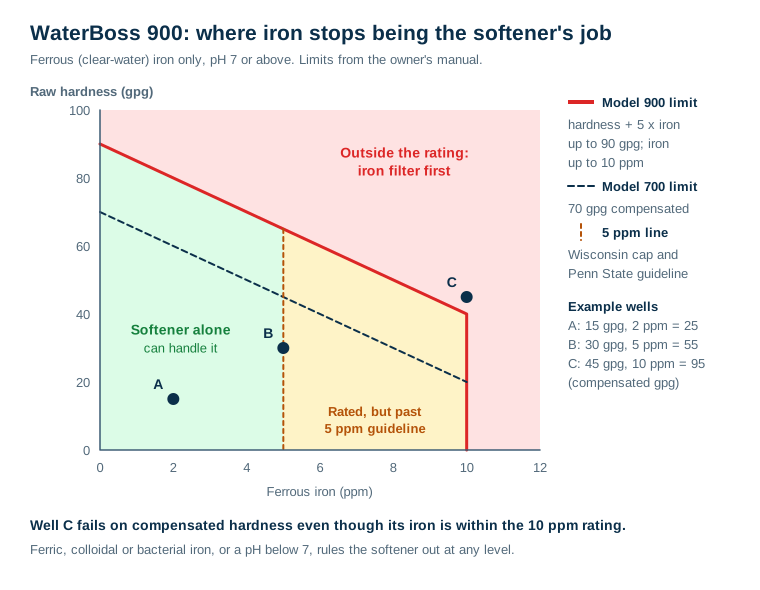
3. Hardness and iron share one limit. The 90 gpg rating is for compensated hardness: your raw hardness plus 5 gpg for every ppm of ferrous iron. At 10 ppm of iron, that leaves room for only 40 gpg of hardness. A well at 45 gpg and 10 ppm sits inside the iron rating and still fails the specification.
4. Five ppm is the realistic ceiling. The manual itself notes that Wisconsin limits iron reduction claims to 5 ppm. Penn State Extension's guide to iron and manganese recommends a softener for iron only when dissolved iron is below 5 mg/L, and only when the raw water has not met air or chlorine first. Between 5 and 10 ppm the WaterBoss is working inside its own rating but outside the independent guideline.
What heavy iron does to salt and regeneration
The iron-sizing rule turns every ppm of iron into extra hardness load, and the arithmetic is laid out in how iron changes water softener sizing. Here it is for the WaterBoss 900, a family of four using 280 gallons a day on 15 gpg water, at the 8.5 lb dose (29,842 grains):
| Ferrous iron | Compensated hardness | Grains a day | Days between regenerations | Salt a year |
|---|---|---|---|---|
| 0 ppm | 15 gpg | 4,200 | 7.1 | about 440 lb |
| 2 ppm | 25 gpg | 7,000 | 4.3 | about 730 lb |
| 5 ppm | 40 gpg | 11,200 | 2.7 | about 1,160 lb |
| 10 ppm | 65 gpg | 18,200 | 1.6 | about 1,890 lb |
Calculated from the manual's capacity table, not measured, and before reserve.
On top of this, the manual asks iron users to run the powerClean cycle every six months. It regenerates every other day with 5 lb of salt for at least two weeks, which is roughly 70 lb of extra salt a year. It also recommends a resin cleaner, or salt with an iron-cleaning additive, every six months.
The table shows the economic limit as clearly as the specification shows the technical one. At 5 ppm the softener uses about two and a half times the salt it would on hardness alone and regenerates every two to three days. That is the point where an iron filter ahead of the softener usually earns its place. The trade-off is costed in water softener vs iron filter.
The Sediment Claim, Tested

Retailers sell the 900 as reducing "dirt and sediment". The manual supports a narrower version of that. The 700 and 900 hold a layer of self-cleaning filter media that the backwash flushes during regeneration, and the installation section says the softener can treat a combination of constituents including iron, dirt and sediment. The same manual adds three limits:
- No sand. "If dirt, sand, or large particles are present in the water supply, the appropriate WaterBoss filter can eliminate this problem."
- No unusual water. If the supply contains sand, sulfur, bacteria, iron bacteria, tannins, algae, oil or acid, it says to pre-treat before the softener.
- The warranty agrees. It excludes water containing "sand, bacterial iron, algae, sulphur, tannins, organic matter, or other unusual substances" unless the specification says the unit handles them.
Some retailer listings quote a micron rating for the filter layer; the manual we read does not give one. Treat the filter layer as protection against fine dirt, not as a replacement for a sediment filter on a well that pumps sand. Where a spin-down or cartridge filter goes, and why, is covered in sediment prefilter before a softener.
Where a Separate Filter Is Still Needed
Put a filter ahead of a WaterBoss when any of these is true:
- Ferric, colloidal or bacterial iron is present, whatever the ppm.
- Ferrous iron is above 5 ppm, or hardness plus 5 × iron is above 90 gpg on the 900 or 70 on the 700.
- The pH is below 7.
- The well produces sand or coarse particles.
- The water is chlorinated, in which case the 950 or a carbon stage is the better plan.
Everything else, including a typical rural well at 15 to 25 gpg with 1 to 3 ppm of clear-water iron, is the WaterBoss 900's home ground.
Warranty and Ownership
The owner's manual we read gives three years on mechanical and electronic parts and ten years on the media tank and valve body and the brine cabinet. Media is not warranted. Labour and service calls are not covered, defective parts go back to WaterBoss prepaid, and the warranty card has to be returned within 30 days of installation. Retailer listings for the current Model 900 advertise five years on parts, so check the card in your box.
Day to day, the 900 is a 26-minute regeneration demand softener with a salt cabinet of about 160 to 170 lb, and it fits where a two-tank unit will not.
Where to Buy a WaterBoss
WaterBoss 900, 36,400 grains. Sold at Home Depot and other retailers. Its Amazon listing showed "currently unavailable" on 1 October 2026, so Home Depot is the place to buy it. The model to buy for well water with clear-water iron, up to the limits above.
WaterBoss 22,000-grain softener. The Model 700 22,000-grain unit is sold at Ace Hardware and Do it Best. We could not confirm that this Amazon listing is the current Model 700, so check the model number on the listing before buying. It suits smaller households, with a 70 gpg compensated limit.
Not included: the WaterBoss Big Boss 36 listing. It is an older item number that the Model 900 has replaced, and we could not confirm it is still sold new.
Who Should Not Buy a WaterBoss
- Wells with more than 5 ppm of iron, or any iron that has already oxidised. Filter first, or choose a dedicated iron system.
- Very hard water with iron. The compensated limit runs out fast: 60 gpg plus 6 ppm is already 90.
- Chlorinated city water, if you were looking at the 700 or 900. The 950 is WaterBoss's own city model.
- Large homes with high peak demand. One cabinet and a 1-inch connection have limits that a twin-tank system does not.
- Anyone hoping to avoid salt. With heavy iron, a WaterBoss uses more of it, not less. The alternatives are compared in salt-based vs salt-free water treatment, but salt-free systems do not remove iron either.
The WaterBoss 900 is a good compact softener for moderate well water with modest clear-water iron. Read its iron rating as a ceiling, not a target.
Frequently Asked Questions
Does the WaterBoss 900 really remove iron?
Yes, within limits. The owner's manual rates the Model 900 for up to 10 ppm of ferrous, clear-water iron, and Wisconsin limits that claim to 5 ppm. It cannot treat ferric, colloidal or bacterial iron, it needs a pH of 7 or higher, and hardness plus 5 grains per gallon for every ppm of iron must stay under 90.
Does a WaterBoss filter sediment?
It handles fine dirt, because the 900 and 700 carry a self-cleaning filter media layer that is flushed during regeneration. It is not a sand filter. The manual says that if dirt, sand or large particles are present, a separate WaterBoss filter should be used, and the warranty excludes damage from water containing sand.
What is the difference between the WaterBoss 700, 900 and 950?
The 700 and 900 are well-water softeners with iron ratings of up to 10 ppm. The 700 handles up to 70 grains of compensated hardness and the 900 up to 90. The 950 is for municipal water without iron: it adds activated carbon for chlorine and treats up to 35 grains. The manual's specification table gives the 700 and 900 a maximum chlorine figure of zero.
How long does a WaterBoss water softener last?
The tank, valve body and brine cabinet carry a 10-year warranty, which is a reasonable floor for the hardware. The resin is not warranted, and on iron water its life depends on maintenance: the manual calls for a resin cleaner and its powerClean cycle every six months. Iron left to build up fouls the resin long before the tanks wear out.
How much salt does a WaterBoss use with iron?
Much more than on hardness alone, because each ppm of iron adds 5 grains per gallon to the setting. For a family of four on 15 gpg water at the 8.5 lb dose, salt use rises from about 440 lb a year with no iron to about 1,160 lb at 5 ppm and roughly 1,890 lb at 10 ppm, before the powerClean cycles are added.
Is the WaterBoss sold on Amazon?
Not the Model 900 at the moment. Its Amazon listing showed "currently unavailable" on 1 October 2026, so buy it from Home Depot, which sells it. A 22,000-grain WaterBoss is listed on Amazon; check that the listing names the model number you want before you buy.
