
What a Water Softener Does Not Remove
What does a water softener remove? Calcium and magnesium, which is its job. It also takes smaller amounts of other positive metal ions: dissolved iron and manganese within the unit's rating, and barium and radium. Those last two are the only health contaminants a softener can be certified to reduce. Lead, PFAS, nitrate, arsenic, fluoride, bacteria, chlorine, silica and microplastics all pass through or need a different technology.
This page is the reference table. It covers 25 contaminants, what ion exchange does to each one, what does work, and the NSF/ANSI standard that certifies it. Every certification claim is checked against NSF's own listing search for drinking water treatment units, and the health guidance comes from EPA and CDC.
What Does a Water Softener Remove? The Short, Honest List
A conventional softener is a tank of cation exchange resin. The beads hold sodium (or potassium) loosely and swap it for positively charged ions that bind more strongly. That gives a short list of things it genuinely removes:
- Calcium and magnesium. Hardness is what the unit is designed, sized and certified for. NSF/ANSI 44, the standard for residential cation exchange softeners, is built around hardness reduction.
- Barium and radium 226/228. Both are positive ions, and both are optional ("elective") claims under NSF/ANSI 44. Only models tested for them can make the claim, so a softener sold for radium has to list it.
- Dissolved iron and manganese, within limits. Clear-water ferrous iron exchanges like hardness, up to the manufacturer's rating. Oxidized iron and manganese foul the resin instead. The details are in can a water softener remove iron and can a water softener remove manganese.
- Some copper. The Minnesota Department of Health notes that some softeners may fully or partly remove copper, iron, manganese and radium. "May" is the right word. No softener is certified for copper.
That is the complete list. Everything else in this article is something a softener either ignores, adds to or is damaged by.
Why Ion Exchange Stops Where It Does
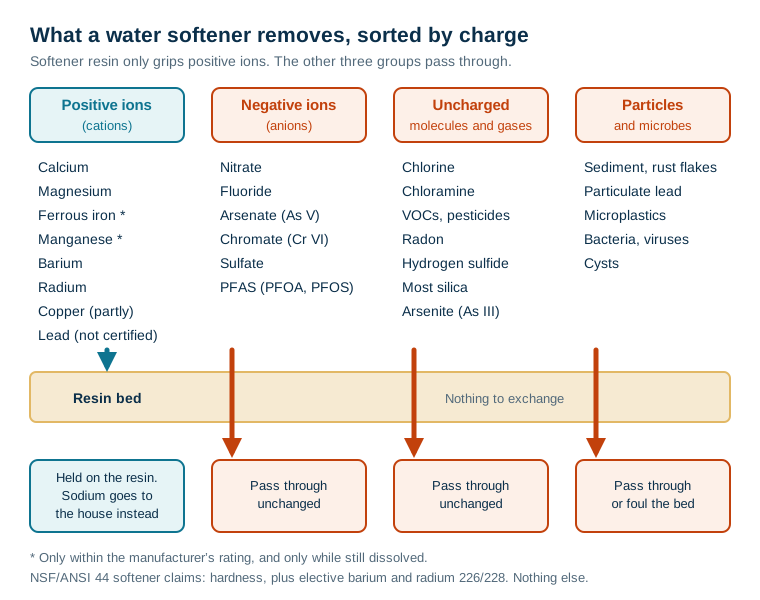
The simplest way to predict what a softener will do is to ask what form the contaminant takes in water.
- Positive ions (cations) compete for the resin. Calcium, magnesium, ferrous iron, manganese, barium and radium are all here. Dissolved lead and copper are too, which is why you will see claims that softeners "remove some lead". Being exchangeable is not the same as being certified, as the lead section below explains.
- Negative ions (anions) are ignored. Nitrate, fluoride, arsenate, chromate, sulfate and the common PFAS all pass through a cation resin untouched.
- Uncharged molecules and dissolved gases are ignored too. Chlorine, chloramine, VOCs, pesticides, radon, hydrogen sulfide, most dissolved silica and trivalent arsenic all belong here.
- Particles and living things are not ions at all. Sediment, rust flakes, particulate lead, microplastics, bacteria, viruses and cysts either pass through or lodge in the bed and foul it.
A softener also does not lower total dissolved solids by much. Each calcium ion that comes out is replaced by two sodium ions, so the mineral load changes character rather than disappearing.
The Contaminant-by-Contaminant Table
Read across a row to see what ion exchange does and what to buy instead. "Certification to look for" names the claim as it appears on NSF's listing search. A product carries a claim only if that claim appears in its own listing. The standard number alone does not tell you.
| # | Contaminant | Does a softener remove it? | Technology that does | Certification to look for |
|---|---|---|---|---|
| 1 | Calcium and magnesium (hardness) | Yes. This is its job | Cation exchange softener | NSF/ANSI 44, hardness reduction |
| 2 | Barium | Yes, if tested for it | Softener with the claim, or RO | NSF/ANSI 44 barium claim, or NSF/ANSI 58 barium |
| 3 | Radium 226/228 | Yes, if tested for it | Softener with the claim, or RO | NSF/ANSI 44 radium claim, or NSF/ANSI 58 radium 226/228 |
| 4 | Dissolved (ferrous) iron | Only within the unit's rating | Oxidizing iron filter above that | No NSF/ANSI 44 iron claim exists; use the manufacturer's rating |
| 5 | Manganese | Small dissolved amounts only | Oxidizing filter | No NSF/ANSI 44 claim; manufacturer's rating |
| 6 | Copper | Partly, at best | Carbon block or RO | NSF/ANSI 53 or 58, copper |
| 7 | Lead | No, not reliably. No softener is certified for it | Point-of-use filter or RO | NSF/ANSI 53 lead plus NSF/ANSI 42 Class I particulate (EPA's advice), or NSF/ANSI 58 lead |
| 8 | PFAS (PFOA, PFOS and others) | No | Activated carbon, PFAS-selective anion resin, RO | NSF/ANSI 53 or 58: PFOA, PFOS or "Total PFAS" |
| 9 | Nitrate and nitrite | No (negative ions) | RO; nitrate-selective anion exchange | NSF/ANSI 58, nitrate/nitrite |
| 10 | Arsenic | No | RO or arsenic adsorption media; trivalent arsenic must be oxidized first | NSF/ANSI 53 arsenic (pentavalent) up to 50 ppb; NSF/ANSI 58 up to 300 ppb |
| 11 | Fluoride | No | RO, activated alumina, distillation | NSF/ANSI 58, fluoride |
| 12 | Hexavalent chromium | No | RO | NSF/ANSI 58, chromium (hexavalent) |
| 13 | Bacteria and viruses | No (CDC) | UV disinfection, chlorination | NSF/ANSI 55 Class A |
| 14 | Cysts (Giardia, Cryptosporidium) | No | Fine filtration, RO, UV | NSF/ANSI 53 or 58, cyst reduction |
| 15 | Chlorine | No, and it damages the resin | Activated carbon | NSF/ANSI 42, chlorine reduction |
| 16 | Chloramine | No | Catalytic carbon | NSF/ANSI 42, chloramine reduction |
| 17 | VOCs, pesticides, trihalomethanes | No | Activated carbon | NSF/ANSI 53, VOC or the named chemical |
| 18 | Radon | No (a gas) | Aeration or whole-house carbon | NSF/ANSI 53, radon |
| 19 | Hydrogen sulfide (rotten egg smell) | No | Oxidation, aeration, carbon for low levels | No claim on NSF's listing search; ask for performance data |
| 20 | Silica | No | RO, partly | No household reduction claim |
| 21 | Microplastics | No | Fine filtration | NSF/ANSI 401, microplastics |
| 22 | Pharmaceuticals and other emerging compounds | No | Activated carbon | NSF/ANSI 401, the named compound |
| 23 | Sediment and turbidity | No, and it fouls the bed | Sediment prefilter | NSF/ANSI 42 nominal particulate; NSF/ANSI 53 turbidity |
| 24 | Tannins | No (standard resin) | Tannin anion resin | Manufacturer's rating |
| 25 | Sodium and total dissolved solids | No. A softener adds sodium | RO, distillation | NSF/ANSI 58 TDS reduction; NSF/ANSI 62 distillation |
Notes on the rows that trip people up:
- Rows 2 and 3. These are real, certifiable health claims, and a softener is one of the better tools for radium. The listing has to show the claim, though. A softener certified for hardness only has not been tested on either.
- Row 8. EPA's page on reducing PFAS with a home filter points to carbon, ion exchange resins and RO, and to certification under NSF/ANSI 53 or 58. The "ion exchange" there means PFAS-selective anion resin, not a softener. EPA also cautions that the certification standards "do not yet indicate that a filter will remove PFAS down to the levels EPA has now set for a drinking water standard."
- Row 10. Arsenic comes in two forms. Pentavalent arsenic is a negative ion. Trivalent arsenic is uncharged at normal pH, and most treatment only works on it after oxidation. That is why the NSF claims name the pentavalent form.
- Rows 19, 20 and 24 are covered in their own articles: sulfur smell after a softener, scale that stays when hardness reads zero (silica) and can a water softener remove tannins.
The NSF/ANSI Standards, Decoded
The standard number tells you what kind of device was tested. The claim tells you which contaminant it was tested on. Both have to match your problem.
| Standard | What it certifies | Typical device |
|---|---|---|
| NSF/ANSI 42 | Aesthetic effects: chlorine, chloramine, taste and odor, nominal particulate, zinc | Carbon and sediment filters |
| NSF/ANSI 44 | Residential cation exchange softeners regenerated with sodium or potassium chloride. Covers hardness reduction, material safety, structural integrity and capacity, with elective barium, radium 226/228 and salt-efficiency claims | Water softeners |
| NSF/ANSI 53 | Health effects: lead, cysts, VOCs, PFOA, PFOS and Total PFAS, pentavalent arsenic, radon, copper, mercury and dozens of named chemicals | Carbon block and other filters |
| NSF/ANSI 55 | Ultraviolet systems. Class A disinfects contaminated water (bacteria, viruses, cysts). Class B is supplemental treatment for water that is already disinfected | UV units |
| NSF/ANSI 58 | Reverse osmosis: TDS reduction, plus claims such as nitrate/nitrite, fluoride, lead, arsenic, barium, radium, hexavalent chromium and PFAS | Under-sink RO |
| NSF/ANSI 62 | Distillation systems | Countertop distillers |
| NSF/ANSI 177 | Shower filters, free available chlorine reduction | Shower-head filters |
| NSF/ANSI 401 | Emerging compounds and incidental contaminants, such as some pharmaceuticals and microplastics | Carbon filters |
| NSF P231 | A protocol for microbiological water purifiers | Purifier devices |
| NSF P473 | A retired PFOA/PFOS protocol. Its criteria were moved into NSF/ANSI 53 and 58 | None now. Treat a P473-only claim as out of date |
| NSF/ANSI/CAN 61 and 372 | Plumbing materials: what a component leaches, and its lead content | Pipes, valves, fittings. These are not treatment claims |
The last row causes real confusion. A softener valve marked NSF/ANSI 61 or 372 was certified as safe plumbing material. That says nothing about what the softener removes. For that, look for NSF/ANSI 44 and the specific claim. NSF is not the only certifier either. WQA, IAPMO and others certify to the same NSF/ANSI standards and keep their own listings.
Why "It Removes Some Lead" Is Not an Answer
Lead is where overclaiming does the most harm, so it needs its own section.
Dissolved lead is a positive ion, and softener resin will take up some of it. New Jersey's environmental agency, in its public guidance on lead, says softeners and RO units "will remove lead" but can also make water more corrosive to lead solder and plumbing. Both halves of that sentence matter.
What a softener cannot do:
- It cannot be certified for lead. NSF/ANSI 44 has no lead reduction claim, so no softener has been tested to show how much lead it removes, or for how long.
- It cannot catch particulate lead. Lead at the tap is often partly particulate, shed by lead service lines, solder and old brass, and particles are not ions.
- It cannot tell you when it stops. Resin releases what it holds at each regeneration, and nobody publishes breakthrough data for lead on a household softener.
EPA's consumer tool for identifying lead-reducing filters is specific. Use a point-of-use or pitcher filter certified to reduce lead to 5 ppb or less under NSF/ANSI 53, and for Class I particulate reduction under NSF/ANSI 42. If utility work is disturbing a lead line near you, how lead service line work can affect a softener covers the bypass and flushing steps. If a metallic taste is what started the question, see why softened water has a metallic taste.
Test Before You Buy Anything
Every row in the table starts with a test result. Buying treatment first and testing later is how homes end up with a softener for a nitrate problem, or a carbon filter for hard water.
On city water, start with your utility's annual Consumer Confidence Report. It lists what was detected at the plant, but not what your own plumbing adds. Lead and copper need a tap sample from your house. On a private well, nobody tests for you. Bacteria, nitrate, hardness, iron, manganese, pH and arsenic are the usual starting panel, with radon, uranium or PFAS added where your state's well program flags them.
A home strip kit is fine for hardness. For anything with a health limit, use a certified lab. Home water test kit vs certified laboratory test explains where the line falls, and how to read your water hardness report walks through the report itself.
Whole House or One Tap: Where Each Fix Belongs
The CDC separates two kinds of system. Point-of-entry treats most or all of the water entering the home. Point-of-use treats water at a single tap, usually the kitchen sink. A softener is always point-of-entry, because hardness damages every pipe and appliance. Many of the fixes in the table do not need to be.
| Problem | Where the fix usually goes | Why |
|---|---|---|
| Hardness, iron, manganese | Whole house | They scale or stain everything the water touches |
| Chlorine, chloramine taste and odor | Whole house (carbon) | Showers and laundry are affected, and chlorine harms the softener |
| Bacteria on a well | Whole house (UV or chlorination) | Every tap is a drinking and bathing tap |
| Radon from a well | Whole house | Radon escapes into indoor air from showers and laundry |
| Lead, nitrate, arsenic, fluoride, PFAS | Usually point-of-use at the kitchen tap | The main exposure is drinking and cooking water, and RO or certified filters there cost far less than whole-house versions |
A softener and a kitchen RO unit are the most common pairing for exactly this reason. The softener protects the house, and the RO handles what the softener leaves in the drinking water, including the sodium it added. How they fit together is in how reverse osmosis and a water softener work together.
What to Do Next
- Get the right test. Use a certified lab for anything with a health limit, and a strip kit only for hardness.
- Mark each result against the table. Anything outside rows 1 to 5 is not a softener job.
- Check the listing, not the box. Search the model on NSF's, WQA's or IAPMO's listing directory and confirm the exact claim appears: "Lead", "Nitrate/Nitrite", "Total PFAS", "Radium 226/228".
- Distrust any softener sold for contaminant removal beyond hardness, iron, manganese, barium and radium. Ask which standard and which claim.
So what does a water softener remove? Hardness, a handful of positive metals, and nothing else you should count on. That is not a weakness of the equipment. It is simply the one job it does, and the other jobs have their own tools.
Frequently Asked Questions
Does a water softener remove lead?
Not in any way you should rely on. Dissolved lead is a positive ion, so softener resin can take up some of it. But NSF/ANSI 44, the softener standard, has no lead reduction claim, and particulate lead passes straight through. For lead, EPA points to a point-of-use filter certified to NSF/ANSI 53 for lead and NSF/ANSI 42 for Class I particulate reduction.
Does a water softener remove PFAS or forever chemicals?
No. Softener resin is a cation resin. It holds positive ions, and the common PFAS are negatively charged or behave as organic molecules. EPA lists activated carbon, PFAS-selective ion exchange resin and reverse osmosis as the technologies that reduce PFAS, and says to look for certification to NSF/ANSI 53 or 58.
Will a water softener kill bacteria in well water?
No. The CDC states plainly that water softeners do not remove parasites, bacteria or viruses. A softener can even give bacteria a surface to grow on if the water reaching it is not safe. Disinfection needs UV certified to NSF/ANSI 55 Class A, or chlorination, and a bacteria test after installation.
Does a water softener remove chlorine from city water?
No, and chlorine damages softener resin over time. Chlorine and chloramine are removed by activated carbon or catalytic carbon, certified to NSF/ANSI 42 for chlorine or chloramine reduction. On city water, the carbon stage normally goes before the softener to protect the resin.
Does a water softener remove nitrates or fluoride?
No. Nitrate and fluoride are negative ions, and softener resin only exchanges positive ones. Both are reduced by reverse osmosis, and NSF/ANSI 58 carries separate nitrate/nitrite and fluoride claims. Check the claim is actually listed for the model before you buy.
Do I need a water filter if I already have a water softener?
Only if a test shows something the softener cannot treat. Hard water alone needs only the softener. Chlorine taste, sediment, lead, nitrate, arsenic, PFAS or bacteria each need their own technology. Test first, then match each result to the table on this page.
