
What Does a Softener Injector or Venturi Do?

The water softener injector venturi is a two-piece nozzle and throat that turns water pressure into suction. During regeneration, water is forced through a tiny nozzle. The jet speeds up and its pressure drops below the pressure in the brine line, so brine is pulled out of the salt tank and carried into the resin. It has no moving parts, which is why low pressure or a speck of debris can stop it completely.
Everything else about the injector (why it clogs, why it needs pressure, why its size matters) follows from that one principle.
The Venturi Principle, Drawn Out
Two pieces of physics do all the work.
- The same water through a smaller hole must go faster. Push a fixed flow through a narrow opening and it speeds up. A thumb over a garden hose does the same thing.
- Faster water has lower pressure. This is Bernoulli's principle. When the water speeds up, its static pressure falls. Make the jet fast enough and the pressure beside it drops below the pressure in a connected line, which is suction.
Here is how a softener injector arranges those two effects. The drawing is a simplified cutaway, not to scale.
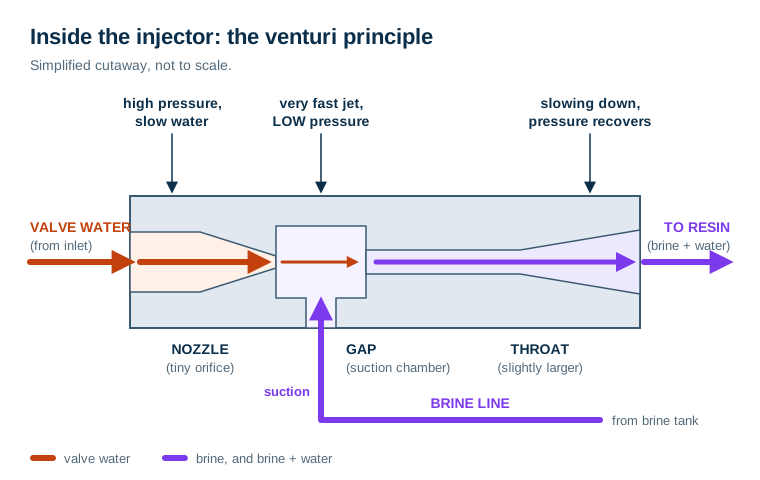
- Nozzle. A precise, small orifice. Water from the valve inlet is forced through it and leaves as a narrow, fast jet.
- Gap (suction chamber). The jet crosses a small open space. Its speed makes the pressure here the lowest in the system. The brine line opens into this space.
- Throat. A slightly larger bore that catches the jet and the brine it drags along, and mixes them. Its shape lets the stream slow down so pressure builds back up enough to push the mix through the resin and out to the drain.
Clack's WS1 and WS1.25 service manual describes its injector in almost exactly those terms: it "increases the velocity of the water, creating a zone of negative pressure that draws in the concentrated liquid regenerant," which then "blends with the stream of water, which passes through the media to regenerate the bed."
Inside the Water Softener Injector Venturi
The whole assembly is small enough to sit in your palm, and it has no springs, valves or anything else that moves.
| Part | Job | What goes wrong |
|---|---|---|
| Screen | Catches debris before it reaches the nozzle | Plugs up. Fleck's troubleshooting table lists "injector screen plugged" on its own |
| Nozzle | Creates the jet. Its hole size largely sets the flow | Scale or grit partly closes it; a pin or drill enlarges it |
| Throat | Catches and mixes jet and brine, then recovers pressure | Scale narrows it; scoring changes its behaviour |
| O-rings and cap seal | Keep the suction chamber airtight | A leak lets the injector suck air instead of brine |
On a Fleck 5600 the nozzle and throat are separate parts that screw into the injector body. On a Clack WS1 they come as one colour-coded injector that pushes into a port under a hand-tight cap, with a blank plug in the second port. Retail cabinet units usually call the same assembly a "nozzle and venturi" and house it on the side of the valve head.
Because there are no moving parts, nothing wears out mechanically. Injectors fail from what gets into them, or from what happens around them. That is good news: the fix is almost always cleaning or correcting a condition, not buying a part. The cleaning procedure, and what the debris tells you, is in how to clean a water softener injector.
What Happens After the Brine Runs Out
The injector keeps working after the brine is gone. Two things happen at the end of brine draw.
- The air check closes. A float valve at the bottom of the brine pickup drops as the brine level falls and seals the line before the injector starts pulling air. Autotrol's manual says "brine draw is completed when the air check closes." That part lives in the brine tank; see water softener brine tank internals.
- The injector becomes a slow-rinse flow control. Water still flows through the nozzle and throat, now without brine. That gentle flow pushes the brine already in the bed slowly through the resin, giving it time to work. This is why Fleck and Autotrol name the step "brine/slow rinse," and why Clack's injector charts list a slow rinse rate for each injector size.
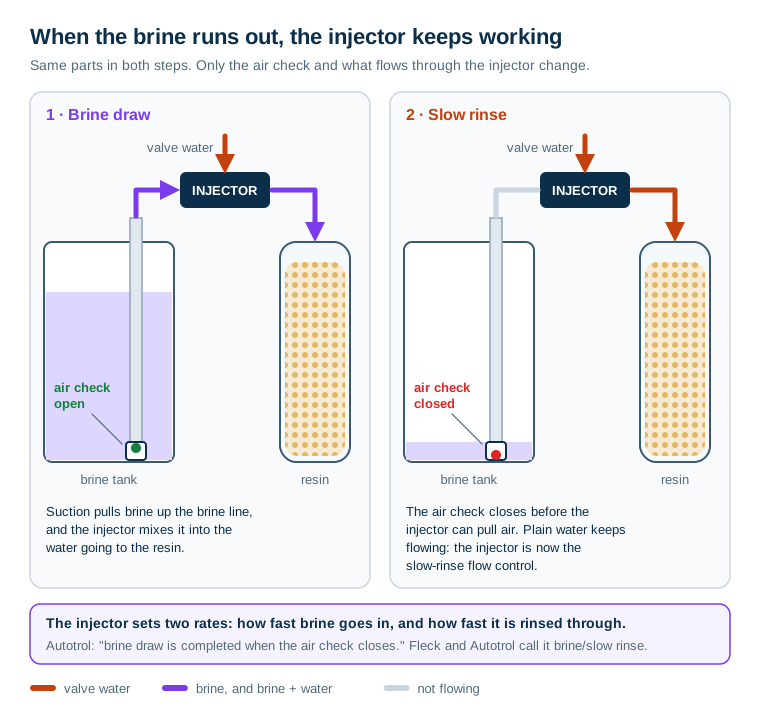
So the injector sets two rates: how fast brine goes in, and how fast it is rinsed through. Both are part of the regeneration's design. For where this step sits in the whole cycle, see how a water softener control valve works.
The 4 Things That Kill Injector Suction
The suction depends on a pressure difference that is small to begin with. Anything that shrinks it from either side can take it to zero, and then the brine does not move at all. The valve cannot tell. It runs the brine step on schedule and moves on.
| What changes | Why it kills suction | What the manuals say |
|---|---|---|
| Inlet pressure too low | A weaker push makes a slower jet, and a slower jet makes less vacuum. Below a threshold there is no draw at all | Fleck: 20 psi minimum for regeneration. Clack: pressure "must remain at minimum of 25 psi" for a valve failing to draw regenerant |
| Debris in the nozzle or throat | A partly blocked nozzle alters the jet. A blocked throat backs the flow up into the suction chamber | Clack: both parts "have small diameter holes that control the flow rates"; scoring or enlarging them "could change the operating parameters" |
| Back pressure from the drain | The throat has to push its flow out through the resin and the drain line. Resistance there pushes pressure back into the suction chamber | Clack lists drain line restriction, and a drain line "too long or too high," as causes of failing to draw |
| Air leak on the suction side | The vacuum fills with air from the leak instead of brine from the tank | Clack: "Regenerant line connection leak — Inspect regenerant line for air leak" |
The practical consequence. When a softener stops using salt and the valve is clearly cycling, the injector and its surroundings are the prime suspects, and the list above is the order to check them. The full diagnosis, starting with a salt bridge, is in why a water softener is not using salt.
Well systems deserve a special look. Pressure on a private well swings between the pressure switch's cut-in and cut-out settings, and a regeneration that happens to run near the bottom of that range gets the weakest draw. If draw is marginal on a well, check the pressure at the low point of the cycle, not only at rest. Softener placement on a well system is covered in where to install a softener on a well system.
Injector Sizing by Tank Diameter
Injectors are sized to the resin tank. A wider tank holds more resin, needs more brine, and needs a larger injector to draw it in the programmed time. Manufacturers colour-code their injectors so the size can be identified at a glance.
To find your tank diameter, wrap a tape measure around the resin tank and divide the circumference by 3.14. Common residential tanks are 8, 9, 10 and 12 inches across.
| Tank diameter | Fleck 5600 injector | Clack WS1 injector (downflow) | Autotrol 255 high-efficiency injector |
|---|---|---|---|
| 6 in | #000 brown | A, black | E, yellow |
| 7 in | #00 violet | B, brown | F, peach |
| 8 in | #0 red | C, violet | G, tan |
| 9 in | #1 white | D, red | H, light purple |
| 10 in | #1 white | E, white | J, light blue |
| 12 in | #2 blue | F, blue | K, pink |
| 13 in | #3 yellow | G, yellow | L, orange (13–14 in) |
| 14 in | #4 green | H, green | L, orange (13–14 in) |
Sources: the parts list in the Fleck 5600SXT downflow service manual (Fleck nozzle and throat are ordered separately and must match); Clack's injector order table in the WS1/WS1.25 manual, which continues to 22-inch tanks; and the injector options in the Autotrol 740/760 and 255/Performa manual.
Notice the colours do not transfer between brands. A white injector is 9–10 inch on a Fleck and 10 inch on a Clack. Red is 8 inch on a Fleck and 9 inch on a Clack. Always identify the injector by valve model and size code, never by colour alone.
Clack adds a caveat that applies to every brand: the tank sizes are typical, and "actual tank size used may vary depending on the design and application of the system." It also notes that for upflow brining, higher pressures or colder water "would need smaller injectors to avoid lifting the bed." If the injector in your valve does not match the table, the original installer may have chosen it deliberately. Check before you "correct" it.
What a wrong-size injector does
- Too small for the tank: brine draws slowly. If the brine step ends before the tank is drawn down, part of the salt stays behind, the bed is under-regenerated, and hardness comes back early. See hardness returns before regeneration.
- Too large for the tank: brine goes through quickly with less contact time, and the slow rinse is faster than designed. Clack lists an incorrect injector size among the causes of salty water after regeneration.
- Mismatched Fleck nozzle and throat: the pair no longer forms the jet-and-catch geometry they were designed for. Draw becomes unpredictable.
What the Injector Cannot Do
- It cannot make brine. It draws whatever is in the tank. Undissolved salt, a salt bridge, or a refill that never happened all mean it draws weak brine or plain water, and the valve reports a normal cycle.
- It cannot compensate for low pressure. No cleaning restores the draw on a supply that is below the valve's minimum while regeneration is running.
- It cannot report a failure. Nothing in a typical residential valve measures whether brine actually moved. The only way to know is to watch the brine level fall during a regeneration.
- It cannot protect itself. The screen stops coarse debris, but fine iron and scale still reach the nozzle. Water carrying a lot of iron or sediment will keep fouling it until that is dealt with upstream; see whether a water softener can remove iron.
The water softener injector venturi is the simplest part of the valve and the one the whole regeneration depends on. Keep its pressure up, its drain clear and its orifice clean, and don't enlarge the hole with a pin.
Frequently Asked Questions
What is the purpose of the injector in a water softener?
It pulls brine out of the salt tank and mixes it into the water flowing through the resin during regeneration. Clack's service manual describes it as increasing the velocity of the water to create a zone of negative pressure that draws in the concentrated regenerant. Without it, the valve would run every regeneration step but the resin would only ever be rinsed with plain water.
What is the difference between an injector, an eductor and a venturi?
In softeners they refer to the same part. Venturi is the physical principle, where water speeds up through a narrow passage and its pressure drops. Injector and eductor are the names manufacturers use for the nozzle-and-throat assembly that puts the principle to work. Fleck and Clack call it an injector, and some older and retail units call it a venturi or eductor.
What water pressure does a water softener injector need?
Pentair's Fleck 5600SXT manual gives a minimum of 20 psi for the valve to regenerate properly. Clack's WS1 troubleshooting table says pressure must stay at a minimum of 25 psi when diagnosing a valve that fails to draw regenerant. The pressure that matters is the pressure at the valve while water is flowing during regeneration, which on a well system can be lower than the gauge shows at rest.
Can a water softener injector be the wrong size?
Yes. Injectors are colour-coded by size and matched to tank diameter. On a Fleck 5600, for example, a #1 white injector is listed for 9 and 10 inch tanks and a #2 blue for a 12 inch tank. Too small an injector draws brine too slowly to finish in the programmed time. Clack also lists an incorrect injector size among the causes of salty water after regeneration.
Can a water softener work without an injector?
Not as a softener. The injector is the only thing that moves brine from the salt tank into the resin. Valves set up as backwash-only filters deliberately replace the injector with a blank plug, which Clack's manual describes, because a filter has no regenerant to draw. Fitting a plug where the injector belongs on a softener stops regeneration entirely.
