
Best Water Softener for Very Hard Water: 3 Picks Sized for 20+ GPG
The best water softener for very hard water is a large-capacity, metered unit that still lasts four days or more between regenerations at a moderate salt setting. For most homes at 20 to 40 grains per gallon, that means 2.5 cubic feet of resin or more. Our three picks are the AFWFilters Iron Pro 2 80k for wells and households of four, the Fleck 9100SXT twin-tank 96k above 30 gpg or for five or more people, and the SoftPro Elite 64k for smaller households on chlorinated city water. Above 20 gpg, the bigger bed is also the cheaper one to run, and the chart below shows why.
Disclosure: Hard Water Solved may earn a commission if you buy through links on this page, at no extra cost to you. It does not change which products we include or how we rank them. Read our disclaimer.
The Three Picks at a Glance
| Pick | Best for | Resin | Amazon |
|---|---|---|---|
| AFWFilters Iron Pro 2 80k (Fleck 5600SXT) | Wells with some iron, households of four, 20–30 gpg | 2.5 cu ft fine mesh, 10% crosslink | Check price on Amazon |
| AFWFilters Fleck 9100SXT twin 96k | Over 30 gpg, or five or more people | 3 cu ft per tank, two tanks | Check price on Amazon |
| SoftPro Elite 64k (upflow) | Three or four people on chlorinated city water, 20–30 gpg | 64,000-grain size, 10% crosslink | Check price on Amazon |
How We Chose These Very Hard Water Softeners
Methodology. Nothing here was physically tested. We ranked on published specifications, manufacturer product pages and warranty statements, and on cost arithmetic anyone can repeat.
- Included: salt-based ion-exchange softeners with a metered (demand-initiated) valve and at least 2 cubic feet of resin, or a twin-tank design. Each had to be listed on Amazon.
- Capacity normalised: every unit is compared at the same salt dose, 9 lb per cubic foot. At that dose, standard resin yields about 26,000 grains per cubic foot, not the 32,000 on the box. See advertised vs usable softener capacity.
- Excluded: salt-free conditioners (they leave the hardness in the water, see below), cabinet units under 2 cubic feet, timer-only valves, and the Fleck 7000SXT 80k listing, whose stock we could not confirm from any seller.
- Prices are not listed here because they change often. Use the buttons to see the current price on Amazon.
The selection rule is a single question: will the bed last at least three days between regenerations at 40 gpg for a family of four, without running at the maximum salt dose? Most 48,000-grain units fail it. All three picks pass.
Days Between Regenerations at 20, 30 and 40 GPG
The arithmetic starts with your daily hardness load. A family of four using about 75 gallons per person, the planning figure Penn State Extension uses for softener sizing, sends 300 gallons a day through the softener. At 20 gpg that is 6,000 grains a day. At 30 gpg it is 9,000, and at 40 gpg 12,000.
Divide each bed's capacity, minus a day of reserve, by that load. A twin-tank unit holds no reserve, because its standby tank takes over the moment the working tank is spent.
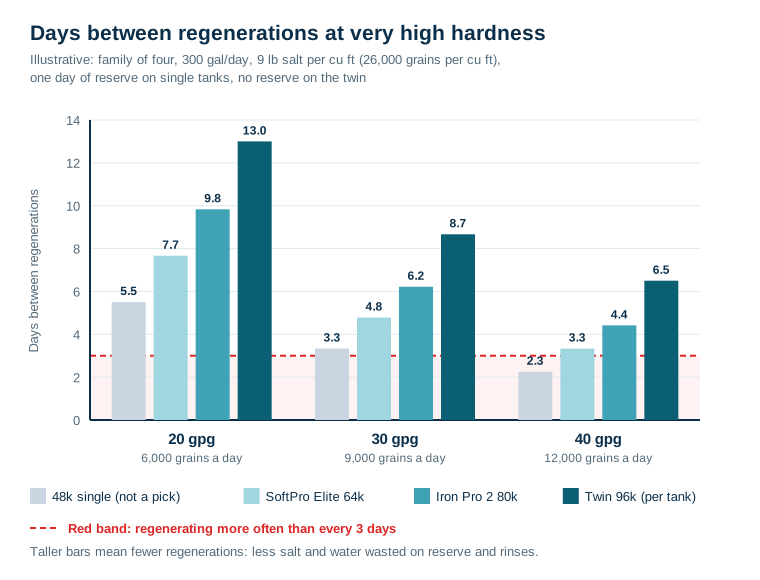
| Softener | Usable grains at 9 lb/cu ft | 20 gpg | 30 gpg | 40 gpg |
|---|---|---|---|---|
| Typical 48k single tank (1.5 cu ft), not a pick | 39,000 | 5.5 days | 3.3 days | 2.3 days |
| SoftPro Elite 64k (2.0 cu ft) | 52,000 | 7.7 days | 4.8 days | 3.3 days |
| Iron Pro 2 80k (2.5 cu ft) | 65,000 | 9.8 days | 6.2 days | 4.4 days |
| Fleck 9100SXT twin 96k (3.0 cu ft per tank) | 78,000 per tank | 13.0 days | 8.7 days | 6.5 days |
Illustrative. Family of four, 300 gallons a day, one day of reserve on single tanks. SoftPro does not publish the resin volume; 2.0 cu ft is the usual 32,000-grains-per-cubic-foot convention for a 64,000-grain rating.
The red band in the chart starts at three days. Below it, a softener spends a large share of its life regenerating. The site's guide on how to set the salt dose treats "more often than every three days or so" as the point to stop cutting salt. At 40 gpg the common 48,000-grain unit is already below that line at a middling salt dose.
What Each Size Costs to Run in Salt and Water
Salt per regeneration rises with resin volume, so a bigger bed uses more salt each time. It still uses less in a year, for two reasons. It regenerates fewer times, and a smaller share of each cycle is reserve that gets recharged before it is ever used.
| Softener | Salt a year, 20 gpg | 30 gpg | 40 gpg | Regenerations a year at 30 gpg | Regeneration water at 30 gpg |
|---|---|---|---|---|---|
| Typical 48k single tank | 896 lb / ~$157 | 1,478 lb / ~$259 | 2,190 lb / ~$383 | ~110 | ~5,500 gal |
| SoftPro Elite 64k | 857 lb / ~$150 | 1,375 lb / ~$241 | 1,971 lb / ~$345 | ~76 | ~3,800 gal |
| Iron Pro 2 80k | 835 lb / ~$146 | 1,320 lb / ~$231 | 1,859 lb / ~$325 | ~59 | ~2,900 gal |
| Fleck 9100SXT twin 96k | 758 lb / ~$133 | 1,137 lb / ~$199 | 1,516 lb / ~$265 | ~42 | ~2,100 gal |
Illustrative. 9 lb of salt per cubic foot per regeneration, salt at an example $7 per 40 lb bag (the figure used in our annual water softener salt cost calculator), and Penn State's figure of about 50 gallons of water per regeneration. Larger tanks use somewhat more water per cycle, so the real water gap is a little narrower than shown.
The bigger difference shows up when you try to save salt. Drop the dose to an efficient 6 lb per cubic foot, where standard resin gives about 21,000 grains per cubic foot. The Iron Pro 2 80k at 30 gpg then lasts about 4.8 days and uses about 1,133 lb a year, roughly $198. The 48,000-grain unit at the same setting would regenerate every 2.5 days. A small bed on very hard water is stuck at a heavy salt dose. A large one can take the efficient setting.
That is the real argument for size at extreme hardness. In the usual sizing debate, the worry is a bed so large it sits idle for weeks, which our guide on whether a softener can be too large covers. Above 20 gpg with three or more people, the daily load is heavy enough to keep even an 80,000-grain bed cycling every week or so.
The Best Water Softener for Very Hard Water, Pick by Pick
AFWFilters Iron Pro 2 80k: best for most very hard homes
- Valve: Fleck 5600SXT digital metered, on-demand regeneration
- Resin: 2.5 cu ft fine-mesh, 10% crosslink, in a tank of about 13 x 54 inches
- Flow: 11 gpm service, 16 gpm peak; needs 4.5 gpm to backwash
- Iron: rated for up to 6 ppm of ferrous (clear-water) iron
- Warranty: 5 years on the control head, 10 years on the mineral tank, per the AFWFilters product page
This is the pick for a household of four on 20 to 30 gpg, especially on a private well. Hard wells often carry a little dissolved iron as well, and fine-mesh resin holds up better to it than standard beads. The standard vs fine-mesh resin guide explains the trade. The 10% crosslink beads also tolerate chlorinated city water, so it is not a well-only unit. In the model above it stays above four days even at 40 gpg.
Watch for: the 4.5 gpm backwash requirement. A weak well pump that cannot hold that flow will under-lift a 13-inch bed. The 5600SXT is a 3/4-inch valve, so a house with several bathrooms running at once can approach the 11 gpm service figure.
Fleck 9100SXT twin 96k: best above 30 gpg or for big households
- Valve: Fleck 9100SXT digital metered, alternating twin tanks
- Resin: 3 cu ft per tank, two tanks of about 14 x 65 inches. The store rates the system at 96,000 grains, which matches one 3 cu ft tank at the 32,000-per-cubic-foot convention
- Flow: 15 gpm service, 22 gpm peak; 5.4 gpm backwash
- Operation: one tank serves while the other regenerates, so the house gets soft water around the clock
- Resin options: the AFWFilters store offers 10% crosslink, high-capacity or Purolite C100E resin. A fine-mesh Iron Pro version is also listed
At 30 to 40 gpg a single tank regenerates so often that the reserve becomes a real cost. A twin removes it. Each tank runs until it is exhausted and then hands over, so all of its capacity is used. That is why the twin wins on salt at every hardness level in the table, despite its larger tanks.
Watch for: price and space. It costs far more than the Iron Pro 2 80k and needs two tall tanks plus a brine tank. We could not find a current warranty statement for this system on the store page, so ask the seller before you buy. Below 30 gpg with four or fewer people, a single 80k tank is the better buy.
SoftPro Elite 64k: best for three or four people on city water
- Valve: SoftPro's upflow-regenerating control valve, demand-initiated
- Resin: 10% crosslink, chosen for chlorine resistance
- Warranty and return: SoftPro's product page describes a limited lifetime warranty on the control valve and a satisfaction-return period. Read the exclusions before relying on it
- Certification: SoftPro's page says the system is NSF, WQA and ANSI certified. We could not match this exact model on a public listing, so confirm it with the seller if certification matters to you
This pick suits a smaller household at the lower end of very hard. Upflow brining sends brine up through the bed from the bottom, which tends to restore more capacity per pound of salt (see upflow vs downflow regeneration). Our table does not credit it with that, because SoftPro publishes a salt-saving claim, not a capacity-at-dose figure we could check. If the claim holds, its real numbers will beat the table.
Watch for: capacity at the top of the range. At 40 gpg with four people it falls to about 3.3 days. Above 30 gpg, choose one of the larger picks.
Which Pick Fits Your Water
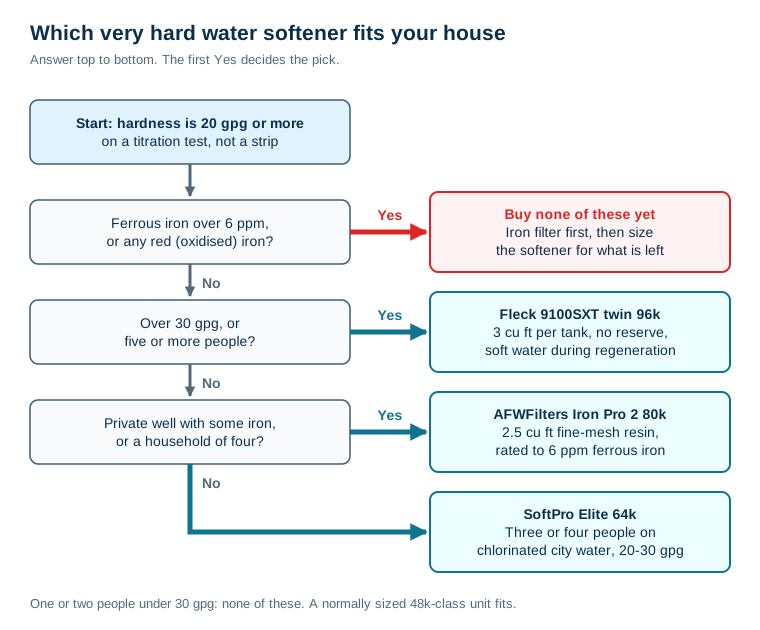
Two numbers come before any of this: an accurate hardness figure from a titration kit and an iron result. Strips report bands, and at 20 gpg and above the band is too wide to size from. If your number lands just above 10.5 gpg, the line Penn State uses for "very hard", the guide to what hardness level is too hard explains why that is a different buying problem from 30 gpg. For the full sizing method, including peak flow, use how to size a water softener.
Why Salt-Free Conditioners Are Excluded Above 20 GPG
A salt-free conditioner does not remove calcium or magnesium. It changes how they behave so they are less likely to stick inside pipes and heaters. At 25 gpg, the water leaving a conditioner is still 25 gpg.
That matters more as hardness climbs, for two reasons:
- Spotting and soap use are unchanged. The hardness is still in the water, so it still dries as white residue on glass and tile and still reacts with soap. At 30 gpg there is a lot of it.
- Manufacturers draw a line around 30 gpg. The site's comparison of salt-free conditioner hardness limits quotes Watts recommending 30 gpg as the working maximum for its OneFlow media, because of residue outside the plumbing. Some media are rated higher for scale inside the pipes, but not for what you see.
If a dealer offers a salt-free system for 35 gpg water, they are selling a fix for a problem you may not have, scale inside pipes, while leaving the one you can see. The wider comparison is in salt-based vs salt-free water treatment.
Settings That Matter More at Extreme Hardness
Buying the right size is half the job. The valve programming decides whether you see the savings in the tables.
- Enter the real hardness, plus iron. Add about 4 gpg to the hardness setting for each 1 ppm of dissolved iron, as set out in how iron changes water softener sizing. Undercounting means hard-water breakthrough before the meter calls a regeneration.
- Pick the salt dose on purpose. Factory defaults are often set high. On a large bed, 6 to 9 lb per cubic foot usually keeps the interval above four days.
- Set reserve to one day of load. At 30 gpg that is about 9,000 grains for four people, which is a much bigger slice of a 48k bed than of an 80k bed.
- Keep the day override at 7 to 14 days. Very hard water rarely triggers it, but it protects the bed during holidays.
- Use a 10% crosslink or fine-mesh resin on chlorinated water. All three picks do. Frequent regeneration and chlorine both age standard resin faster.
Who Should Buy None of These
- Iron above about 6 ppm, or any red (oxidised) iron. Fit an iron filter first. Penn State notes that oxidised iron clogs resin. Our water softener vs iron filter guide covers the order.
- One or two people under about 30 gpg. An 80k bed will sit for two weeks or more between regenerations. A normally sized 48,000-grain unit fits better.
- Hardness under 20 gpg. These are oversized for moderate water. Size from your own load instead.
- Renters, or homes with no drain near the main line. A large two-tank softener needs a drain, an outlet and permission.
- Anyone who will not program the valve. A big bed left on a heavy factory salt setting loses most of its running-cost advantage.
At 20 gpg and above, the cheapest softener to run is rarely the cheapest to buy. Choose the resin volume from your hardness and household size, then set the salt dose deliberately.
Frequently Asked Questions
What size water softener do I need for very hard water?
Work it out from your daily hardness load, not from a chart. Multiply people by about 75 gallons a day, then by your hardness in grains per gallon. A family of four on 30 gpg water puts about 9,000 grains a day through the softener. Aim for a bed that lasts at least four to five days at a moderate salt setting with a day of reserve held back. For that household it means at least 2.5 cubic feet of resin, sold as an 80,000-grain unit.
Is a 48,000-grain softener big enough for 30 gpg water?
Not for a family of four. At 9 lb of salt per cubic foot, a 48,000-grain unit holds about 39,000 grains. Hold back a day's reserve of 9,000 grains and it lasts about 3.3 days, so it regenerates roughly 110 times a year. It will keep the water soft, but it burns more salt and regeneration water than a larger bed. It also cannot drop to an efficient salt setting without regenerating every two to three days.
Can a salt-free conditioner handle very hard water?
Salt-free conditioners do not remove hardness, so the water is just as hard after them, only less likely to form scale inside pipes. Several media makers recommend about 30 gpg as a working maximum, because above it the white residue on glass and fixtures gets noticeably worse. At 20 to 40 gpg, a conditioner leaves you with exactly the spotting and soap problems you are trying to fix.
How much salt does a softener use on very hard water?
Far more than on moderate water, because salt use rises in step with hardness. For a family of four at 9 lb of salt per cubic foot, expect roughly 760 to 900 lb a year at 20 gpg, 1,140 to 1,480 lb at 30 gpg and 1,520 to 2,190 lb at 40 gpg. The low end is a large twin-tank unit and the high end a 48,000-grain single tank. At about $7 per 40 lb bag that is roughly $130 to $380 a year.
Is a twin-tank softener worth it for very hard water?
It is worth it when hardness is above about 30 gpg or the household has five or more people. A twin holds back no reserve, because the standby tank takes over the moment the first is exhausted. So it uses all of its capacity and regenerates least often. It also never sends hard water into the house during regeneration, which matters more when regenerations come every few days.
