
SpringWell FutureSoft vs Nuvo H2O: TAC Media vs Citric Acid, and What Each Needs Over 10 Years
SpringWell FutureSoft vs Nuvo H2O is a choice between two opposite ways of keeping hardness from turning into scale. FutureSoft passes water over TAC media that turns some calcium into microscopic crystals and adds nothing to the water. NuvoH2O releases citric acid from a cartridge, which binds calcium as calcium citrate and lowers pH. Neither softens: a hardness test reads the same before and after both. FutureSoft accepts harder water (81 gpg against 25 gpg) and usually costs less to run. Over 10 years a family of four replaces about 20 NuvoH2O Manor cartridges, against about 20 sediment filters and one media change for FutureSoft, whose media price SpringWell does not publish. NuvoH2O is cheaper to buy and has published scale data on water heaters, but it depends on a cartridge every six months and on starting pH.
Disclosure: Hard Water Solved may earn a commission if you buy through links on this page, at no extra cost to you. It does not change which products we include or how we rank them. Read our disclaimer.
How this comparison was built. Neither system was physically tested. Specs and limits come from SpringWell's FutureSoft product page and installation guide, and from NuvoH2O's Manor product page and its Manor cartridge page. The 10-year replacement count uses each brand's published cartridge and media ratings and the assumptions listed beside it.
- Compared: the SpringWell FutureSoft FS1 (1 to 3 bathrooms) and the NuvoH2O Manor (homes over 1,500 sq ft), the two models a typical family would choose.
- Not compared: combo systems with carbon or iron stages, which change the cost and the job.
- Prices are not listed here because they change often. Use the buttons to see the current price on Amazon.
SpringWell FutureSoft vs Nuvo H2O at a Glance
| SpringWell FutureSoft FS1 | NuvoH2O Manor | |
|---|---|---|
| Mechanism | Template-assisted crystallization (TAC) media, upflow | Citric acid released from a CitraCharge cartridge |
| What is added to the water | Nothing | Citric acid; pH moves toward neutral |
| Hardness limit | 81 gpg | 25 gpg |
| pH range | 7.0 to 9.5 | 7.3 to 8.5 |
| Iron, manganese, hydrogen sulfide | 0 ppm listed | "Exclusively for scale"; treat separately |
| Rated flow | 12 gpm (FS4 15, FS+ 20) | Not stated on the product page |
| Consumable | Sediment pre-filter cartridge; media "5+ year lifespan" | Cartridge, about 6 months or 50,000 gallons |
| Purchase price | Higher | Lower |
| Replacement cartridges | Sediment filters, 10 in or 20 in | Manor cartridge; cheaper on autoship |
| Warranty | Lifetime against defects; wear and out-of-spec water excluded | 5-year limited; 90-day money-back guarantee |
| Amazon | "Currently unavailable" on 1 Oct: Check price on Amazon | Listed: Check price on Amazon |
FutureSoft limits from SpringWell's product page and specification table. NuvoH2O figures from its Manor product and cartridge pages. SpringWell's product page does not say which size of sediment filter the FutureSoft pre-filter takes.
How Each One Controls Scale
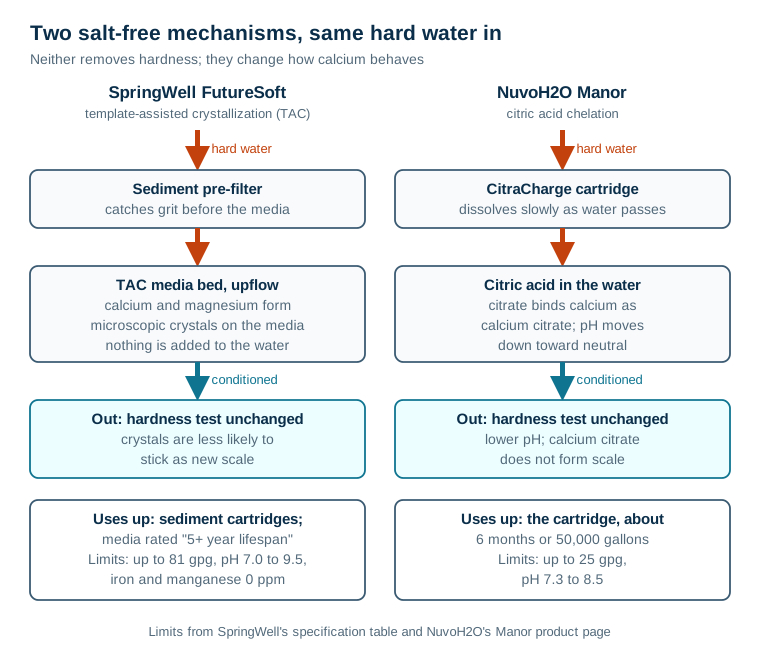
FutureSoft (TAC). Water passes a sediment pre-filter, then flows up through a bed of TAC media. The media's surface acts as a template on which dissolved calcium and magnesium form microscopic crystals. These ride through the plumbing and are less likely to stick to pipes and heating elements as new scale. Nothing is dosed, and the media is not used up in the way a cartridge is. SpringWell rates it for "5+ year" life. The general mechanism is explained in how a salt-free water conditioner works.
NuvoH2O (citric acid chelation). The CitraCharge cartridge slowly releases citric acid. NuvoH2O says the citrate binds calcium and magnesium, turning calcium carbonate into calcium citrate, which does not form scale. The acid also lowers the water's pH toward neutral, which reduces its tendency to scale. The cartridge dissolves as it works, which is why it is replaced about every six months.
Three practical consequences follow from the difference:
- Only NuvoH2O changes water chemistry. That matters for pH-sensitive plumbing. NuvoH2O does not recommend its systems below pH 7.3, and copper dissolves more readily as pH falls. In a copper-plumbed house with water near that line, FutureSoft is the safer choice. How a lower pH affects copper and fixtures is covered in does a water softener change pH.
- Only FutureSoft is media-limited by contaminants. TAC media fouls on iron, manganese, copper, oil and sulfur, which is why SpringWell lists all five at 0 ppm. The reasons are set out in hardness limits for salt-free conditioners.
- Neither shows up on a hardness test. You judge both by what happens on kettles, glass shower screens and water heater elements, not by a strip.
The Evidence Behind Each Claim
Both makers make strong claims. Neither has published an independent test of its own product:
| FutureSoft | NuvoH2O | |
|---|---|---|
| Maker's claim | "Prevents up to 95% of scale buildup" | Calcium citrate "does not form scale" |
| Test behind it | None published: no protocol, lab or report named | NuvoH2O-funded study, run in 2011 and 2012 "in conjunction with, but not endorsed by" Battelle |
| What the test found | Not applicable | Five treated tankless heaters averaged 0.87 g of scale against 45.6 g for five untreated, on about 15 gpg water |
| Independent evidence for the technology | WateReuse project 08-06: TAC media in general cut scale by more than 88% under the DVGW W 512 heated test | None found for citric acid systems |
| Certification | None named for scale control | States compliance with NSF/ANSI 42 (aesthetic effects and material safety), not a scale standard |
The honest reading: the technology behind FutureSoft has the stronger independent evidence, but the product does not. NuvoH2O has product-specific data, but on one appliance type, one water and a protocol it approved and paid for. How to weigh percentages like these is covered in evaluating salt-free and maintenance-free claims.
The Water Each One Can Handle
This is usually what decides the choice, before cost:
| Your water test shows | FutureSoft | NuvoH2O |
|---|---|---|
| Hardness up to 25 gpg | Within limits | Within limits |
| Hardness 25 to 81 gpg | Within limits; expect visible spotting | Outside the published limit |
| Hardness above 81 gpg | Outside the limit | Outside the limit |
| pH 7.0 to 7.3 | Within limits | Not recommended |
| pH above 8.5 | Within limits to 9.5 | Outside the stated range |
| Any measurable iron or manganese | Pretreat first (0 ppm listed) | Treat separately; NuvoH2O is "exclusively for scale" |
| Hydrogen sulfide (rotten-egg smell) | Pretreat first (0 ppm listed) | Treat separately |
| Free chlorine | Up to 3 ppm | No limit stated on the product page |
| Private well | Speak to SpringWell first, per its installation guide | Check pH first; many wells are below 7.3 |
Two conclusions stand out. On moderately hard city water between pH 7.3 and 8.5, both fit, and the choice comes down to cost and pH sensitivity. Outside that window, the published limits usually rule one of them out. Test before you buy. The wider choice between conditioning and softening, including when neither is enough, is covered in salt-based vs salt-free water treatment.
What Each Needs Replaced Over 10 Years
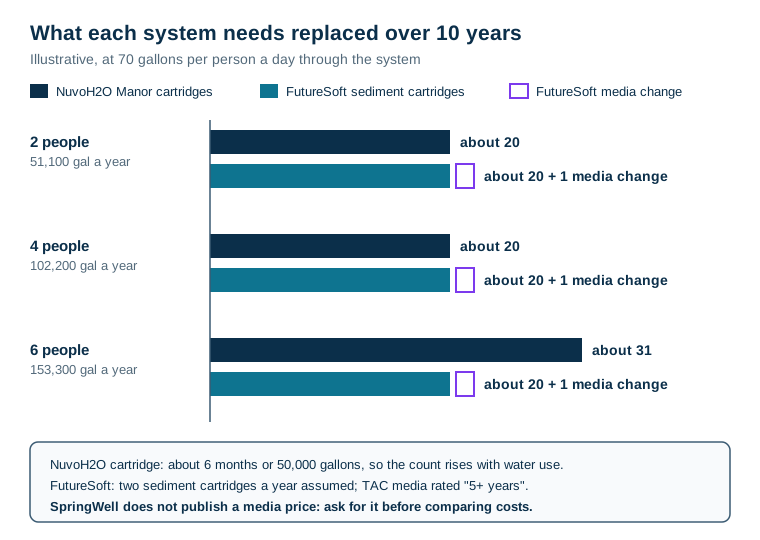
Assumptions, all illustrative. Price each line at current prices before you decide:
- Household water through the system: 70 gallons per person a day, so about 102,200 gallons a year for four people. Outdoor taps are plumbed before the system.
- NuvoH2O Manor: cartridges run out at about 6 months or 50,000 gallons, whichever comes first, so a year needs the larger of 2, or gallons ÷ 50,000.
- FutureSoft FS1: two sediment cartridges a year, 10-inch or 20-inch, plus the TAC media replacement at "5+ years".
- Not included: the purchase price of each system and installation, which is similar for both.
| Over 10 years | 2 people | 4 people | 6 people |
|---|---|---|---|
| Gallons a year | about 51,100 | about 102,200 | about 153,300 |
| NuvoH2O cartridges a year | 2.0 | 2.0 | 3.1 |
| NuvoH2O Manor cartridges, 10 years | about 20 | about 20 | about 31 |
| FutureSoft sediment cartridges, 10 years | about 20 | about 20 | about 20 |
| FutureSoft media changes, 10 years | 1 (rated "5+ years") | 1 (rated "5+ years") | 1 (rated "5+ years") |
Six people may need the larger FutureSoft FS4 for flow, which costs more to buy. NuvoH2O cartridge counts follow the Manor's 6-month or 50,000-gallon rating.
Three things come out of the count:
- NuvoH2O is cheaper to buy, FutureSoft to keep. NuvoH2O's purchase price is lower, but each Manor cartridge is a dissolving citric acid charge that costs more than a FutureSoft sediment filter, so the longer you keep the system, the more the comparison tilts toward FutureSoft.
- The unknown is FutureSoft's media. Its one media change in ten years is the only FutureSoft cost SpringWell does not publish. Ask SpringWell for the media price before you buy, then compare 20 Manor cartridges against 20 sediment cartridges plus that media change, because that number settles the comparison.
- Big households tilt the answer. At six people the Manor runs through its 50,000-gallon rating before six months are up and needs about three cartridges a year, about 31 over ten years. FutureSoft's sediment filter count stays the same.
If you choose NuvoH2O, the autoship price matters: buying cartridges one at a time instead of on autoship raises a family of four's yearly cartridge bill. Routine tasks and costs for both types of system are listed in salt-free water conditioner maintenance.
Installation and Day-to-Day Differences
- Setup. FutureSoft's media must soak for at least 48 hours before installation and be flushed in both directions before service. For NuvoH2O, the job is mainly fitting the housing in the line and loading the cartridge.
- Space. The FS1 tank is 6 x 35 inches (39 inches with the head), plus a separate pre-filter housing. The Manor is a cartridge housing with 1-inch ports.
- Power and drain. Neither needs electricity or a drain line, which is a large part of why people choose salt-free systems.
- Returns. NuvoH2O offers a 90-day money-back guarantee, with a 20 percent restocking fee on systems installed by its partner. SpringWell's 6-month window applies to uninstalled products, less a 10 percent restocking fee and shipping both ways.
- Checking it works. Inspect a kettle or a glass shower screen after a few months, and the water heater at its yearly service. Neither system will remove scale already there, a point covered in can a salt-free conditioner remove existing scale.
SpringWell FutureSoft or Nuvo H2O: Which to Buy
- Buy FutureSoft if your hardness is above 25 gpg, your pH is between 7.0 and 7.3, your plumbing is copper, or you plan to keep the system ten years or more. It costs more upfront and less to own, as long as the media change is priced sensibly.
- Buy NuvoH2O if your water is moderately hard city water between pH 7.3 and 8.5, you want the lower purchase price, or you value its manufacturer-funded water heater data. Put the cartridges on autoship and budget for at least two a year, more above 100,000 gallons.
- Buy neither until you have a full water test if you are on a well.
Who Should Buy Neither
- Anyone who needs soft water. Soap lather, laundry, spot-free glass and appliance warranties with a hardness limit all need hardness removed. Both systems leave it in.
- Wells with iron, manganese or sulfur and no plan for pre-treatment. FutureSoft lists them at 0 ppm; NuvoH2O says it is for scale only.
- Very hard water. Above 25 gpg NuvoH2O is out of range. Near FutureSoft's 81 gpg limit, spotting will be obvious. A salt-based softener does this job better.
- Acidic water below pH 7.0. It needs neutralising first, whichever system follows. The other mismatches are set out in when a salt-free conditioner is the wrong choice.
The SpringWell FutureSoft vs Nuvo H2O decision usually comes down to water chemistry first and cost second. Check hardness and pH, then ask SpringWell what its media change costs. If that price is reasonable, FutureSoft is the cheaper system to own. If your water sits comfortably between pH 7.3 and 8.5, NuvoH2O is the cheaper one to buy.
Frequently Asked Questions
What is the difference between SpringWell FutureSoft and Nuvo H2O?
The mechanism. FutureSoft uses template-assisted crystallization (TAC) media that turns some hardness into microscopic crystals and adds nothing to the water. NuvoH2O uses a cartridge that releases citric acid, which binds calcium as calcium citrate and lowers pH toward neutral. Neither removes hardness, so a hardness test reads about the same before and after either system.
Which is cheaper to run, FutureSoft or Nuvo H2O?
Usually FutureSoft, but check current prices. Its media is rated for 5+ years and its routine consumable is the sediment pre-filter cartridge. NuvoH2O Manor cartridges last about 6 months or 50,000 gallons, so a household buys at least two a year: about 20 over 10 years for a family of four, and about 31 for six people. FutureSoft needs about 20 sediment cartridges over the same 10 years plus a media change, whose price SpringWell does not publish.
Which handles harder water, FutureSoft or Nuvo H2O?
FutureSoft, on paper. SpringWell lists 81 grains per gallon as the maximum hardness for all FutureSoft sizes, while NuvoH2O lists 25 gpg for its whole-home systems. Both are maximums, not comfortable operating points. On very hard water, spotting is more visible with either, and a salt-based softener is usually the better tool.
Can I use FutureSoft or Nuvo H2O on well water?
Only with pre-treatment for most wells. SpringWell lists iron, manganese, copper, oil and hydrogen sulfide at 0 ppm for FutureSoft, and its installation guide says not to install on well water without speaking to customer service first. NuvoH2O says its systems are exclusively for scale and recommends them only above pH 7.3, which rules out many wells. Test the well fully before choosing either.
Does Nuvo H2O lower pH more than FutureSoft?
Yes. Lowering pH is part of how NuvoH2O works, because it adds citric acid, and NuvoH2O does not recommend it below pH 7.3. FutureSoft adds nothing, so it is not designed to change pH, and SpringWell rates its media from pH 7.0 to 9.5. In a copper-plumbed house with water near pH 7.3, that difference matters.
Is either system proven to stop scale?
Partly. Independent testing of TAC media in general, a WateReuse study using the DVGW W 512 heated test, measured more than 88% scale reduction; SpringWell publishes no test of FutureSoft itself behind its 95% claim. NuvoH2O's evidence is a study it funded, carried out in conjunction with but not endorsed by Battelle, which found far less scale on treated tankless water heaters at 15 gpg.
