
Fleck vs Clack: Inside the Two Valves Behind Most DIY Softeners

In the Fleck vs Clack choice, the Clack WS1 is the better-engineered valve and the Fleck 5600SXT is the easier one to get serviced. The WS1 passes 27 gpm at a 15 psi drop against the 5600SXT's 20 gpm, backwashes at up to 27 gpm against 7, and comes apart by hand. The 5600SXT has the larger installed base, cheaper heads and parts on almost every supplier's shelf. Inside, they wear differently. The Fleck's piston runs through five loose seals and four spacers. The Clack's runs through one moulded stack. Both can be rebuilt with an inexpensive parts kit, and that is the real reason either beats a proprietary valve.
Disclosure: Hard Water Solved may earn a commission if you buy through links on this page, at no extra cost to you. It does not change which products we include or how we rank them. Read our disclaimer.
How this comparison was put together. Nothing here was physically tested. Valve specifications come from Pentair's Fleck 5600SXT downflow service manual and specification sheet, and Clack's WS1 and WS1.25 drawings and service manual (form V3115-99). Repair steps are paraphrased from those manuals. Parts were checked at the AFWFilters store, which stocks both families. Prices are not listed here because they change often. Use the buttons to see the current price on Amazon.
Fleck vs Clack at a Glance
| Fleck 5600SXT | Clack WS1 | |
|---|---|---|
| Maker | Pentair (Fleck brand) | Clack Corporation, Windsor, Wisconsin |
| Service flow, valve, 15 psi drop | 20 gpm | 27 gpm (includes bypass and meter) |
| Peak flow, 25 psi drop | 26 gpm | Not stated separately |
| Maximum backwash | 7 gpm | 27 gpm at 25 psi |
| Cv (flow at 1 psi drop) | 5.0 | 7.0 |
| Plumbing connections | 3/4 to 1-1/4 in | 0.75 to 1.5 in |
| Softener tank range | 6 to 12 in | Injector chart runs well past 12 in |
| Regeneration | Downflow or upflow | Downflow or upflow |
| Piston position sensing | Drive motor and switches | Optical pulse counting, no switches or cams |
| Settings after a power cut | Stored in memory; super capacitor keeps the clock | Nonvolatile EEPROM; reset the clock only |
| Meter | 3/4 in turbine, 0.25 to 15 gpm, ±5% | Optional meter assembly (V3003) |
| Working pressure | 20 to 125 psi | 20 to 125 psi |
| Temperature | 34 to 110°F | 40 to 110°F |
| Bare head | The cheaper of the two | Sold by parts specialists |
Pentair's sheet says the 5600SXT valve is tested and certified by the WQA to NSF/ANSI 44 and to NSF/ANSI 372 for lead-free compliance. That covers the valve as tested, not any particular seller's finished softener, so a system built on either valve still needs its own listing if certification matters to you.
Inside the Valve: Seal and Spacer Stack vs One-Piece Stack
Both valves are piston valves. A piston slides inside a bore, and its position decides where the water goes: service, backwash, brine draw, rinse or refill. The difference is what the piston slides through, and that decides how each valve wears and how you fix it. The positions themselves are explained in how a water softener control valve works.
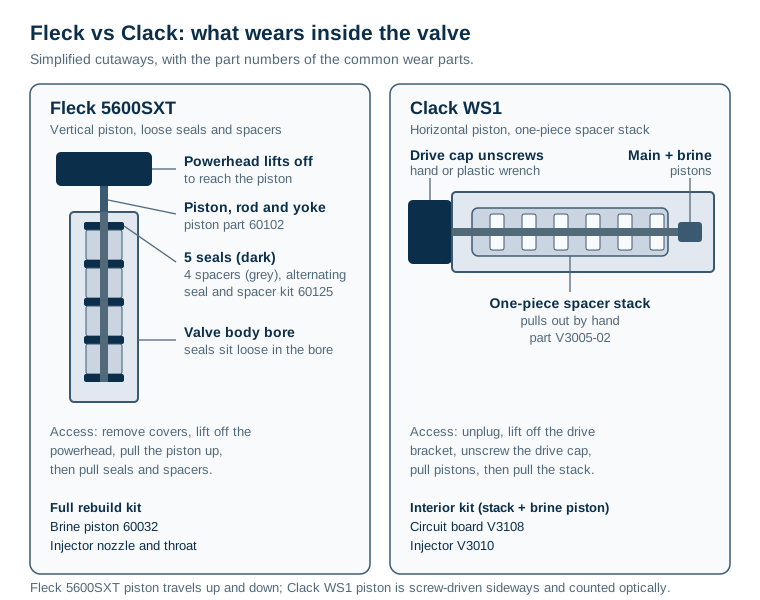
Fleck 5600SXT. The piston moves up and down, driven by a yoke from the powerhead's main gear. It runs through an alternating stack of five seals and four spacers, sold together as kit 60125. The seals are loose parts that sit in the bore. When one wears, water slips past it into the wrong port, which shows up as a drain that runs or hard water in service. The manual lists the drive motor and switches among the culprits when the valve will not find its position.
Clack WS1. The piston moves sideways, screw-driven from a drive cap that threads into the front of the valve. A small regenerant (brine) piston clips onto the back of the main piston. Both run through a one-piece spacer stack (V3005-02), sealed to the bore with EPDM o-rings and to the piston with one-way silicone lip seals. Clack's manual says the stack is designed to be "removed using your fingers". Position is found by counting light pulses from a reflective drive gear, with no switches or cams to wear.
What this means in practice:
- Wear shows up in the same places. On both valves, worn seals cause leaks to drain, hard water bleeding through, and high salt use. Both manuals name the seals, spacers and piston first for those faults.
- Clack swaps one part, Fleck swaps nine. A Clack rebuild replaces the stack as a unit. A Fleck rebuild means pulling and refitting each seal and spacer in order, which is easy but fiddly.
- Fleck has more electromechanical parts to fail. Switches can wear on the Fleck. The Clack has fewer moving electrical parts, but its circuit board and optical sensor are more specialised.
Which Parts Fail
Both manuals' troubleshooting tables point at the same small group of parts. Here is what each one is called, and what fails when it wears.
| Part | Fleck 5600SXT | Clack WS1 | Symptom when it fails |
|---|---|---|---|
| Seals and spacers | Kit 60125 | Spacer stack V3005-02 | Water running to drain; hard water in service; high salt use |
| Main piston | 60102 series | Sold in interior kits | Leak to drain, motor stalling, error codes |
| Brine (regenerant) piston | 60032 | Included in the interior kit | Will not draw brine; too much water in the brine tank |
| Interior or rebuild kit | Rebuild kit for 5600SXT softener | Interior kit (seal pack and brine piston) | All of the above |
| Injector | Nozzle and throat set | V3010 injector | No brine draw; salt level never drops |
| Drive motor | 24 V timer motor | Drive motor | Valve will not move between positions |
| Controller | Front panel with circuit board | Five-button circuit board V3108 | Blank display, lost programme, will not respond |
| Complete head | Metered softener head | Complete WS1 head | Only for a cracked body or failed drive |
Part names from the service manuals and the AFWFilters store, which stocks both families; Clack heads come from parts specialists. Prices are not listed because they change often. Most of these are small, inexpensive parts, so we don't link them as picks.
Two patterns stand out. The Clack's interior kit costs less than the Fleck's rebuild kit, because it is fewer parts. The Fleck's complete head is cheaper than the Clack's, so a badly damaged Fleck is cheaper to replace outright. A plugged injector is the cheapest fault on either. Before ordering anything for a softener that will not draw brine, clean it using how to clean a water softener injector.
The Repairs a Homeowner Can Do on Each
Both rebuilds start the same way: put the softener in bypass, unplug it, and relieve the pressure by running a softened tap or starting a manual backwash. The full preparation is in servicing a water softener control valve. After that, the two diverge.
Fleck 5600SXT: replacing the piston, seals and spacers
From Pentair's service manual:
- Remove the back and front covers, and disconnect the meter signal wire from the front cover.
- Remove the screw and washer at the drive yoke, then the timer mounting screws. The powerhead lifts off.
- Remove the end plug retainer plate.
- Pull up on the piston yoke until the piston assembly comes out.
- Pull out the seals and spacers, and fit the new ones from the kit in the same alternating order.
- Push the new or cleaned piston back in by its end plug, and twist the yoke clockwise to line it up with the drive gear.
- Refit the retainer plate, then the powerhead, making sure the drive pin on the main gear engages the slot in the yoke.
- Refit the screws and covers, return the bypass to service, set the time of day, and cycle the valve manually to check each position.
Use silicone lubricant on o-rings only. The job needs a screwdriver and patience with the seal order.
Clack WS1: replacing the stack and pistons
From Clack's service manual:
- Remove the valve cover, then unplug the power and meter leads and lift the drive bracket off the back plate.
- Unscrew the drive cap assembly anticlockwise. A flat screwdriver or Clack's plastic service wrench starts it; it then unscrews by hand.
- Pull the drive cap straight out. The main piston and the brine piston come with it.
- Unsnap the brine piston, then the main piston. Clean them in dilute sodium bisulfite or vinegar, or replace them.
- Pull the spacer stack out by hand and fit the new one.
- Reassemble in reverse. Caps and nuts seal on o-rings and need only firm hand tightening.
- Plug the power back in and hold NEXT and REGEN for 3 seconds. This resets the electronics and finds the service position.
The manual allows only silicone-based lubricant and warns against tools on the connection nuts.
The step people skip. Both manuals end the job with a check cycle. On the Fleck, step the valve manually through each position. On the Clack, the resync is mandatory after any work on the drive or pistons. If the valve then leaks at the head rather than to drain, the cause is an o-ring, covered in why a softener leaks at the control head.
Programming and Diagnostics
Fleck 5600SXT. Everything is set from a three-button keypad: regeneration mode (meter immediate, meter delayed, time clock, day of week), capacity, hardness, reserve as gallons or a 0 to 50% safety factor, day override, regeneration time and each cycle length. It is simple, documented in every dealer's manual, and the settings most often needing change, capacity and hardness, are easy to reach.
Clack WS1. Five buttons and four menus, each opened by holding two buttons for three seconds: user screens, installer settings (hardness, day override, regeneration time), system setup (cycle times, salt fill and grains capacity) and diagnostics. Diagnostics is the WS1's standout. It shows days and gallons since the last regeneration, reserve used for each of the last seven days, and up to 63 days of usage history. That makes a running toilet easy to spot.
On both valves the critical setting is the same: the capacity must match the salt dose. A 1.5 cubic foot bed programmed at its 48,000-grain box rating with an efficient salt fill will run out before it regenerates. The method is in how to set softener capacity and reserve.
Flow: Where the Gap Actually Matters
The WS1's 27 gpm against the 5600SXT's 20 gpm is a real difference at the valve. In a typical home it rarely reaches the tap. Distributor listings for packaged 1.5 cubic foot systems in a 10 x 54 inch tank quote about 13 gpm with either valve on top, because the resin bed is the restriction.
The gap matters in two cases:
- Larger tanks. Pentair rates the 5600SXT for softener tanks of 6 to 12 inches. Its 7 gpm backwash limits it there. The WS1's 27 gpm backwash lets it serve wider tanks and backwashing filter media without changing valve family.
- High peak demand. At 15 gpm, the 5600SXT valve alone loses about 9 psi from its Cv of 5.0, against about 4.6 psi for the WS1 at a Cv of 7.0. That is the moment the valve, not the bed, starts to matter. Pressure loss through a whole softener is explained in water softener pressure drop.
Why Either Beats a Proprietary Valve
Several online and big-box softeners use valves made for one brand only, with parts sold only by that brand. That works while the brand is in business and keeps stocking parts. The Fleck and Clack families are different in three ways:
- Open parts supply. Seals, pistons, injectors and boards for both are sold by many independent suppliers.
- Published manuals. Pentair and Clack publish full service manuals with exploded drawings, part numbers and troubleshooting tables. Most single-brand valves do not.
- Any technician can work on them. A water treatment technician who has never seen your softener has almost certainly seen its valve.
A Pelican or SpringWell head, a Whirlpool rotor valve or an Aquasure head is not worse for being proprietary. It is a dependency on one company. Choosing Fleck or Clack removes it. For the wider decision about whether to soften at all, start with salt-based vs salt-free water treatment.
Warranties: Who Actually Covers the Valve
Neither valve maker gives you a warranty directly.
- Clack warrants its valves to the system builder (the OEM) for five years from shipment from its plant. What reaches you is whatever the seller writes.
- Fleck valves are likewise covered by the seller. AFWFilters' standard terms on its 5600SXT systems are 5 years on the valve and 10 on the tank.
So compare the seller's written warranty, not the valve brand. Our checklist for that is in how to read a water softener warranty.
What You Can Buy on Amazon
| Product | Amazon, 2 Oct 2026 | Amazon |
|---|---|---|
| AFWFilters Fleck 5600SXT 48,000-grain system | Listing active | Check price on Amazon |
| DuraWater Fleck 5600SXT 48,000-grain system | Listing active | Check price on Amazon |
| Fleck 5600SXT metered softener head | Listing active | Check price on Amazon |
| Clack WS1 48,000-grain softener | Currently unavailable | Dropped |
AFWFilters Fleck 5600SXT 48k. 1.5 cubic feet of resin in a 10 x 54 inch Pentair tank, a bypass with a 1-inch yoke, and AFWFilters' 5-year valve and 10-year tank terms. AFWFilters also sells a 10% crosslink version for chlorinated water.
DuraWater Fleck 5600SXT 48k. 1.5 cubic feet of resin preloaded, a 1-inch bypass and a 14 x 36 inch brine tank with a safety float. The listing gives a 5-year valve warranty.
Fleck 5600SXT head alone. For replacing a failed head on a sound tank. You need a bypass or yoke, and the injector and drain flow control must match your tank diameter.
Why no Clack pick. The only complete Clack WS1 system listed on Amazon was unavailable, and its listing gave no resin type, tank size or warranty. Clack sells only to system builders, so a Clack-valved softener comes from a water treatment dealer or an online specialist. Ask any Clack seller for the resin volume and grade, the salt fill and grains capacity it will be programmed at, and its written warranty.
Which Valve for Which Buyer
| If you | Choose |
|---|---|
| Want the cheapest system with parts everywhere | Fleck 5600SXT |
| Have a 1 to 3 bathroom home on a 1.5 cu ft tank | Either; buy the better seller |
| Need a tank wider than 12 inches or a backwashing filter | Clack WS1 |
| Want to rebuild the valve yourself with the fewest parts | Clack WS1 |
| Want a local technician to know it on sight | Fleck 5600SXT |
| Want usage history to track down leaks | Clack WS1 |
| Need to order complete on Amazon this week | Fleck 5600SXT |
Who Should Choose Neither
- Very large homes with high simultaneous demand. Neither the 5600SXT nor the WS1 is the high-flow option. Look at a 1-1/4 inch valve such as the Fleck 7000SXT or the Clack WS1.25, and size the tank to match.
- Anyone who wants app control and alerts. The 5600SXT and the standard WS1 boards in these systems are keypad-only.
- Wells with significant iron, manganese or sulfur. The valve is not the answer. Treat the water first.
- Owners who will never open the menu. Both valves reward someone who checks the capacity and hardness settings. A cabinet softener with a set-and-forget controller may suit you better.
The verdict on Fleck vs Clack: buy the Clack WS1 if you value engineering margin and an easy rebuild, and the Fleck 5600SXT if you value price and how widely it is known. Either one keeps you out of a single-brand parts dependency. In a typical home, the seller, the resin and the programming decide more than the valve does.
Frequently Asked Questions
Which is better, Fleck or Clack?
On the spec sheets the Clack WS1 is the stronger valve: 27 gpm of service flow at a 15 psi drop against 20 gpm for the Fleck 5600SXT, 27 gpm of backwash against 7 gpm, and nonvolatile memory. The Fleck's advantage is how common it is: more technicians know it and more suppliers stock its parts. In a typical 1.5 cubic foot softener the resin tank limits flow before either valve does, so the better system and seller usually matter more than the valve name.
Can a Clack valve replace a Fleck valve?
Yes, on most residential tanks. Both the Fleck 5600SXT and the Clack WS1 mount on the standard 2.5-inch, 8-thread tank opening. You need the Clack's own bypass and connectors, an injector and drain line flow control sized for your tank diameter, and a distributor tube cut to the right height. The plumbing connections are different, so plan for new fittings at the inlet and outlet.
How much does it cost to rebuild a Fleck 5600SXT?
It depends on which parts have worn. The cheapest fixes are an injector nozzle and throat or a brine piston; next come the seal and spacer kit (60125) and the piston assembly; a complete rebuild kit for the 5600SXT softener valve replaces all of them at once. Even the full kit costs much less than a new metered 5600SXT head, so a rebuild usually makes sense unless the body is cracked or the electronics have failed. Parts prices change often, so check current prices with a parts supplier.
How much does it cost to rebuild a Clack WS1?
Most WS1 rebuilds need only the interior kit, a bundle of the seal pack and brine piston, or the V3005-02 spacer stack on its own. A WS1 injector is the cheapest part; a replacement five-button circuit board costs more. A complete WS1 head from a parts specialist costs far more than any of these, so the interior kit is the first fix for most leaks to drain. Parts prices change often, so check current prices with a parts supplier.
Is a Clack valve easier to repair than a Fleck?
Usually, yes. Clack designed the WS1 to come apart without screws: caps and nuts seal on o-rings and need only hand tightening, and the one-piece spacer stack pulls out by hand once the drive cap and pistons are out. A Fleck 5600SXT needs the covers and powerhead removed and the screws and end plug plate undone before the piston comes out, then each seal and spacer comes out separately. Neither job needs special skills.
