
SpringWell FutureSoft Review: The Scale Claim, the Limits and the Fine Print
The short answer from this SpringWell FutureSoft review: FutureSoft is a salt-free conditioner that reduces new scale, it does not soften water, and its headline claim is not backed by any published test. SpringWell says it "prevents up to 95% of scale buildup." The product page, installation guide and site name no test protocol, lab or report behind that figure. Independent testing of the same type of media, template-assisted crystallization (TAC), measured more than 88% scale reduction under the DVGW W 512 heated test. So the technology is credible. This specific claim is unverified.
Whether FutureSoft suits your home comes down to its limits more than its claim. SpringWell's own specification table sets iron, manganese, copper, oil and hydrogen sulfide at 0 ppm, chlorine at 3 ppm or less, pH between 7.0 and 9.5, and hardness at 81 grains per gallon or less. Its installation guide adds: "Do not install on well water unless you have spoken to a customer service representative first."
Disclosure: Hard Water Solved may earn a commission if you buy through links on this page, at no extra cost to you. It does not change which products we include or how we rank them. Read our disclaimer.
How this review was put together. Specs and limits are from SpringWell's FutureSoft product page and the FS1/FS4 installation instructions; warranty wording is quoted from SpringWell's warranty page. The independent benchmark is WateReuse Research Foundation project 08-06. Nothing here comes from physical testing. Prices are not listed here because they change often; check the current price on SpringWell's own store. Its Amazon listings showed "Currently unavailable" on 1 October 2026.
SpringWell FutureSoft Review: The Short Version
| What it is | Upflow TAC salt-free conditioner with a sediment pre-filter |
| What it does | Reduces new scale; leaves hardness minerals in the water |
| What it does not do | Soften, stop water spots, remove iron or sulfur |
| Headline claim | "Prevents up to 95% of scale buildup" (no protocol or report published) |
| Hardness limit | 81 gpg |
| Zero-tolerance list | Iron, manganese, copper, oil, hydrogen sulfide |
| Media life | "5+ year lifespan" |
| Sizes | FS1, FS4 and FS+, sold direct |
| Warranty | Lifetime against defects; wear and out-of-spec water excluded |
Good fit: city water, moderately hard, chlorinated within normal limits, in a home that cannot take a drain line or wants to avoid added sodium and salt bags, and whose main worry is scale in the water heater and pipes.
Wrong fit: any well with iron, manganese or sulfur; anyone who wants spot-free glass and slick-feeling water; very hard water where spotting will be obvious.
The Scale Claim Held Against the DVGW W 512 Method
A salt-free conditioner cannot be judged with a hardness test, because the hardness is still there. The question is how much less scale forms when the water is heated. That is what the German DVGW W 512 protocol measures. It heats treated and untreated water under controlled conditions and compares the scale that forms, which is why independent researchers use it. The mechanism behind the numbers is explained in how a salt-free water conditioner works.
Here is how the evidence lines up:
| Evidence | Says | Protocol | Independent? | Applies to FutureSoft? |
|---|---|---|---|---|
| SpringWell product page | "Prevents up to 95% of scale buildup" | Not named | No | It is SpringWell's claim; no report published |
| SpringWell installation guide | "Eliminate scale" | Not named | No | Marketing wording |
| SpringWell comparison panel | "Cuts new scale buildup"; "Won't make water feel slick or stop spotting the way salt does" | None | No | An honest description of the limits |
| WateReuse project 08-06 (Arizona State University) | TAC reduced scale formation by more than 88% | DVGW W 512 | Yes | Supports TAC media in general, not this product |
| Same study | Electromagnetic and electrically induced devices about 50% | DVGW W 512 | Yes | Shows TAC outperforms coil devices |
Three things follow:
- "Up to 95%" is plausible for TAC but unproven for FutureSoft. It sits above the independent result. "Up to" also means the best case, not the typical one. Ask SpringWell for the test report: which protocol, which lab, what water, and how many hours.
- SpringWell publishes no DVGW certificate. A search of SpringWell's site for "DVGW" returned no results on 1 October 2026. Some competitors cite DVGW or other third-party listings; FutureSoft does not.
- The study's limits matter. It tested two waters, Colorado River water and a groundwater. It found the scale reduction did not depend on water type, but the quantity of scale did. Neither water carried the iron, manganese or sulfur that SpringWell's limits exclude.
The way to read any salt-free scale percentage is set out in evaluating salt-free and maintenance-free claims. The short version: a TAC claim close to 88% is believable; the report behind it is what turns it into evidence.
Every Water Condition FutureSoft's Own Specs Exclude
This is where most FutureSoft buying mistakes happen. SpringWell's specification table gives the same limits for the FS1, FS4 and FS+:
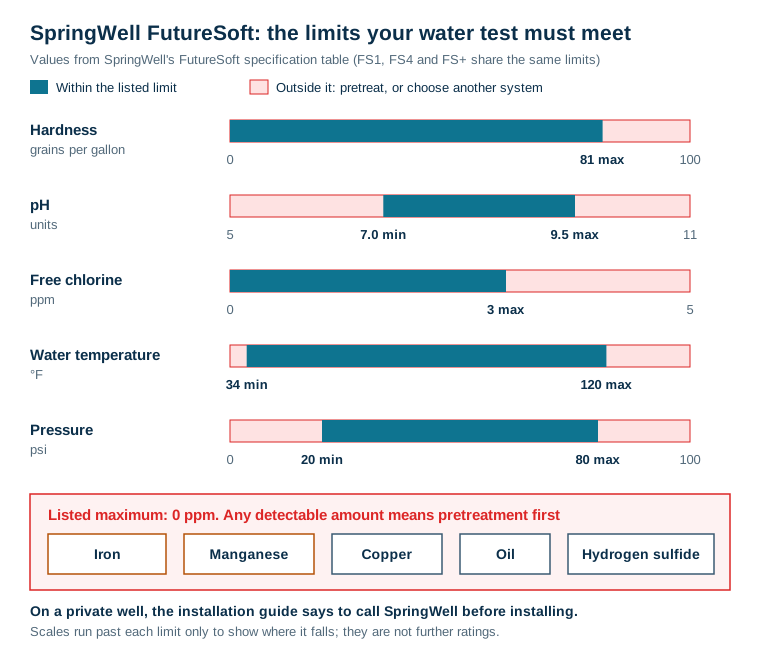
| Parameter | SpringWell's listed limit | What to do if your water is outside it |
|---|---|---|
| Hardness | 81 gpg maximum | Above it, choose a salt-based softener |
| pH | 7.0 to 9.5 | Below 7.0, neutralise first; the media is rated only from pH 7.0 |
| Free chlorine | 3 ppm maximum | City water is normally below this; check after main flushing |
| Iron | 0 ppm | Any detectable iron needs a filter ahead of the tank |
| Manganese | 0 ppm | Same: pretreat |
| Copper | 0 ppm | Investigate the source, often corroding pipework |
| Oil | 0 ppm | Pretreat; oil coats the media |
| Hydrogen sulfide | 0 ppm | Pretreat with an oxidising filter |
| Salinity | 35,000 ppm maximum | Rarely a constraint in household water |
| Temperature | 34 to 120°F | Install on the cold supply only |
| Pressure | 20 to 80 psi | Fit a pressure-reducing valve above 80 psi |
Two inconsistencies are worth knowing:
- Copper. The specification table lists 0 ppm. The warranty page says copper above 1.30 mg/L is "considered high and thus unacceptable." Use the stricter number.
- Iron. Older listings and reviews quote an iron limit below 0.3 ppm. The current specification says 0. Treat any measurable iron as a reason to pretreat. Why iron and manganese foul TAC media is explained in hardness limits for salt-free conditioners.
The well-water exclusion is also written into the warranty. For water "sourced from the personal Well of a house owner," SpringWell lists hydrogen sulfide, oil, copper above 1.30 mg/L, and "presence of iron and/or manganese" as conditions needing pretreatment, and states that installing "on water conditions beyond the recommended specification for that particular system will render the warranty void."
In practice: on city water, FutureSoft's limits are usually met. On a private well, assume you need a filter ahead of it until a full lab test proves otherwise. For the wider decision between a conditioner and a softener, see salt-based vs salt-free water treatment.
What Ships, and How Big Each Size Is
| FS1 | FS4 | FS+ | |
|---|---|---|---|
| Bathrooms | 1 to 3 | 4 to 6 | 7+ |
| Tank | 6 x 35 in (39 in with head) | 9 x 48 in (52 in with head) | 13 x 54 in (58 in with head) |
| Service flow | 12 gpm | 15 gpm | 20 gpm |
| Flow direction | Upflow | Upflow | Upflow |
In the box: the conditioner tank, a pre-filter housing with mounting bracket, a sediment cartridge, a spanner wrench, a gasket and lubricant, MNPT fittings and a hose bib assembly. The bypass valve is sold separately on the FS1 and FS4.
The tank sizes are small for the flow ratings, especially the FS1 at 6 x 35 inches for 12 gpm. TAC media works by contact rather than exchange capacity, so a small tank is not automatically a problem, but SpringWell does not publish the media volume or the contact time behind each flow rating. If your home regularly runs several fixtures at once, the FS4 is the safer choice.
Installation and the Maintenance It Still Needs
FutureSoft needs no drain, no salt and no electricity. The installation guide adds two steps buyers often miss:
- The media must soak for at least 48 hours before installation. You fill the tank through the hose bib, set it to bypass and wait two days.
- The media must then be flushed in both directions until the water runs clear, before the tank goes into service.
After that, the maintenance is real but light:
| Task | Interval |
|---|---|
| Sediment cartridge in the pre-filter | On the cartridge's schedule; more often on dirty water |
| FutureSoft media replacement | SpringWell says "5+ year lifespan" |
| Pre-filter O-ring lubrication | At each cartridge change |
| Water heater check | Yearly, to confirm scale is actually reduced |
The warranty treats "failure to replace filters or media at the appropriate time" as "neglect." Keep receipts for cartridges and media. The full schedule and costs are in salt-free water conditioner maintenance.
What It Does to Scale You Already Have
FutureSoft is sold to prevent new scale. SpringWell makes no claim that it removes existing deposits. Some owners report old scale softening over months, and there is a plausible reason for it, but it is not something to buy the product for. A water heater with a thick sediment layer should be flushed or descaled first, and limescale on fixtures cleaned off, so that you can see whether new buildup forms. The evidence and the realistic expectations are covered in can a salt-free conditioner remove existing scale.
Spotting is a separate issue. TAC leaves the hardness in the water, so when a drop evaporates on glass, the minerals are left behind. SpringWell's own comparison panel says FutureSoft "won't make water feel slick or stop spotting the way salt does." Spots tend to wipe off more easily, but they do not disappear.
The Warranty and Guarantee in Plain Terms
SpringWell's warranty page says: "SpringWell Water ('SpringWell') warrants that all its FutureSoft salt-free water softeners shall be free of any defects in material and workmanship throughout the lifespan of the system under normal application, service and use."
That covers defects. It does not cover:
- Media worn out by normal use, which is expected around year five.
- Damage from water outside the listed specification, including iron, manganese or sulfur on a well.
- Freezing, physical damage or installation errors.
- Plumber fees: "SpringWell is not responsible nor liable for plumber fees."
- Transfer: the warranty belongs to the registered owner in the original home.
The "6-month money-back guarantee" badge is, in SpringWell's returns policy, a returns window for uninstalled products in undamaged packaging, less a 10% restocking fee and both-way shipping. Installed systems get a 6-month "Performance Promise" of troubleshooting and parts, with refunds only for units SpringWell finds defective. Read that before treating the guarantee as a trial period.
Combos and Amazon Availability
| Option | Sizes sold direct |
|---|---|
| FutureSoft on its own | FS1 / FS4 / FS+ |
| City water filter + FutureSoft combo | CSF1 / CSF4 / CSF+ |
| Well water filter + FutureSoft combo | WSSF-1 / WSSF-4 |
SpringWell has Amazon listings for the FutureSoft FS1 and for its well water filter plus FutureSoft combo, but both showed "Currently unavailable" when checked on 1 October 2026, with no offer to buy. For now, buy direct from SpringWell and check the current price there:
- SpringWell FutureSoft salt-free water softener, 1 to 3 bathrooms (FS1). Sold direct.
- SpringWell whole-house well water filter and salt-free conditioner combo. An iron, sulfur and manganese filter ahead of FutureSoft, which is the configuration SpringWell's own limits call for on most wells. Sold direct, at a higher price than FutureSoft alone.
If the Amazon listings come back, check which returns policy applies there. Registration with SpringWell is required for the warranty either way.
Who Should Not Buy the SpringWell FutureSoft
- Anyone with iron, manganese or hydrogen sulfide in the water. The specification lists 0 ppm for all three. Buy the well combo or a different system.
- Anyone who wants spot-free glass, slick-feeling water or less soap. That is softening, and FutureSoft does not soften.
- Homes with very hard water. The 81 gpg limit is a maximum, not a comfortable operating point, and spotting increases with hardness.
- Acidic water below pH 7.0. It needs neutralising first. The guide to when a salt-free conditioner is the wrong choice covers this and the other mismatches in detail.
- Buyers who want proof before paying. SpringWell publishes no test report behind its 95% figure. If independent evidence for the specific product matters to you, ask for the report first, and buy only if it names the protocol and lab.
The verdict of this SpringWell FutureSoft review: for city water within its limits, it is a reasonable TAC conditioner that will reduce new scale with very little upkeep. Its 95% claim is marketing until SpringWell publishes the test behind it, and its zero-tolerance list for iron, manganese, copper, oil and sulfur rules it out on most private wells without a filter in front.
Frequently Asked Questions
Does the SpringWell FutureSoft actually soften water?
No. FutureSoft uses template-assisted crystallization media, which converts some hardness into microscopic crystals that are less likely to stick to pipes and heaters. The calcium and magnesium stay in the water, so a hardness test reads about the same before and after the tank. SpringWell's own comparison says it will not make water feel slick or stop spotting the way a salt-based softener does.
Is the 95% scale reduction claim for FutureSoft verified?
Not publicly. SpringWell says FutureSoft prevents up to 95% of scale buildup, but its product page and installation guide name no test protocol, laboratory, water chemistry or report, and a search of its site for DVGW returns nothing. The best independent evidence for TAC media in general, a WateReuse study using the German DVGW W 512 heated test, measured more than 88% scale reduction. That supports the technology, not this specific product.
Can FutureSoft be used on well water?
Only with care. SpringWell's specification table lists 0 ppm as the maximum for iron, manganese, copper, oil and hydrogen sulfide, and its installation guide says not to install on well water without speaking to customer service first. Most wells need a filter ahead of it, which is why SpringWell sells a well filter and FutureSoft combo.
What is the maximum hardness for the SpringWell FutureSoft?
SpringWell lists 81 grains per gallon as the maximum hardness for all three sizes. Independent testing of TAC media was done at far lower hardness, and conditioners generally work best on moderately hard water. On very hard water, expect more visible spotting and plan to test performance on your water heater rather than relying on the maximum.
How long does FutureSoft media last?
SpringWell describes it as high-capacity media with a 5+ year lifespan. The lifetime warranty covers the media against defects in material and workmanship, not normal wear, and the warranty treats failure to replace filters or media at the appropriate time as neglect. Budget for a media change around year five and a sediment cartridge change on the pre-filter's own schedule.
Will FutureSoft remove existing scale from my pipes?
Do not buy it for that. FutureSoft is sold to prevent new scale. Some owners report existing deposits softening over time, but SpringWell makes no descaling claim in its specification, and descaling a water heater or fixtures with existing buildup is a separate job.
