
Morton vs Whirlpool Water Softener: Salt, Water and 10-Year Running Cost Compared

Morton vs Whirlpool water softener is a closer contest than the two brand names suggest: the same company builds both, and their nearest models use almost exactly the same salt. The Morton M34 is rated at 5,060 grains of hardness per pound of salt and the Whirlpool WHES33 at 5,094. For a family of four on 15 gpg water, that is about 303 lb against 301 lb of salt a year. The real difference is regeneration water. At the efficient setting the Whirlpool uses about 600 fewer gallons a year, which is worth about $80 over ten years. Your salt setting changes the 10-year running cost by $410 to $500. The badge changes it by less than $80.
Disclosure: Hard Water Solved may earn a commission if you buy through links on this page, at no extra cost to you. It does not change which products we include or how we rank them. Read our disclaimer.
How this comparison was built. No softener was physically tested. Every capacity, salt and water figure comes from the two owner's manuals: the Morton System Saver manual for models M20 to M34 and the Whirlpool WHES30 and WHES33 manual (revision H, January 2025). The maker is confirmed on NSF's public listings. The running-cost model uses those rated figures and the assumptions stated beside each table, so you can rerun it for your own house.
- Compared: the Morton M34 and Whirlpool WHES33. They are the two brands' closest twins, with 0.91 and 0.88 cubic feet of resin.
- Not compared: Whirlpool's 40,000-grain WHES40E. Lowe's no longer sells it, Whirlpool's current brochure no longer lists it and its Amazon listing has gone.
- Prices are not listed here because they change often. Use the buttons to see the current price on Amazon.
Morton vs Whirlpool: One Maker, Two Badges
Neither Morton nor Whirlpool builds its own softeners. NSF's NSF/ANSI 44 listing for Morton and its listing for Whirlpool both name Water Channel Partners of Eagan, Minnesota. Whirlpool's manual calls the company its manufacturer and warrantor. Morton's says the unit is "manufactured for" Morton.
So this is not a contest between two engineering teams. It is two badges on one platform, with different resin volumes, flow restrictors and warranty terms. Both use demand regeneration that learns your water use. Morton calls its version Look-Ahead and Whirlpool calls its version 6th Sense. Both have a salt-efficiency switch that ships turned off. That is why the comparison comes down to arithmetic, not features.
The Closest Twins, Spec for Spec
Both manuals publish capacity at three salt doses, plus regeneration water at the lowest and highest doses. That is everything a running-cost comparison needs.
| Morton M34 | Whirlpool WHES33 | |
|---|---|---|
| Resin | 0.91 cu ft | 0.88 cu ft |
| Capacity at lowest dose | 13,700 grains @ 2.7 lb | 13,400 grains @ 2.6 lb |
| Capacity at middle dose | 29,200 grains @ 8.6 lb | 28,500 grains @ 8.3 lb |
| Capacity at highest dose | 34,900 grains @ 14.5 lb | 34,100 grains @ 14.1 lb |
| Rated efficiency (lowest dose) | 5,060 grains per lb | 5,094 grains per lb |
| Regeneration water, lowest dose | 2.3 gal per 1,000 grains | 1.9 gal per 1,000 grains |
| Regeneration water, highest dose | 31.6 gal | 33.3 gal |
| Rated service flow (manual) | 7.8 gpm | 7.2 gpm |
| Pressure drop at that flow | 14.7 psi | 14.9 psi |
| Maximum hardness / clear-water iron | 110 gpg / 9 ppm | 105 gpg / 9 ppm |
| Maximum drain flow | 2.2 gpm | 1.8 gpm |
From the manuals cited above. Whirlpool's WHES33 product page gives slightly different figures, 4,950 grains per pound and 8.0 gpm, and the 8.0 gpm figure matches NSF's listing.
Three things stand out. The capacity curves almost overlap. The "34" and "33" in the names are capacity at the heaviest salt dose, the least efficient way to run either unit, a point covered in advertised vs usable softener capacity. And the one real gap is the regeneration water at the efficient setting.
Annual Salt Use at the Same Hardness
The salt formula is the one from the site's guide to how much salt a water softener uses: grains removed a year divided by grains per pound. For a family of four using 280 gallons a day, the house needs 1,533,000 grains removed a year at 15 gpg.
Pounds of salt a year, family of four:
| Hardness | Morton M34, lowest dose | Whirlpool WHES33, lowest dose | Either, salt-efficiency floor (4,000 gr/lb) | Morton M34, highest dose | Whirlpool WHES33, highest dose |
|---|---|---|---|---|---|
| 10 gpg | 202 | 201 | 256 | 425 | 423 |
| 15 gpg | 303 | 301 | 383 | 637 | 634 |
| 20 gpg | 404 | 401 | 511 | 849 | 845 |
| 25 gpg | 505 | 502 | 639 | 1,062 | 1,056 |
Calculated from the manuals' rated figures, not measured. Two people use about half these amounts.
At any one setting the two brands are within six pounds a year, less than one-sixth of a bag. Move either softener from its lowest dose to its highest, though, and salt use doubles. Why a small, frequent salt dose recovers more grains per pound is explained in what water softener salt efficiency means.
The table's lab figures are a best case. Both manuals say operational efficiency is "typically less" than the rated figure, because of reserve capacity, partial regenerations and other contaminants. Expect to pour in more than the table shows, but expect the gap between the two brands to stay small.
Regeneration Water: The One Real Difference
Salt is only half the running cost. Every regeneration also sends water down the drain: backwash, brine draw, rinse and refill. The manuals give it two ways. At the lowest dose it is gallons per 1,000 grains of capacity. At the highest dose it is total gallons per regeneration.
| Family of four, 15 gpg | Morton M34 | Whirlpool WHES33 |
|---|---|---|
| Regenerations a year, lowest dose | about 112 | about 114 |
| Water per regeneration, lowest dose | about 31.5 gal | about 25.5 gal |
| Regeneration water a year, lowest dose | about 3,530 gal | about 2,910 gal |
| Regenerations a year, highest dose | about 44 | about 45 |
| Regeneration water a year, highest dose | about 1,390 gal | about 1,500 gal |
At the efficient setting both softeners regenerate about every three days. The Whirlpool uses about six fewer gallons each time, which adds up to about 600 gallons a year. At the highest dose the order flips, but the gap is only about 110 gallons. Either way it is a small share of a household that uses about 100,000 gallons a year. How regeneration water is counted, and where it goes, is covered in how much water regeneration uses.
The 10-Year Running Cost
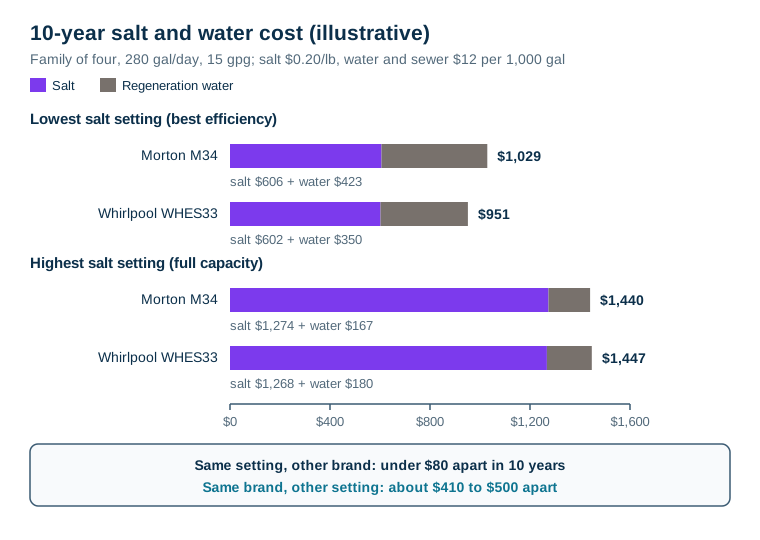
Assumptions: a family of four, 280 gallons a day, 15 gpg, salt at $0.20 a pound and water and sewer together at $12 per 1,000 gallons. Electricity is left out, because both run on the same kind of low-voltage plug-in transformer and the difference rounds to nothing.
| 10-year running cost | Morton M34 | Whirlpool WHES33 | Difference |
|---|---|---|---|
| Lowest dose, family of four, 15 gpg | about $1,029 | about $951 | about $78 |
| Highest dose, family of four, 15 gpg | about $1,440 | about $1,447 | about $7 |
| Lowest dose, two people, 15 gpg | about $515 | about $476 | about $39 |
| Lowest dose, family of four, 25 gpg | about $1,715 | about $1,586 | about $129 |
Illustrative. Rerun it with your own salt price and water rate. In a town with cheap water, the Whirlpool's advantage shrinks further.

What this means for buying: if your water is very hard and your water rate is high, the Whirlpool's lower regeneration water is worth about $10 to $15 a year. Everywhere else, the difference is too small to decide on. What does matter is switching the efficiency setting on, and keeping it on. That alone saves both brands about $40 to $50 a year at 15 gpg.
Regeneration Control and the Efficiency Switch
Both softeners decide when to regenerate from a meter and a learned usage pattern, and both pick the salt dose for each regeneration. The difference between them is in the defaults:
- Salt efficiency ships off on both. Whirlpool's manual says that with the feature on, the softener will "operate at salt efficiencies of 4000 grains of hardness per pound of salt or higher," and "may recharge more often using smaller salt dosage and less water." Morton's manual makes the same 4,000 grains-per-pound promise. California installations must have it on.
- Iron cleaning costs water. Whirlpool's clear-water iron feature adds a short backwash and fast rinse before each regeneration. Its manual says to switch it off on water with no iron or sediment, to save water.
- Iron sizing is identical. Both manuals tell you to add 5 to the hardness setting for every 1 ppm of clear-water iron.
If you are coming from an old timer softener, either one will cut salt sharply. The reason is explained in metered vs timer-based water softeners.
Warranty, Price and Where Each Is Sold
| Morton M34 | Whirlpool WHES33 | |
|---|---|---|
| Where the brand page sends you | Menards | Lowe's |
| Tanks | 10 years | 10 years |
| Electronics | 1 year, as "all other parts" | 3 years |
| Other parts | 1 year, parts shipped, labor not covered | 1 year full parts and labor |
| Extension | M34 product page says parts cover extends with Morton cleanser | Up to 5 years with registration and Whirlpool cleanser every four months |
Warranty terms from the manuals, Morton's M34 product page and Whirlpool's extended-warranty page.
The two were listed at close enough prices when we checked that a sale decides it. The warranty is not as close. Whirlpool's first year includes labor and its electronics are covered for three years. Morton's manual covers non-tank parts for one year with no labor. If you would rather not fit a replacement circuit board yourself in year two, that tips the choice toward Whirlpool. Whirlpool's extension needs registration and one bottle of its cleanser every four months, and aftermarket parts void it. The way to weigh conditions like that is set out in how to read a water softener warranty.
Service life is the same question for both. Tanks outlast valves, and the rotor, seals and board wear first, as covered in how long a water softener lasts. Parts for both come from the same maker.
Amazon Availability and Alternatives
On 2 October 2026 neither twin could be bought on Amazon:
| Listing | Status |
|---|---|
| Morton MSD34C | Currently unavailable |
| Whirlpool WHES33 | Currently unavailable |
| Whirlpool WHES40E | Listing removed (checked 1 October) |
If you want to order online, these two come from the same maker and were listed on Amazon:
- EcoPure EPH130. A softener-and-filter cabinet with AutoSense demand regeneration, sized for up to five people. The listing gives no grains-per-pound figure, so read the spec label before comparing it with the table above. Check price on Amazon
- EcoPure EP42. Retailer listings give 42,000 grains, up to 110 gpg and 11 ppm of iron, and NSF lists it at 8.2 gpm. That makes it the better fit for a busier house than either twin. Check price on Amazon
Morton or Whirlpool: Which to Buy
- Buy the Whirlpool WHES33 if you are on metered water and sewer at a high rate, if you want labor covered in year one and electronics for three years, or if Lowe's is your nearest store.
- Buy the Morton M34 if Menards has it on sale, if you want its slightly higher rated flow of 7.8 gpm, or if you prefer a bigger resin bed by a few hundredths of a cubic foot.
- Either way, switch on the salt-efficiency setting, set the hardness correctly with iron added, and log the salt you actually pour in for the first three months.
Who Should Buy Neither
- Houses that run more than about 8 gpm at peak. Both twins are rated at 7 to 8 gpm. Two showers and a washer at once can exceed that.
- Wells with red-water, bacterial or high iron. Both are rated for up to 9 ppm of clear-water iron only, and Wisconsin requires extra treatment above 5 ppm.
- Very hard water above about 25 gpg in a big household. At the efficient setting both would regenerate every other day or so. A larger resin bed makes more sense.
- Anyone hoping to avoid salt altogether. Both are salt-based ion exchange softeners. The trade-offs with conditioners are in salt-based vs salt-free water treatment.
Morton vs Whirlpool water softener comes down to warranty, store and price on the day. The salt bill will be the same within a bag a year. Spend your attention on the efficiency setting instead, because that is where the $400 to $500 over ten years really is.
Frequently Asked Questions
Are Morton and Whirlpool water softeners made by the same company?
Yes. NSF's current NSF/ANSI 44 listings name Water Channel Partners of Eagan, Minnesota as the company behind both the certified Morton softeners and the certified Whirlpool softeners. Whirlpool's owner's manual names Water Channel Partners as manufacturer and warrantor, and Morton's manual says its units are manufactured for Morton. The same company also sells softeners under its own EcoPure name.
Which uses less salt, Morton or Whirlpool?
Neither, by any margin that matters. At the lowest salt dose the Morton M34 is rated at 5,060 grains per pound of salt and the Whirlpool WHES33 at 5,094 in its January 2025 manual. For a family of four on 15 gpg water, that works out to about 303 lb and 301 lb of salt a year. The setting you choose changes salt use far more than the brand does.
Does a Morton or Whirlpool softener use more water?
The Whirlpool WHES33 uses less at its efficient setting. Its manual gives 1.9 gallons of regeneration water per 1,000 grains of capacity at the minimum salt dose, against 2.3 gallons for the Morton M34. For a family of four on 15 gpg water that is about 2,900 gallons a year against about 3,500. At the maximum salt dose the two are within about 110 gallons a year of each other.
Is the Morton M34 or the Whirlpool WHES33 cheaper to buy?
They were listed at almost the same price when we checked, so a sale usually decides it. The Morton 34,000-grain softener is sold through Menards and the Whirlpool WHES33 through Lowe's, so check the current shelf price at each before you buy. On Amazon, both listings showed as unavailable.
Which has the better warranty, Morton or Whirlpool?
Whirlpool's, in the first year. The WHES33 carries one year of full parts and labor, three years on the electronics and ten years on the tanks, extendable to five years with registration and Whirlpool's cleanser. Morton's M20 to M34 manual covers the tanks for ten years and all other parts for one year, with parts shipped free but labor not covered.
Should I turn on the salt efficiency setting?
Yes, if salt cost matters more to you than how often the softener regenerates. Both brands ship with it switched off. With it on, both manuals state the softener will run at 4,000 grains per pound of salt or better, using smaller salt doses and regenerating more often. In California it must be switched on.
