
Water Softener Prices by Type, Size and Brand

Water softener prices run from about $500 for a small cabinet to about $1,100 for an 80,000-grain single-tank softener bought online, $1,230 to $1,710 for a twin tank, and $1,785 to $2,320 for a salt-free conditioner. Dealer brands such as Culligan, Kinetico and EcoWater are sold installed, and their reported quotes usually fall between about $1,800 and $6,500, with bundled packages higher. The fairest way to compare those numbers is price per 1,000 grains of capacity you can actually use. On that scale, larger online softeners cost about $20, twin and upflow units about $44 to $46, and a dealer-installed system several times more.
Disclosure: Hard Water Solved may earn a commission if you buy through links on this page, at no extra cost to you. It does not change which products we include or how we rank them. Read our disclaimer.
Water Softener Prices at a Glance: the Price Matrix
Every cell below is either a rounded online price for that type and size or a published quote range, with the source in the notes. Online prices are equipment only. Dealer prices include installation, because dealers do not sell the box on its own.
| Type | 32,000 grain | 48,000 grain | 64,000 grain | 80,000 grain | Where sold |
|---|---|---|---|---|---|
| Cabinet (all-in-one) | 35k: about $700 | 42k: about $690 to $740 | n/a | n/a | Amazon, maker stores, hardware stores |
| Single-tank metered, standard resin | about $760 | about $780 | about $880 | about $1,030 | Online |
| Single-tank metered, 10% crosslink resin | about $760 | about $790 | about $890 | about $1,050 | Online |
| Softener plus iron (fine mesh resin) | about $770 | about $800 | about $900 | about $1,100 | Online |
| Upflow premium (city) | about $1,370 | about $1,460 | about $1,590 | n/a | Online |
| Twin tank | about $1,230 | about $1,390 | about $1,710 | n/a | Online |
| Salt-free conditioner | 1 to 3 baths: about $1,785 | 4 to 6 baths: about $1,960 | 7+ baths: about $2,320 | n/a | Maker direct |
| Dealer systems, installed | $1,800 to $6,500 reported across Culligan series; $2,895 to $5,985 owner-reported for Kinetico; $3,600 to $10,000 for EcoWater | Local dealer only |
Salt-free sizes are by bathrooms and flow rather than grains, so they are placed in the columns by step, not capacity. The upflow figures are for city-water models.
How we built the matrix. Nothing was physically tested. Online figures are equipment-only prices from makers' and sellers' own stores in early October 2026, rounded to set a range for each type and size rather than to price any one listing. Dealer ranges are published owner quotes and cost surveys, cited where used, because no dealer brand publishes a price list.
- Normalised: capacity is re-stated at 6 lb of salt per cubic foot of resin, an efficient setting, not the box rating.
- Excluded: the Whirlpool WHES18 cabinet and the GE GXSHC40N, both "Currently unavailable" on Amazon on 2 October 2026; GE lists the GXSHC40N as obsolete. SpringWell's FutureSoft Amazon listing also showed "Currently unavailable" that day.
- Prices of individual products are not listed here because they change often. Use the buttons to see the current price on Amazon.
Prices by Capacity: Bigger Tanks Cost Less per Grain
The grain number on a box is the top of the capacity curve, reached only at a heavy salt dose. At an efficient 6 lb per cubic foot, standard resin delivers about 21,000 grains per cubic foot. That is the figure the site's guide to advertised vs usable softener capacity uses, and it is the one to price against.
| Box rating | Resin | Usable at 6 lb/cu ft | Typical online price | Price per 1,000 usable grains |
|---|---|---|---|---|
| 32,000 | 1.0 cu ft | about 21,000 | about $760 | about $36 |
| 48,000 | 1.5 cu ft | about 31,500 | about $780 | about $25 |
| 64,000 | 2.0 cu ft | about 42,000 | about $880 | about $21 |
| 80,000 | 2.5 cu ft | about 52,500 | about $1,030 | about $20 |
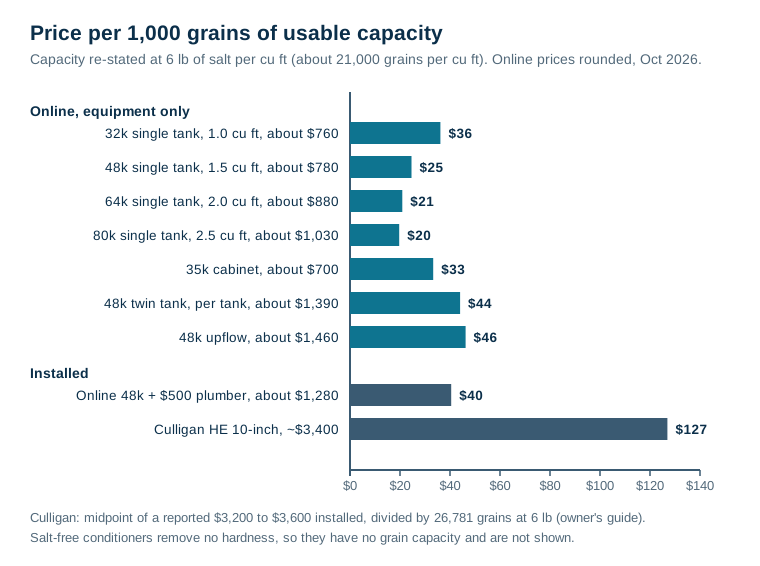
The step from 32,000 to 48,000 grains costs only a little more, yet it adds half as much resin again. The valve, brine tank and bypass cost the same whichever size you buy, so the small unit carries the fixed costs on the least resin. That is the strongest price argument for not buying the smallest size that might just cope.
It is not an argument for buying the biggest. An oversized bed on a household that uses little water sits for days between regenerations, and if the valve is left on a heavy factory salt setting, the salt bill grows with the tank. Size from your daily hardness load, using how to size a water softener, then buy the next size up only if the price step is small.
Water Softener Prices by Type
Cabinet softeners: about $500 to $750
A cabinet puts the resin tank inside the salt bin. It is the cheapest way into a whole-house softener and the easiest to fit in a closet, but salt storage is small and most use proprietary valves.
GE GXSH35W Smart, 35,000 grain. One cubic foot of resin, Wi-Fi alerts, NSF/ANSI 44 certified by IAPMO R&T per its manual. On price per usable grain it lands close to a 32,000-grain two-tank unit.
EcoPure EP42, 42,000 grain. It holds about 200 lb of salt in retail listings, more than most cabinets. EcoPure does not publish its resin volume, so it is left out of the per-grain chart.
Single-tank metered softeners: about $760 to $1,050
The standard two-tank design: a resin tank with a metered valve on top and a separate brine tank. These are the price benchmark for everything else, because the Fleck 5600SXT valve is serviced by many sellers.
AFWFilters Fleck 5600SXT 48,000 grain. The 1.5 cubic foot high-capacity resin system, the benchmark 48k single tank.
AFWFilters Fleck 5600SXT 48,000 grain, 10% crosslink resin. The small upgrade buys resin that tolerates chlorine better, which matters on city water; why is covered in standard vs chlorine-resistant softener resin.
Softener plus iron filter: about $765 to $1,100
Fine mesh resin removes some dissolved iron along with hardness. It costs a few dollars more than standard resin at each size.
AFWFilters Iron Pro 2, 64,000 grain. It costs only slightly more than the standard 64k. The seller rates it for ferrous iron up to 6 ppm. Above that, or with oxidized iron, a separate filter is the answer, not a dearer softener; water softener vs iron filter sets out where the line falls.
Upflow premium: about $1,370 to $1,590
Upflow (counter-current) brining gets more capacity from each pound of salt, and premium brands add longer valve warranties and phone support.
SoftPro Elite 48,000 grain. Sold in city water and well water versions, it costs well over the AFWFilters 48k with the same 10% resin grade. Upflow regeneration typically recovers 5% to 12% more capacity per pound of salt, which narrows the per-grain gap a little but does not close it. The mechanism is in upflow vs downflow regeneration.
Twin tank: about $1,230 to $1,710
Two resin tanks alternate, so one is always in service and soft water never runs out during regeneration.
AFWFilters Fleck 9100SXT twin, 48,000 grain. It has 1.5 cubic feet per tank, and a twin of this size costs roughly $600 more than one 1.5 cubic foot tank. Priced on the capacity of the tank in service, it comes to about $44 per 1,000 grains. The extra buys continuity and the use of the whole bed, which single-tank vs twin-tank water softeners weighs against the price.
Salt-free conditioners: about $1,785 to $2,320
A template-assisted conditioner changes how hardness minerals behave; it does not remove them. It has no grain capacity, so it cannot be priced per grain.
SpringWell FutureSoft. Sold in FS1, FS4 and FS+ sizes by bathroom count. Its Amazon listing showed "Currently unavailable" on 2 October 2026, so it may have to be bought direct. Running costs are close to zero. Whether it suits your water is a different question from price, covered in salt-based vs salt-free water treatment.
Dealer systems: about $1,800 to $10,000 installed
Culligan, Kinetico, EcoWater, RainSoft and Hague sell through local dealers and do not list whole-house softeners on Amazon. Their quotes include installation, and the brand does not publish prices.
Prices by Brand
| Brand | Where sold | Price range |
|---|---|---|
| AFWFilters (Fleck valves) | Own store, Amazon | Equipment only; in the single-tank, iron and twin-tank ranges above |
| Aquasure Harmony | Amazon | Equipment only; check the current price |
| WaterBoss 900 | Home Depot | Equipment only; check the current price |
| GE (2025 range) | Amazon, GE | Equipment only; check the current price |
| EcoPure | Amazon, hardware stores | Equipment only; in the cabinet range above |
| SoftPro Elite | Own store, Amazon | Equipment only; in the upflow range above |
| SpringWell salt-based | Own store | Equipment only; check the current price |
| SpringWell FutureSoft | Own store | Equipment only; in the salt-free range above |
| Culligan | Dealer, installed | Under $1,000 to above $5,000 in owner accounts; $1,800 to $6,500 installed across series (Modernize survey, August 2026) |
| Kinetico | Dealer, installed | $2,895 to $5,985 owner-reported softener quotes, 2024 to 2025 |
| EcoWater | Dealer, installed | About $3,600 to $10,000 owner-reported, refiners at the top |
| Hague WaterMax | Dealer, installed | About $4,000 to $6,500 (dealer guides and owner quotes, 2025 to 2026) |
| RainSoft | Dealer, installed | Not published; often sold on a monthly payment |
Culligan's own buyer's guide says a softener "can cost anywhere between $500 and $10,000", and puts a professional-grade system "closer to $5,000" (Culligan, updated May 2026). The per-grain chart above shows why that gap exists. A Culligan HE 10-inch holds 1.5 cubic feet of resin, the same as a 48k online unit, and Culligan's owner's guide rates it at 26,781 grains at 6 lb of salt. At a reported $3,200 to $3,600 installed, that is about $127 per 1,000 grains. The online unit with a $500 plumber is about $40. The difference is the dealer's service, warranty handling and sales cost, not more softening per dollar.
Online, Big-Box or Dealer: What the Channel Adds
The same capacity costs very different amounts depending on who sells it:
- Online, equipment only. The lowest price. You or a plumber install it, program it and maintain it. Fleck-valve systems can be repaired with parts from many sellers.
- Big-box and warehouse packages. Fixr's installation cost guide lists retailer packages from about $1,000 to $2,800 at one big-box chain and $4,000 to $6,000 at a warehouse club. The store arranges an installer; the equipment is usually a retail brand.
- Local dealer. One price for equipment, installation and a service relationship, often with financing on offer. The warranty is longer on paper, but labor after year one is usually the dealer's charge.
Buying online moves two jobs onto you: getting it installed, and getting it programmed to an efficient salt setting. Skip the second and an online softener loses much of its running-cost advantage over a dealer unit.
The Other Two Halves of the Budget
The purchase price is only one of three numbers. The second is installation. A simple swap into an existing loop is a short job, while a new loop, drain run, outlet and permit can double the labor. Line-by-line figures and why two quotes differ are in water softener installation cost.
The third is running cost: salt, regeneration water, electricity, upkeep and an eventual resin change. Over ten years these often add up to more than the softener itself, which is why a slightly dearer, more salt-efficient unit can be the cheaper one to own. The full model is in the total cost of owning a water softener.
How to Check a Price Before You Pay It
- Convert the box rating. Ask for the resin volume in cubic feet, multiply by about 21,000, and divide the price by that figure in thousands. A unit that cannot tell you its resin volume cannot be priced fairly.
- Compare like with like. Equipment-only online prices against dealer installed prices is not a fair test. Add a realistic installation figure to the online price first.
- Check what the price leaves out. Bypass valve, fittings, a sediment prefilter, and on wells an iron filter. Some online prices include a bypass; some list it separately.
- Get the dealer price in writing, as a cash price. A monthly payment is not a price. Ask for the model number, resin volume, salt setting and warranty terms on the same page.
- Date the price. Online softener prices move with sales. A screenshot with the date is the only price you can hold a seller to.
When the Cheapest Price Is the Wrong Buy
- City water with chlorine or chloramine. Pay the $10 to $25 extra for 10% crosslink resin. Standard resin degrades faster, and replacing it costs far more than the upgrade.
- Well water with iron above the softener's rating, sulfur smell or low pH. Treat those first. A cheap softener fouled by iron is not cheap.
- Very small households on moderate water. A 32k unit costs more per grain, but it is still the right size if a larger bed would sit idle. Price per grain matters most when you need the capacity.
- Anyone who will not program it. A dealer unit set up and checked by a technician can cost less to run than an online unit left on its factory salt dose. If you will not change the settings, factor that in before you take the lower price.
- Homes where softening is not needed at all. Below about 3 to 7 grains per gallon, many households see little benefit. Test the water before pricing anything.
Prices quoted here move. Use the matrix to set expectations and the per-grain sum to test any quote, then check the live price on the day you buy.
Frequently Asked Questions
How much does a water softener cost?
Bought online without installation, a whole-house salt-based softener costs about $500 to $750 for a cabinet, $760 to $1,100 for a single-tank metered unit, $1,230 to $1,710 for a twin tank and $1,370 to $1,590 for an upflow premium unit, on online store prices in October 2026. Dealer brands are sold installed and usually quoted at about $1,800 to $6,500, with some packages above $10,000. Installation on an online unit adds roughly $150 to $1,000 of labor.
What size water softener do I need, and how does size change the price?
Size from your daily hardness load, not the number of bathrooms. Price rises slowly with size: online, a 32,000-grain single-tank softener costs about $760 and an 80,000-grain one about $1,030. Because the bigger tank holds far more resin, the price per 1,000 grains of usable capacity falls from about $36 to about $20. Oversizing still costs you in salt if the valve is set badly.
Why are dealer water softeners so expensive?
A dealer price includes the equipment, installation, the sales visit, a local service relationship and often a long warranty, all quoted as one figure. The hardware itself is not several times better. On capacity at the same salt dose, a dealer-installed Culligan HE quoted at about $3,400 works out near $127 per 1,000 usable grains, against about $40 for an online 48,000-grain unit with a $500 plumber.
Is a salt-free water softener cheaper than a salt-based one?
Not to buy. Whole-house salt-free conditioners run about $1,785 to $2,320, more than most single-tank salt-based softeners. It costs less to run because it uses no salt and sends no water to drain. It also does not remove hardness, so it is a different product, and it is excluded from price-per-grain comparisons for that reason.
Does a twin-tank water softener cost more than a single tank?
Yes. Online, a twin with 1.5 cubic feet per tank costs roughly $600 more than a single 1.5 cubic foot tank. The twin supplies soft water during regeneration and never holds back a day of reserve, which can recover some of the gap in salt on a heavy household load, but on a typical family it rarely pays back.
