
Dealer vs Online Water Softener: What the Price Gap Buys Over 15 Years
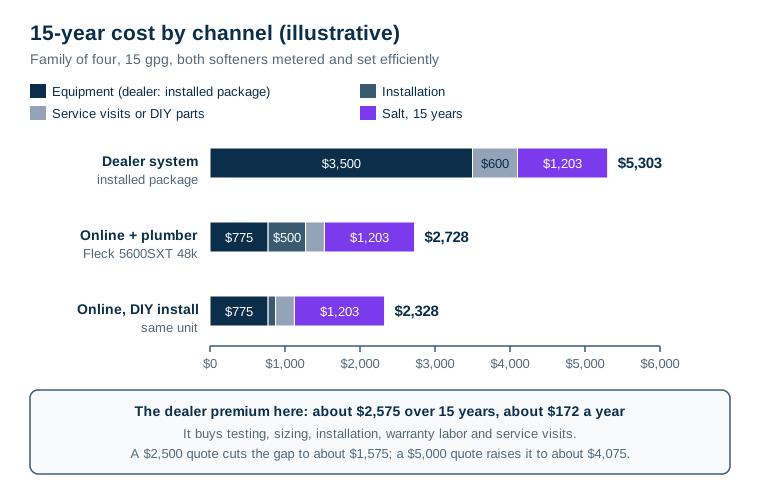
Dealer vs online water softener comes down to who does the work. A dealer sells you an installed system and a service relationship. An online seller sells you a box. In our illustrative 15-year model for a family of four, a dealer system at $3,500 installed costs about $5,303 including service and salt. An online softener, modelled at $775 of equipment, with a $500 plumber install and DIY upkeep costs about $2,728. That is a premium of about $2,575, or $172 a year. It is worth paying if you will never touch the softener, if your water needs more than softening, or if you have a dealer you trust. It is wasted if you can change a seal kit and program a valve.
Disclosure: Hard Water Solved may earn a commission if you buy through links on this page, at no extra cost to you. It does not change which products we include or how we rank them. Read our disclaimer.
How this comparison was built. No system was physically tested and no dealer was mystery-shopped. Dealer prices are not published by most dealer brands, so the dealer figure is illustrative and placed inside the range owners report. The online equipment figure is an illustrative model input, not a current listing price. Installation labor is from Fixr's national guide. Every assumption sits beside the table that uses it, so you can swap in your own quotes.
- Compared: a dealer-installed metered softener against an online metered softener installed by a plumber, and the same online unit installed by the owner.
- Excluded: rental and lease-to-own plans, which are a separate decision covered in renting vs buying a water softener, and salt-free conditioners.
- Prices of the online units are not listed here because they change often. Use the buttons to see the current price on Amazon.
What Each Channel Actually Sells You
The two channels sell different things, and comparing their prices only makes sense once that is clear.
| Dealer | Online | |
|---|---|---|
| What you buy | An installed system with a service relationship | A softener in a box, sometimes with a fitting kit |
| Water test | Usually done in your home before the quote | Your job: home kit or lab |
| Sizing and programming | Done by the dealer | Your job, from the manual |
| Installation | Included in the price | You, or a plumber you hire |
| Warranty claims | Through the dealer, labor often included early on | With the seller, parts shipped, labor rarely covered |
| Repairs after warranty | Dealer visit at the dealer's rates | DIY parts, or a technician you find |
| Valve | Often proprietary to the brand | Often a widely sold valve, such as a Fleck or Clack, or the seller's own |
| Price transparency | Quote after a home visit | Listed price |
The last line matters most when you shop. Dealer brands rarely publish prices. Kinetico and RainSoft publish none, and owner reports put installed Culligan and Kinetico systems anywhere from about $2,500 to $6,000 depending on model, size and region. Fixr's water softener installation cost guide puts retailer installation packages at about $1,000 to $2,800 at the low end and $4,000 to $6,000 at the high end.
Online Benchmarks: What a Box Costs
These are the online systems the cost model uses as benchmarks. All are metered and sold on Amazon.
| System | Type | Warranty headline | Amazon |
|---|---|---|---|
| AFWFilters Fleck 5600SXT 48,000 | Single tank, Pentair Fleck valve | 5-year valve, 10-year tank (AFW standard) | Check price on Amazon |
| Aquasure Harmony 48,000 | Two-tank, Aquasure's own valve | 5 years on valve, electronics and resin if registered within 60 days | Check price on Amazon |
| SoftPro Elite 48,000 | Upflow single tank | Lifetime tanks and valve; shorter cover on seals and board | Check price on Amazon |
Warranty headlines from each seller's published terms; read the full terms before buying.
SpringWell's SS4 softener sells direct, but its Amazon listing showed "currently unavailable" on 1 October 2026, so it is not used as a benchmark here.
None of these includes installation. A 48,000-grain box sized for a family of four on moderate hardness is the like-for-like match for a typical dealer quote. Check the resin volume on both quotes, though: grain numbers alone hide real differences, as explained in how to compare water softener spec sheets.
The 15-Year Cost Model
Assumptions, all illustrative:
- Household: a family of four on 15 gpg water, about 1.53 million grains of hardness a year.
- Salt: both softeners metered and set to an efficient 6 lb per cubic foot, about 401 lb a year at $0.20 a pound. That is about $80 a year, or $1,203 over 15 years, for both channels. Regeneration water is treated as equal too.
- Dealer: an installed package at $3,500, inside the owner-reported range, plus a $600 allowance for dealer service visits over 15 years.
- Online + plumber: a 48k online softener such as the AFWFilters Fleck 5600SXT, modelled at $775 of equipment, plus $500 of plumber labor (inside Fixr's $150 to $1,000 range), plus a $250 DIY parts allowance for a seal kit, injector and resin cleaner over 15 years.
- Online, DIY install: the same unit, $100 of fittings and materials, and the same $250 parts allowance.
| Over 15 years | Dealer | Online + plumber | Online, DIY install |
|---|---|---|---|
| Equipment | $3,500 (installed package) | $775 | $775 |
| Installation | included | $500 | $100 |
| Service or parts | $600 | $250 | $250 |
| Salt | $1,203 | $1,203 | $1,203 |
| Total | about $5,303 | about $2,728 | about $2,328 |
Three things come out of this:
- The gap is almost all upfront. Salt and water cost the same in both channels if both softeners are metered and set efficiently. A dealer softener does not save you its premium in running costs unless the online unit is badly programmed.
- The quote moves the answer more than anything else. At a $2,500 dealer quote the 15-year gap shrinks to about $1,575. At $5,000 it grows to about $4,075.
- DIY installation saves the least. Doing the plumbing yourself saves about $400 in this model. Buying online at all saves about $2,575. If you are nervous about cutting into the main, hire the plumber and still buy online.
What the model leaves out cuts both ways. Dealers sometimes include a water test, a first bag of salt and labor on early warranty claims, which have real value. Online owners who hire a technician for every repair should add call-out fees. When a repair is worth a professional, and when it is not, is covered in when to call a water softener technician. Typical yearly upkeep costs for either channel are set out in annual water softener maintenance cost.
What the Dealer Premium Buys
The roughly $170 a year in our model is not markup alone. Here is what a good dealer gives you, and how to check you are getting it:
- A water test and sizing. Ask for the results in writing: hardness, iron, manganese, pH and TDS, and the capacity and salt setting they chose. If the dealer will not hand over the numbers, you are paying for a test you cannot use.
- A complete installation. Bypass, drain with an air gap, brine overflow and any permit. The line items that make installation quotes differ are broken down in water softener installation cost.
- Warranty labor. Online warranties usually ship parts and leave labor to you. Ask how many years of labor the dealer includes, and get it in the contract.
- Service access. Proprietary valves mean dealer parts and dealer visits for life. Ask what a standard service call costs today, and whether the warranty transfers if you sell the house.
A dealer quote also comes with sales risks. In-home presentations can bundle extra treatment you do not need, or push financing. If you sign at home, the FTC's Cooling-Off Rule gives you until midnight of the third business day to cancel many in-home sales for a full refund. The seller must give you two copies of a cancellation form.
What Buying Online Asks of You
The online saving is real only if you can carry the jobs a dealer would have done:
- Test the water properly. A hardness strip is not enough for a well. Iron, manganese and pH change the equipment you need. A sensible first panel is laid out in building a water test panel before treatment.
- Install it or hire someone who will. The steps, and the parts that inspectors and home buyers look at, are in how to install a whole-house water softener.
- Program it from usable capacity. Online units arrive set to defaults. Enter your real hardness, add iron, and set a sensible salt dose.
- Keep up the maintenance. Salt level, a yearly check of the brine tank and injector, and a seal kit every several years. The tasks and timings are in the water softener maintenance schedule.
- Handle warranty claims yourself. That means registering on time, keeping receipts, diagnosing the fault on the phone and fitting the part the seller ships.
Putting a Dealer Quote Next to an Online Bid
A dealer quote and an online price are hard to compare because one is a bundle and the other is a part list. Turn both into the same lines before you decide:
| Line | Dealer quote: ask for | Online bid: add up |
|---|---|---|
| Softener | Model name, resin volume in cubic feet, valve maker | Seller's price for the same resin volume |
| Pre-treatment | Each extra filter itemized, with the test result that justifies it | Only what your own test shows you need |
| Installation | Bypass, drain, air gap, overflow, permit, each listed | Plumber's written bid for the same work |
| Electrical | Whether an outlet is included | Electrician, if there is no outlet nearby |
| Warranty labor | Years of labor included, in writing | Usually none; budget for your own time |
| Service | Price of a standard visit today, and any service plan | DIY parts, or a technician's call-out fee |
| Payment | Cash price, and the total cost if financed | Card or cash at the listed price |
Two lines tend to explain most of the gap. The first is pre-treatment: a dealer package may include a carbon or iron stage your water does not need, or one it really does. Your own test result settles which. The second is financing. A monthly payment can make a $5,000 package look like a small bill, so always ask for the cash price and the total paid over the loan.
Once both columns are filled in, the comparison is honest. If the dealer's itemized price is within a few hundred dollars of the online bid plus a plumber, the service relationship is nearly free, and the dealer is the better buy. If it is $2,000 or more above, you are choosing to pay that for convenience. That can still be the right choice, as long as it is a choice.
Which Channel Suits You: A Self-Assessment
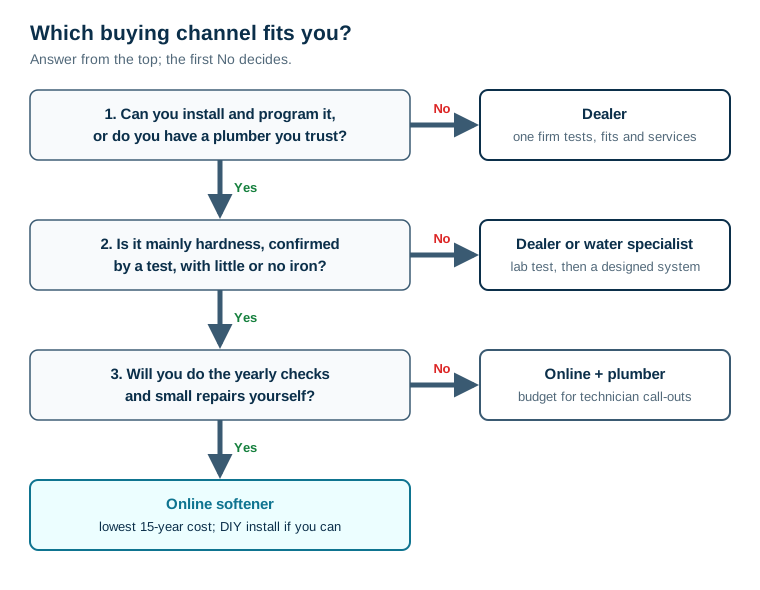
Most owners fit one of these profiles:
| Owner profile | Best channel | Why |
|---|---|---|
| Will not touch plumbing, no plumber they trust | Dealer | One firm owns testing, installation and every repair |
| Private well with iron, sulfur, low pH or bacteria | Dealer or independent water specialist | The job is a designed treatment train, not a softener |
| Buying for an elderly parent or a rental property | Dealer, or online with a plumber on a service plan | Someone else must be reachable when it fails |
| Handy, city water, hardness only | Online, DIY install | Lowest 15-year cost; the work is within reach |
| Handy but short of time | Online + plumber | Most of the saving, none of the pipe-cutting |
| Moving within three years | Online + plumber, or rent | A dealer premium is hard to recover; see the renting guide |
If you are between two profiles, get both prices. Ask a local dealer for an itemized written quote that names the model, resin volume and valve. Ask a plumber to bid on installing a named online unit. Then put the two numbers into the table above.
Who Should Buy Neither Option Yet
- Anyone without a water test. Neither channel can size a softener from a guess, and a dealer's own test is no substitute for a copy you keep.
- Homes where hardness is not the problem. Iron above a few ppm, sulfur smell or acidic water need treatment ahead of a softener first.
- Buyers being pushed to sign on the first visit. Take the quote away, compare it, and use the cooling-off period if you already signed.
- Owners who want to avoid salt. Both channels in this comparison sell salt-based softeners. The alternatives are weighed in salt-based vs salt-free water treatment.
The dealer vs online water softener decision is really a question about you, not the hardware. If you can test, fit and maintain a softener, or will pay a plumber once to fit it, buying online saves about $2,500 over 15 years in a typical case. If you cannot, a good dealer is the cheaper mistake to avoid.
Frequently Asked Questions
Is it cheaper to buy a water softener online or from a dealer?
Online, usually by a wide margin. In our illustrative 15-year model for a family of four, a dealer system installed for $3,500 costs about $5,303 including service and salt, against about $2,728 for an online softener, modelled at $775 of equipment, with a $500 plumber install and DIY maintenance. The gap is roughly $170 a year, and most of it is the upfront price.
Are dealer water softeners better quality than online ones?
Not automatically. Many dealer and online systems use similar control valves and resin. Some dealer brands, such as Kinetico's non-electric twin-tank designs, are genuinely different engineering. What a dealer adds for certain is a service relationship: water testing, sizing, installation, warranty labor and a local technician. Judge the quote on the model, resin volume, valve and written service terms, not on the brand name.
Can I buy a Culligan or Kinetico softener online?
No. Culligan, Kinetico, EcoWater under its own name, RainSoft, Hague and Rheem do not sell their whole-house softeners on Amazon. Kinetico and Culligan sell through local dealers. If you want a comparable system online, the closest equivalents are metered softeners built on widely used valves, such as a Fleck 5600SXT system for a single tank or a Fleck 9100SXT for twin tanks.
Can I cancel a water softener contract signed at home?
Often, yes. The FTC's Cooling-Off Rule gives you until midnight of the third business day to cancel many sales made in your home, for a full refund. The seller must give you two copies of a cancellation form and a copy of the contract. Mail the signed form before that deadline, ideally by certified mail. Some sales are excluded, so read the FTC's guidance before you rely on it.
How much does it cost to have a plumber install an online water softener?
Labor alone commonly runs from about $150 to $1,000, according to Fixr's national cost guide. A swap into an existing softener loop is a short job; cutting into the main, adding a bypass, running a drain and fitting an overflow takes most of a day. A new outlet is usually a separate electrician's charge.
Who should buy a water softener from a dealer?
Owners who will not install or maintain a softener themselves, homes with complex well water that needs a designed treatment train, and anyone who values one phone number for testing, repairs and warranty claims. A good local dealer is worth paying for in those cases. Get an itemized written quote naming the model and resin volume, and compare it with an online system plus a plumber's bid.
