
Water Softener Glossary

This water softener terms glossary defines 67 words you will meet on spec sheets, installation quotes and service reports, in plain language. Each entry includes a "Why it matters" line explaining how the term affects buying or troubleshooting. Most also link to the article that covers the subject in depth.
Terms are in alphabetical order, grouped by letter. The diagram below shows where the physical parts sit on a softener.
How to Use This Water Softener Terms Glossary
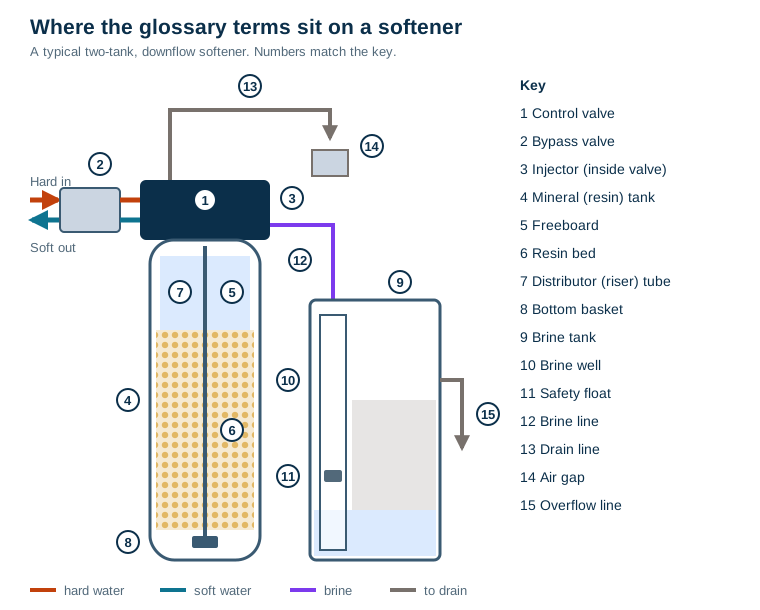
- On a spec sheet, look up each number's conditions. Capacity, flow rate and efficiency all depend on a setting, and the entries below say which one.
- On a quote, look up anything bundled with the softener, such as a prefilter, a carbon tank or a service plan, before you agree to it.
- On a service report, look up the fault the technician named, then follow the link to see whether the fix matches it.
Units follow US practice. One grain per gallon (gpg) is 17.1 mg/L or ppm of hardness as calcium carbonate.
A to B
Air gap. An open vertical space between the end of the softener's drain line and the drain it discharges into, so waste water can never be siphoned back into the softener. Why it matters: plumbing codes and manufacturers require one, and pushing the drain tube down into a standpipe is one of the most common installation mistakes. See water softener drain air gap.
Backwash. The first stage of most regenerations. Water flows up through the resin bed to lift and loosen it and carry trapped sediment and iron to drain. Why it matters: backwash only works if the flow is strong enough to expand the bed. A weak well pump or wrong drain flow control leaves sediment in the resin. The full cycle is in how water softener regeneration works.
Bed expansion. How far the resin bed rises during backwash, as a percentage of its settled depth. Why it matters: resin makers typically ask for 50 percent or more. Too little and the bed stays dirty. Too much and resin can be carried to drain.
Brine. A strong solution of salt, or potassium chloride, and water made in the brine tank. Saturated brine is roughly a quarter salt by weight. Why it matters: the softener can only recharge resin with brine it can actually draw. Everything in the brine tank exists to make and deliver it.
Brine draw. The regeneration stage in which the injector pulls brine from the brine tank into the resin tank and down through the bed. Why it matters: a failed brine draw is the classic cause of "it regenerates but the water is hard". Watch the brine tank water level fall during this stage to confirm it.
Brine line. The small tube that carries brine from the brine well to the control valve, and refill water back the other way. Why it matters: a loose fitting lets it suck air instead of brine. A kinked or blocked line stops brine draw entirely.
Brine tank. The larger, usually plastic tank that holds the salt and water. It is sometimes called the salt tank. Why it matters: most owner-fixable faults live here. Its parts are explained in water softener brine tank internals.
Brine well. A vertical tube inside the brine tank that keeps salt away from the float and the brine line pickup. Why it matters: the slots at its base are what mushy salt buries. If the base is blocked, no brine is drawn.
Bypass valve. A valve on the softener's inlet and outlet that routes water around the softener, for service or for untreated water to outdoor taps. Why it matters: a bypass left half-open sends hard water to the whole house and is easy to miss. The checks are in water softener bypass valve testing.
C
Calendar override (day override). A setting on a metered valve that forces a regeneration after a set number of days, even if the meter has not reached capacity. Why it matters: it keeps a lightly used bed fresh. Set too short, it wastes salt, and it often sets the salt bill for small households.
Capacity (grain capacity). The hardness, in grains, the resin can remove between regenerations. It is set by the resin volume and the salt dose. Why it matters: the number in a model name is usually capacity at the maximum salt dose. Compare units at the same dose. See what grain capacity means and advertised vs usable softener capacity.
Channeling. Water cutting preferred paths through the resin bed instead of flowing evenly through it, so part of the bed is bypassed. Why it matters: capacity falls and hardness leaks early even though the resin is fine. See water softener resin channeling.
Chloramine. A disinfectant made from chlorine and ammonia that many utilities use because it lasts longer in the pipes than chlorine. Why it matters: it reaches your house at a higher residual and keeps attacking resin. It also needs catalytic carbon to remove. See how chloramine affects a water softener.
Compensated hardness. The hardness figure used for sizing and the valve setting, after adding allowances for iron, manganese and anything else that uses resin capacity. Why it matters: a softener sized on raw hardness alone runs out early on iron water. The formula is in test iron and manganese before sizing.
Control valve (head). The motorized valve on top of the resin tank that directs water through service, backwash, brine draw, rinse and refill. Why it matters: it decides when and how the softener regenerates, and it is the part most often worth repairing rather than replacing. See how a water softener control valve works.
Crosslink percentage (DVB content). The proportion of divinylbenzene binding the polystyrene chains in each resin bead. Standard resin is about 8 percent; chlorine-resistant resin is 10 percent. Why it matters: more crosslinking means more resistance to chlorine and a longer bed life on city water. See standard vs chlorine-resistant softener resin.
D to F
Demand-initiated regeneration (metered). Regeneration triggered by the water actually used, measured by a meter in the valve, rather than by the calendar. Why it matters: it usually cuts salt and water use substantially compared with a timer. See metered vs timer-based water softeners.
Distributor tube (riser tube). The central pipe inside the resin tank that carries water between the bottom of the bed and the control valve. Why it matters: a crack lets water skip the resin, and resin beads in your plumbing usually mean it or its basket has failed. See inside a water softener mineral tank.
Distributor basket (bottom screen). The slotted screen on the bottom of the riser tube that lets water through and keeps resin in. Why it matters: its slot size must be smaller than the smallest bead, which matters when re-bedding with fine mesh resin.
Downflow and upflow. The direction brine travels through the bed during regeneration. Downflow goes the same way as service water. Upflow goes against it. Why it matters: upflow units can regenerate with less salt, but need a valve built for it. See upflow vs downflow regeneration.
Drain line flow control (DLFC). A small restrictor washer in the drain outlet that sets the backwash and rinse flow rate for the tank size. Why it matters: the wrong size under-cleans the bed or washes resin to drain. It is also why drain line diameter and length matter. See water softener drain line requirements.
Fast rinse. A short, high-flow downward rinse at the end of regeneration that packs the bed and flushes out the last brine. Why it matters: salty-tasting water right after regeneration often points to a rinse that is too short, or to a brine valve that did not close.
Fine mesh resin. Softening resin made in smaller beads, roughly 0.2 to 0.6 mm. Why it matters: it exchanges dissolved iron faster, but traps rust particles and needs gentler backwash. See standard vs fine mesh resin.
Fouling. Anything other than hardness coating resin beads or blocking their exchange sites, mainly iron, manganese, sediment and organic matter. Why it matters: fouling can often be reversed with a cleaner if caught early. Chlorine damage cannot. See water softener resin fouling.
Freeboard. The empty space between the top of the resin and the top of the tank. Why it matters: it looks like a half-empty tank, but it is there on purpose so the bed has room to expand during backwash.
G to I
Grain. An old unit of weight, 1/7,000 of a pound or about 64.8 mg. Softener capacity and hardness are both counted in grains. Why it matters: it is the unit that links a water test to a softener's size.
Grains per gallon (gpg). Hardness expressed as grains of calcium carbonate per gallon. 1 gpg = 17.1 mg/L = 17.1 ppm. Why it matters: most valves expect gpg. Entering a ppm figure makes the softener think the water is 17 times harder than it is. See water hardness units: gpg, ppm and mg/L.
Hardness. Dissolved calcium and magnesium, reported as calcium carbonate. Why it matters: it is the only thing a softener is designed to remove. The kinds are explained in types of water hardness.
Hardness leakage. Small amounts of hardness passing through a working softener, typically well under 1 gpg. Why it matters: a softened sample that reads a trace is not a fault. See should softened water test at zero.
Hardness setting. The hardness value programmed into the valve. The valve divides capacity by it to decide how many gallons it can treat. Why it matters: it is the most common setting error, whether the figure is too high, too low or in the wrong unit. See how to set hardness on a water softener.
Injector (venturi). A small nozzle-and-throat assembly in the control valve that uses water flow to create suction and pull brine from the brine tank. Why it matters: its tiny passages clog with grit and sludge, and a clogged injector stops brine draw. See what a water softener injector does.
Ion exchange. The swap at the heart of a softener: resin releases sodium or potassium ions and takes up calcium and magnesium in their place. Why it matters: it is exchange, not filtration, so the water keeps its other dissolved minerals. See how a whole-house water softener works.
Iron allowance. The extra hardness added to the setting for each ppm of dissolved iron, commonly 3 to 4 gpg per ppm. Why it matters: without it the bed runs out early and fouls faster. See how iron changes water softener sizing.
L to P
Langelier Saturation Index (LSI). A calculated number, from pH, hardness, alkalinity, temperature and TDS, that shows whether water tends to deposit scale (positive) or dissolve it (negative). Why it matters: softening lowers the LSI. On already acidic water that can make it more corrosive to copper. See how to interpret pH and hardness together.
Mineral tank (resin tank). The tall, usually fiberglass-wrapped tank holding the resin bed, with the control valve on top. Why it matters: its size, quoted as diameter and height such as 10 × 54, sets how much resin it can hold and how much backwash flow it needs.
Mushing. Salt breaking down into a dense sludge on the brine tank floor that buries the brine well openings. Why it matters: it stops brine draw while the salt above looks normal. See salt mushing in a brine tank.
NSF/ANSI 44. The American national standard for residential cation exchange water softeners, covering capacity claims, materials and structural integrity, with an optional efficiency rating. Why it matters: certification is per model and verifiable. A brand name or "meets NSF standards" is not the same thing. See what NSF/ANSI 44 means.
Overflow line. A tube from a fitting high on the brine tank to a drain, as a backup if the tank ever overfills. Why it matters: it must fall by gravity to a drain on its own, never teed into the main drain line. See brine tank overflow line requirements.
Peak flow rate. The highest flow the softener can deliver briefly, usually at a larger pressure drop than the service flow rate. Why it matters: a figure without its pressure drop cannot be compared between brands. See grain capacity vs peak flow rate.
pH. A 0 to 14 scale of acidity. Below 7 is acidic. The EPA's aesthetic range for drinking water is 6.5 to 8.5. Why it matters: acidic water usually needs a neutralizer ahead of the softener, and neutralizers can add hardness.
Point of entry (POE). Treatment of all the water entering the house, as a whole-house softener does. Point of use (POU) treats one tap. Why it matters: some problems need POE, others only POU. See point-of-entry vs point-of-use water softening.
Potassium chloride. An alternative regenerant to salt that puts potassium, rather than sodium, into the softened water. Why it matters: it costs several times more per bag and needs a higher setting. See potassium chloride vs sodium chloride.
ppm and mg/L. Parts per million and milligrams per litre. In drinking water they are effectively the same number. Why it matters: lab and utility reports use them. Divide by 17.1 to get gpg.
Prefilter. A filter ahead of the softener, usually a sediment cartridge, a carbon tank or an iron filter. Why it matters: it protects the resin from what it cannot handle. See sediment prefilter before a softener.
Pressure drop. How much water pressure falls across the softener at a given flow, in psi. Why it matters: it is what you feel as weak showers when two fixtures run. Spec sheets quote flow rates at a stated drop, often 15 psi. See water softener pressure drop.
Proportional brining. A valve feature that scales the salt used to the capacity actually consumed, rather than using a fixed dose every time. Why it matters: it saves salt on households with uneven use. See proportional brining vs fixed salt dosing.
R
Refill. The final regeneration stage, in which the valve sends a measured volume of water back into the brine tank to dissolve salt for next time. Why it matters: the refill volume sets the next salt dose. A tank that keeps filling points to the refill control or float.
Regeneration. The whole cycle that recharges the resin: backwash, brine draw, slow rinse, fast rinse and refill, usually overnight. Why it matters: nearly every softener fault shows up as one stage failing. See how water softener regeneration works.
Reserve capacity. The share of capacity a metered valve holds back so the resin never runs out before regeneration, often about a day's water. Why it matters: too little lets hard water through, and too much wastes salt. See water softener reserve capacity.
Resin. Small plastic beads covered in exchange sites that hold sodium and trade it for hardness. It is the part that does the softening. Why it matters: resin life, typically 10 or more years on clean water, sets when a softener needs a re-bed. See what water softener resin does.
Resin cleaner. A chemical, usually with sodium hydrosulfite or citric acid, dosed into the brine well to strip iron and some manganese from resin. Why it matters: it helps with fouling but does nothing for chlorine damage. See resin and iron cleaners.
S
Safety float. A float in the brine well that shuts off refill if the water in the brine tank rises too high. Why it matters: it is a backstop. A stuck float and a failing refill control together cause an overflowing brine tank.
Salt bridge. A crust of fused salt spanning the brine tank above an empty void, so the water below never touches the salt. Why it matters: the tank looks full while making no brine. See how to identify and break a salt bridge.
Salt dose (salt setting). The pounds of salt used per regeneration, often quoted per cubic foot of resin, or set as refill minutes. Why it matters: it is the biggest lever on your salt bill. See how to set the salt dose on a water softener.
Salt efficiency. Grains of hardness removed per pound of salt at a given setting. Why it matters: efficiency-rated softeners must reach at least 3,350 grains per pound, and efficiency falls as the salt dose rises. See water softener salt efficiency.
Salt-free conditioner (TAC). A device that changes how hardness forms scale, commonly by template-assisted crystallization, without removing it. Why it matters: the water still tests hard, and soap and spotting behave as with hard water. See how a salt-free water conditioner works.
Salt types. Evaporated pellets, solar crystals, rock salt, block salt and potassium chloride. Why it matters: purity, not shape, decides how much residue builds up. See water softener salt types compared.
Service. The normal operating position, with water flowing down through the resin and out to the house. Why it matters: a valve stuck anywhere other than service after regeneration can leave the house without water or send it to drain.
Service flow rate. The continuous flow a softener delivers at a stated pressure drop while still producing soft water. Why it matters: size for your household's peak demand, not only for capacity. Compare figures at the same pressure drop.
Single tank and twin tank. A single-tank softener has one resin tank and is offline while regenerating. A twin-tank unit alternates between two tanks so soft water is always available. Why it matters: twin tanks suit large or round-the-clock demand. See single-tank vs twin-tank water softeners.
Slow rinse (brine rinse). The regeneration stage after brine draw, in which slow water pushes the brine through the bed and finishes the exchange. Why it matters: it is where most of the actual recharging happens, which is why it runs slowly.
Sodium added. The sodium a softener puts into the water in exchange for hardness, about 7.5 mg per quart for each gpg removed, according to Penn State Extension. Why it matters: it scales with hardness, which matters on a sodium-restricted diet. See how much sodium a water softener adds.
T to V
TDS (total dissolved solids). Everything dissolved in the water, measured in mg/L. Why it matters: softening barely changes it, so a TDS meter cannot check a softener. See hard water vs TDS and alkalinity.
Timer (time-clock) regeneration. Regeneration on a fixed schedule, whatever water was used. Why it matters: it wastes salt when use is low and can run out when use is high. Time-clock units cannot be efficiency rated under NSF/ANSI 44.
Turbidity. Cloudiness from suspended particles, reported in NTU. Why it matters: it decides whether a sediment prefilter is needed before the softener. It sits on the pre-purchase test list in how to build a water test panel before treatment.
Usable capacity. The capacity you actually get in your house, after salt dose, reserve, iron and resin age take their share. Why it matters: it is often well below the advertised figure, and it is the number to size with. See how to size a water softener.
Vacation mode. A valve setting, or a routine, for a softener that will sit unused for a while. Why it matters: resin left stagnant can grow bacteria and taste off when you return. See water softener vacation mode.
Terms That Mean Different Things on Different Spec Sheets
A few terms are defined the same way everywhere but measured under different conditions. These are where comparisons between brands most often go wrong.
| Term | What to ask for | Why |
|---|---|---|
| Grain capacity | Capacity at each salt dose, and the resin volume in cubic feet | A "48,000-grain" rating can be quoted at very different doses |
| Service flow rate | The pressure drop it was measured at | 12 gpm at 25 psi drop is not 12 gpm at 15 psi |
| Salt efficiency | The setting it was measured at | The efficient setting and the high capacity figure are never the same setting |
| Certification | The exact model on the certifier's listing | Brand-level claims do not transfer to every model |
| Iron limit | Whether it applies to dissolved iron only | Most softeners handle only small amounts of dissolved iron, not rust |
Full worked comparisons are in how to compare water softener spec sheets.
Sources for the Definitions
Definitions follow manufacturer manuals and these public sources: Penn State Extension's water softening guide for hardness units and sodium, the EPA's page on cation exchange water softeners for regeneration water use, and the Department of Energy's Building America guide to water softeners for the NSF/ANSI 44 efficiency rating. Where a term is claimed for or against softeners in sales material, water softener myths, corrected sets out the evidence.
Frequently Asked Questions
What does grain capacity mean on a water softener?
It is the amount of hardness, counted in grains, the resin can remove before it needs to regenerate. It depends on the salt dose. The same cubic foot of resin gives about 22,930 grains at 6 lb of salt and 32,310 at 15 lb in one manufacturer's table, and the number in the model name is usually the high-salt figure.
What is the difference between gpg and ppm?
Both measure hardness as calcium carbonate. Grains per gallon (gpg) is the unit most US softener valves expect. Parts per million (ppm), the same as mg/L in water, is what most lab reports and utility reports use. One gpg equals 17.1 ppm, so divide a ppm figure by 17.1 before entering it into a valve that asks for gpg.
What is regeneration on a water softener?
The cleaning cycle that recharges the resin. The valve backwashes the bed, draws brine through it to push the collected calcium and magnesium off, rinses the brine out, and refills the brine tank for next time. It usually runs at night and takes one to two hours.
What does reserve capacity mean?
The share of capacity a metered valve holds back so the resin does not run out before the scheduled regeneration. It is usually about one day's water use. Too little lets hard water through near the end of a cycle. Too much wastes salt and water, because the softener regenerates with capacity still unused.
What is brine draw?
The stage of regeneration in which the injector pulls saturated brine from the brine tank into the resin tank. If brine draw fails, because of a blocked injector, a salt bridge or mushy salt, the softener goes through the motions of regenerating but the resin is never recharged and the water turns hard.
What does NSF/ANSI 44 certification mean?
It is the American national standard for residential cation exchange softeners. A certified model has been independently tested for its claimed capacity, its structural integrity and the safety of its materials. An optional efficiency rating also requires at least 3,350 grains of hardness removed per pound of salt. Certification applies to a specific model, so check the listing rather than the brand.
