
Water Softener Myths, Corrected
Water softener myths come from three directions: sales pitches that oversell softeners, critics who condemn them, and rival products that borrow their name. This page corrects fifteen of the most repeated claims. Each gets a verdict, the evidence for and against, and a link to the article that treats it properly. Softeners do not purify water, remove lead or make water acidic. Softened water is not unhealthy for most people.
Six of the myths below favour softeners, six attack them, and three come from the alternatives. A correction page that only corrects one side is marketing.
How the Fifteen Myths Line Up
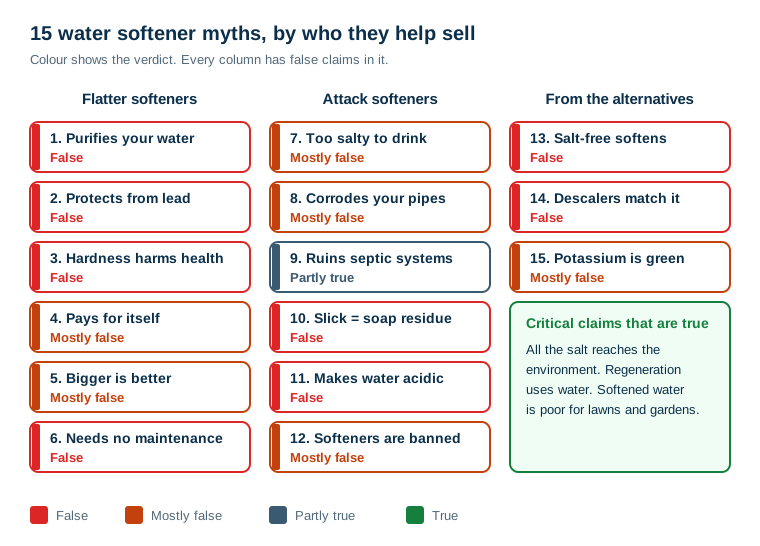
Verdicts use four labels:
- False: the evidence says the opposite.
- Mostly false: there is a grain of truth, but the claim as stated misleads.
- Partly true: real under some conditions, wrong as a general rule.
- True: used for the critical claims near the end that hold up.
Water Softener Myths That Help Sell Softeners
These are the overclaims. They make a softener sound like more than it is.
Myth 1: "A water softener purifies your water"
Verdict: False. A softener exchanges calcium and magnesium for sodium or potassium. It does not disinfect and does not filter out most contaminants. Penn State Extension's water softening guide states that softeners "will not necessarily remove any of the more serious drinking water contamination problems." Bacteria need disinfection, and lead, arsenic, nitrate and PFAS need treatment certified for each one.
Full answer: what a water softener does not remove.
Myth 2: "A softener will protect you from lead"
Verdict: False. Ion exchange resin can take up some dissolved metals, but a household softener is not designed or certified for lead reduction, and much of the lead risk comes from solder, fittings and fixtures after the softener, where no whole-house device can catch it. Softener certification under NSF/ANSI 44 covers hardness reduction, not lead. Lead needs a device certified specifically for it, at the tap you drink from.
Full answers: what NSF/ANSI 44 means and lead service line work and your water softener.
Myth 3: "Hard water is bad for your health"
Verdict: False. Hardness is calcium and magnesium, and neither is a health hazard at tap-water levels. EPA has no drinking water standard for hardness. The research that exists leans slightly the other way, with some studies linking magnesium in water to lower heart disease mortality. Hard water is a nuisance for plumbing and soap, not a medical problem.
Full answer: is hard water bad for you.
Myth 4: "A softener pays for itself"
Verdict: Mostly false. Softened water does save money on water heating with gas, on descaling and on detergent if you cut the dose. In the worked model on this site, those savings come to $0 to $300 a year at 15 gpg against an ownership cost of about $418 a year. The gap closes only with very hard water and a gas or tankless heater. Buy a softener for what it does to your water, not as an investment.
Full answer: the total cost of owning a water softener.
Myth 5: "A bigger grain rating is always better"
Verdict: Mostly false. A larger softener regenerates less often, which helps up to a point. Beyond that it costs more to buy and gives nothing back. Advertised grain ratings are also usually quoted at the highest salt dose, which is the least efficient setting. The right size comes from hardness times daily use, at an efficient salt setting.
Full answer: is a higher grain rating always better.
Myth 6: "Softeners are maintenance-free and last forever"
Verdict: False. A softener needs salt, occasional brine tank cleaning and attention to salt bridges. Its resin wears, faster on chlorinated or chloraminated city water, and its control valve seals age. A well-kept unit lasts many years, but not indefinitely.
Full answers: water softener maintenance schedule and how long a water softener lasts.
Myths That Help Sell Against Softeners
These come from critics, forum threads and, sometimes, sellers of alternatives. Each has a real point buried in it.
Myth 7: "Softened water is too salty to drink"
Verdict: Mostly false. Softening adds sodium, not salt taste in most cases. Penn State puts it at 7.5 mg per quart for each grain per gallon of hardness removed. At 15 gpg that is about 112 mg per quart, or roughly 28 mg in an 8-ounce glass. That matters for someone on a doctor-ordered sodium restriction. For them, potassium chloride or an unsoftened kitchen tap solves it.
Full answers: sodium in softened water and is softened water safe to drink.
Myth 8: "Softened water corrodes your pipes"
Verdict: Mostly false. Softening does not lower pH. An EPA pilot study that fed raw and softened water to matched pipe loops found no detrimental effect on the factors that control corrosion. The flip side of the myth, that hard water scale protects pipes, is weak too: scale forms in porous patches and corrosion continues underneath. Corrosive water is a real problem, but it was corrosive before the softener.
Full answer: does soft water damage or protect pipes.
Myth 9: "Softeners ruin septic systems"
Verdict: Partly true. The studies that exist, all funded by the water treatment industry's research foundation, found efficient, demand-initiated softeners caused no harm and could even help solids settle. Very inefficient units that use far more salt than needed made septic effluent worse, and timer units add a lot of extra water. Efficiency is the deciding factor, and some states restrict discharge to septic anyway.
Full answer: water softener planning for a home with septic.
Myth 10: "The slippery feel means soap is left on your skin"
Verdict: False. The slippery feel is the opposite: soap rinsing off completely because no calcium is left to form a curd that clings. On hard water, that curd is what makes skin feel "squeaky clean". Using less soap on soft water reduces the slickness.
Full answer: why soft water feels slippery.
Myth 11: "Softeners make water acidic"
Verdict: False. A softener swaps calcium and magnesium for sodium. It does not add or remove the hydrogen ions, bicarbonate or carbon dioxide that set pH. If water is acidic after a softener, it was acidic before, and it needs a neutralizer.
Full answer: does a water softener change pH.
Myth 12: "Water softeners are banned"
Verdict: Mostly false. Most of the US has no restriction. Rules exist where treatment plants cannot handle chloride, mostly in California, where some local agencies restrict or ban new self-regenerating units. One district required removal of existing units with compensation. Portable exchange tanks and salt-free conditioners are generally allowed.
Full answer: softener brine restrictions and drought rules.
Myths From the Alternatives and the Green Pitch
Myth 13: "Salt-free softeners soften water"
Verdict: False. Salt-free conditioners leave the hardness in. A hardness test reads the same, and spots, soap and laundry do not change. What a good one can do is reduce scale in heated equipment. The difference between those two goals is the key to the whole category, set out in scale prevention vs hardness removal.
Full answer: does a salt-free system actually soften water.
Myth 14: "Magnetic and electronic descalers do the same job"
Verdict: False. In the WateReuse Research Foundation's independent comparison, electromagnetic and electrically induced precipitation devices reduced scale by about 50 percent in heated tests, against more than 88 percent for template assisted crystallization media. None of them removes hardness.
Full answer: water softener vs electronic descaler.
Myth 15: "Potassium chloride makes a softener environmentally friendly"
Verdict: Mostly false. Potassium chloride removes sodium from the discharge and from softened water, which helps soils, septic drainfields and low-sodium diets. It still contains chloride, which is the part that accumulates in rivers and aquifers. The Minnesota Pollution Control Agency's chloride page notes that softener brine goes to treatment plants not designed to remove salt. Using less regenerant is the environmental fix.
Full answers: potassium chloride vs sodium chloride and the lifecycle environmental impact of a water softener.
Three Critical Claims That Are True
Correcting myths only works if the true criticisms are admitted too.
- Softeners send salt to the environment, all of it. Every pound in the brine tank ends up in wastewater, and conventional treatment cannot remove the chloride. See where water softener regeneration waste goes.
- Softeners use water to regenerate. EPA WaterSense says regeneration can use up to 10,000 gallons a year on inefficient units. Demand-initiated control cuts that substantially. See how much water a softener uses per year.
- Softened water is not ideal for lawns and gardens. It adds sodium and removes the calcium that holds clay soil together. Outdoor taps should bypass the softener. See should outdoor faucets bypass a water softener.
Why These Myths Keep Circulating
Most of the fifteen follow one of three patterns. Recognising the pattern is often faster than checking the facts.
A local truth becomes a general rule. Very inefficient softeners did harm septic effluent in testing. A handful of California districts did restrict softeners. Softened water is poor for clay soil. Each is true somewhere, under some conditions, and each turns into a myth when the conditions are dropped.
A name is borrowed. "Salt-free softener", "conditioned water" and "purified by softening" all attach one technology's result to another. The product is then judged on a promise it never made, and either oversold or unfairly condemned.
A symptom is misread. The slippery feel is read as soap left on the skin. Spots after a salt-free unit are read as a broken unit. A hardness test after a conditioner is read as proof of failure. In each case the observation is real and the explanation is wrong.
A fourth pattern sits behind many sales conversations: fear sells faster than evidence. Health scares about hard water sell softeners. Health scares about sodium sell alternatives. The evidence behind both is thinner than the pitch suggests.
How to Check a Claim Yourself
When a salesperson, a forum post or a product page makes a claim, four questions sort most of them out.
- Is it about hardness or about something else? A softener changes calcium and magnesium. A claim about bacteria, lead, pH or taste is about something else.
- Can you test it? Hardness removal shows up on a test strip. Scale prevention shows up in the water heater after months. Health claims need a certification for the specific contaminant.
- Who paid for the evidence? Industry-funded research is not automatically wrong, and much of what exists is industry-funded. Look for independent work that points the same way.
- Does the seller say what the product cannot do? Honest sellers on both sides will.
Most water softener myths fall apart at the first question. The rest usually fall at the second.
Frequently Asked Questions
What is the biggest myth about water softeners?
That a softener purifies water. It removes calcium and magnesium, and within limits some dissolved iron and manganese. It does not disinfect or reliably remove lead, arsenic, nitrate, PFAS or most other health-related contaminants. Penn State Extension warns that softeners will not necessarily remove any of the more serious drinking water contamination problems.
Is it a myth that softened water is bad for you?
Mostly, yes. Softening adds sodium in proportion to the hardness removed, about 7.5 mg per quart for each grain per gallon according to Penn State Extension. For most people that is a small share of daily sodium. People on a doctor-ordered low-sodium diet should ask their doctor, and can use potassium chloride or a hard-water kitchen tap.
Do water softeners damage pipes?
Not when the raw water is not corrosive and the softener works properly. Softening does not change pH, and an EPA pilot study found no detrimental effect on the water quality factors that control corrosion. The idea that hard water scale protects pipes is weak: scale forms in porous patches and corrosion continues underneath.
Are water softeners bad for septic systems?
Efficient, demand-initiated softeners are not, according to the research that exists, all of it funded by the water treatment industry's research foundation. Very inefficient softeners that use far more salt than needed did worsen septic effluent in testing. Some states and counties restrict softener discharge to septic regardless, so check local rules.
Do salt-free water softeners really soften water?
No. Salt-free conditioners, most using template assisted crystallization, leave the hardness in the water. They can reduce scale in heated equipment, by more than 88 percent in one independent study, but a hardness test reads the same and soap, spots and laundry do not change.
Are water softeners illegal?
Not in most of the US. A few local agencies, mainly in California, restrict or ban new self-regenerating softeners because their treatment plants cannot remove chloride. One district required removal of existing units with compensation. Most places that are concerned run voluntary salt-reduction programs instead.
